Amid Russia-West divide, India's G20 Sherpa Kant sees New Delhi as "honest broker"

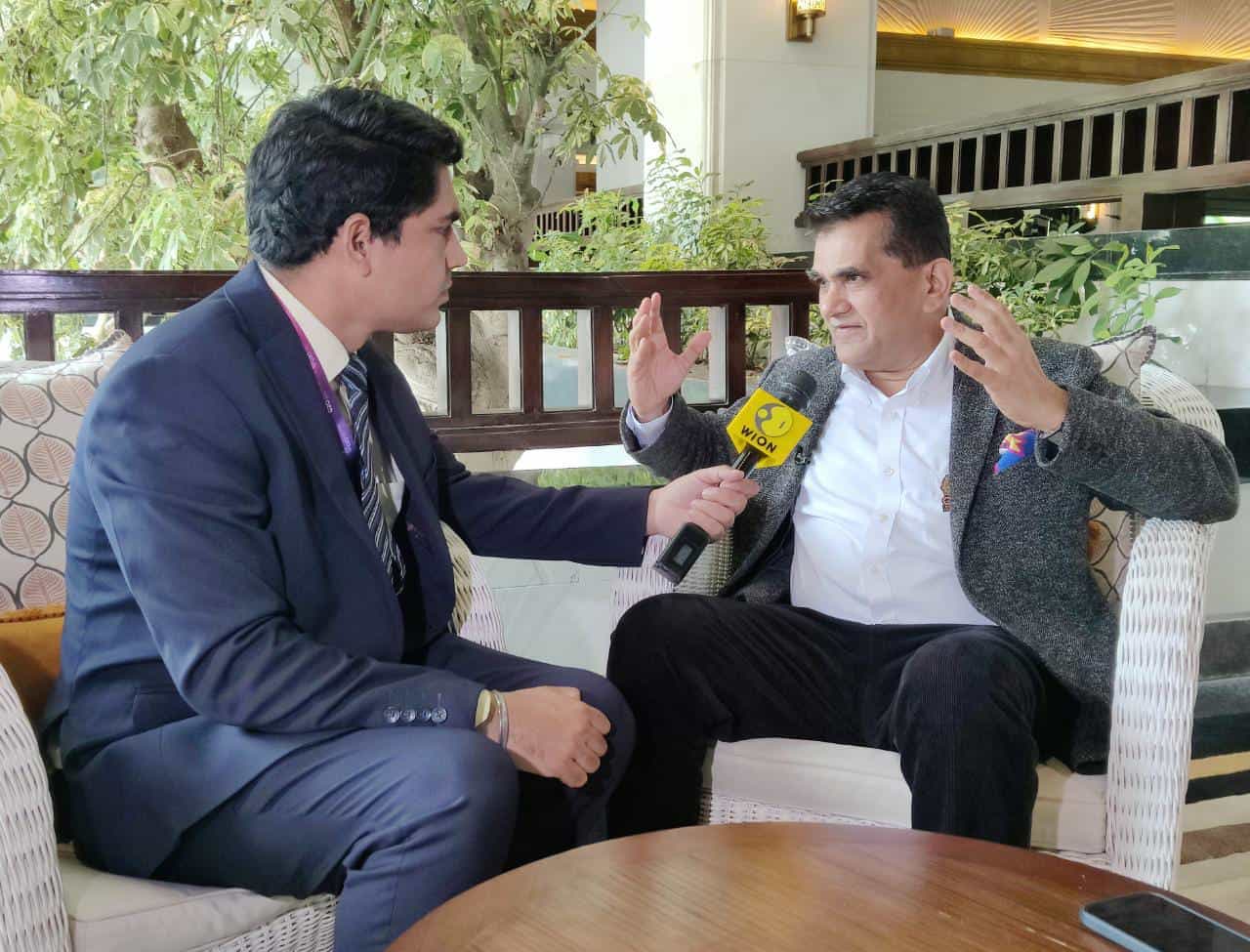
Amid Russia, West divide, India's G20 Sherpa Kant sees New Delhi as "honest broker"
Amid the Russia-West divide, India's G20 Sherpa Amitabh Kant sees New Delhi's role as one of an "honest broker". The remarks come even as the divide that emerged after Russia Ukraine conflict threatens global stability & rise of a new cold war. Speaking to our diplomatic correspondent Sidhant Sibal in Bali, Indonesia Kant said, "our job will be to be an honest broker to everybody, do the balancing act on every single issue, and ensure consensus on all issues."
The 4th and the last Sherpa meet under the Indonesian Presidency of the G20 grouping took place from the 11th to the 13th of November. Sherpa is the chief negotiator of each country and puts forward his country's views and leads the discussions.
The Indian Sherpa also was hopeful that all leaders will visit India next year in September when it holds the annual summit of the grouping. He said, "We are hopeful that every single in the world will participate in our G20. It will be a unique occasion".

India takes over the presidency of the grouping from the first of December. This is the first time India will be the president of the grouping which began its annual summit-level meetings after the 2008 financial crisis. Transcription of the interview done by Shriya Handoo.
Sidhant Sibal: What will be the overarching message from India during this year's G20 summit at Bali? You have been engaged in Sherpa talks
Amitabh Kant: The PM is very clear that there are geopolitical tensions, sustainable development goals falling behind instead of progressing, global supply chains being very disrupted, huge challenges of global debt, issue of climate change, and many crises in the world amidst the chaos. The Prime Minister has announced India’s theme as one earth one family one future and that everyone is a part of one single cosmos. We have to live together and sort out our challenges, there is huge unity in the diversity of man and political thought, geographical existence, and economic models. But we are all one in the end and therefore it’s important that we all work for the common good and for the common citizens of the world. That is the message which India sends from its ancient civilization. The message of Vasudev Kutumbkam is that we are one family.
)
Microsoft executive called AI training the ‘largest theft of labour in human history’
&im=FitAndFill=(700,400))
What TSMC's 2nm technology means for Apple
)
Ed Sheeran addresses Macklemore's removal, Gaza conflict during Philadelphia concert: 'I cannot hide how I feel'
)
Saudi vs Houthis: Houthis claim missiles & drones used in attack on key Saudi sites
)
'Lot of things to learn from experienced players': Jayasuriya backs Rohit, Virat for 2027 ODI World Cup
)
TIFF 2026: Theja Rio’s Angh wins Platform Prize, puts Nagaland story on global stage
)
Trump defends AI amid growing alarm, announces new 'AI force' and promises an 'AI czar'
)
Harry Brook targets long reign at top of T20I rankings after Sri Lanka sweep
)
US ships in Indian Ocean ‘will be attacked’ if war resumes, warns Iran
)
Operation Sindoor’s hidden naval dimension | MoD reveals Indian Navy Special Forces joined May 7 strikes
)
'Were you here to sell chickpeas?': Wasim Akram criticises Babar Azam's captaincy
)
North Korea's nuclear tests triggered 1,399 earthquakes: Earth is still shaking | Gravitas
)
Samsung raises Galaxy S26 prices by Rs 20,000: Here’s what each model now costs
)
AI actress Tilly Norwood glitches mid-interview, switches from English to Chinese | Watch
)
Sikh bus driver assaulted, bus stolen and rammed into cars in England; video surfaces
)
S Jaishankar, former Army chief among high-profile names issued Delhi SIR notices
)
SNL UK takes aim at Ed Sheeran with AI Princess Diana sketch
)
Mark Carney mimics Trump in hilarious moment over C$70 billion clean-energy investment; room erupts in laughter
)
AUS vs ZIM, 3rd ODI: Ellis stars as Australia edge Zimbabwe by one wicket in last-over thriller
)
West Indies Squad for India Series: Hetmyer included for T20Is, Holder rested
)
Bessent meets China’s He Lifeng to prepare for Trump-Xi summit
&im=FitAndFill=(700,400))
Top 10 countries in mathematics: See the world’s best performers in 2026
)
‘0% chance’: Nvidia CEO Jensen Huang dismisses AI extinction fears by 2030
)
Chancellor Friedrich Merz vows to stay on as exit polls signal major poll setback
)
Trump in ‘deciding mode’ on Iran, says ‘very big things’ going to happen soon
)
Trump says he'll build an 'AI Force' and appoint a czar, for 'high IQ' people only
)
Trump announces ‘AI Force’ as debate grows over AI risks and regulation
)
Munich Mayor taps first keg to kick off Oktoberfest
)
Saudi Arabia exits China-led mBridge digital currency platform amid Saudi-Houthi conflict
)
AI kill switch explained: Why shutting down a dangerous AI may not be as simple as pressing a button
)
Kampala-Ankara rift deepens: Uganda suspends military ties, seeks Fred Lumbuye's extradition
)
China now makes advanced memory chips without the machines it was banned from buying
)
Arvind Kejriwal, family members, Delhi CM Rekha Gupta get SIR notices
)
Apple reportedly building AI server with M8 Ultra chips, may use Nvidia technology
)
BTS' fans question iHeartRadio’s treatment of group after brief festival set
)
Iran sets 7 conditions to end war with US: What are Tehran’s demands?
)
Several petrol pumps, other businesses to refuse UPI payments above Rs 2,000 from Oct 16: Is it legal?
Sidhant Sibal: How difficult the conversation this time has been given that there is this backdrop of Russia Ukraine conflict and there is a looming sense of a Cold War between the west and the Russians, so do you see that impacting the conversation and will there be a ministerial document of the head of the governments who are meeting here? Are you hopeful that this will come out this time?
Amitabh Kant: The negotiations have been very tough and very intense. The challenge with G20 is that it’s a consensus-making body. The difference between United Nations G7 and G20 is that U.N. is a too larger body, it’s a body of 186 members. You can do voting there. G7 is too rich, for an elite body. G20 comprises both the developed and the developing world. But the important thing is that it works out of consensus and once it decides to work on a consensus then it is able to drive certain actions and it has done this in the past. It has gotten the world out of the financial crisis, it has got the world to manage global debt, created financial stability board, and taken action during covid. This is one body capable of taking action on behalf of the world. And the objective here is to get everyone around to a consensus to drive growth, progress, and financial inclusion.
Sidhant Sibal: This time around the Russian president is not participating and the Russian delegation is represented by FM Lavrov. How do you see this development and the western stance during the conversation at G20?
Amitabh Kant: All sherpas are negotiating for the last 3 days and have had separate discussions in the finance track which then comes into the Sherpa track. The challenge has been to bring cohesiveness, and unity of thought, bringing everyone together. We have been able to manage it so far and we are hopeful that we will be able to do this and we will be able to come out with a good communique which the leaders will then be able to announce and sign and take it forward. That is the objective. We are all working together to make this achievement.
Sidhant Sibal: What are the preparations when it comes to the Indian presidency starting a few weeks from now?
Amitabh Kant: So now we’ll take over the presidency on the first of December. The first meeting will be the sherpa meeting in Udaipur on the 4,5,6. We are doing G20 in over 55 cities and over 200 plus meetings. It is a very large canvas. Every state is a part of it. We are demonstrating that we are a great country with vibrant federalism. PM wants every state, and every union territory to be a key player. Therefore, we are well prepared for whatever we’ve done. Tried to bring a great Indian experience. Well, bring not only the content part of it, the political will part but also, we’ll bring Indian culture and cuisine, heritage all that live with the G20.
Sidhant Sibal: Perhaps some moment for India to project its rise and power. Will India use the G20 as the platform for that?
Amitabh Kant: We’ll push for both hard and soft power because one is India is the fifth largest economy in the world. It will soon go on to become the third-largest economy in the world. More than that it has done truly path-breaking work in digital transformation. It has done phenomenal work in infrastructure creation. Our digital payments are 7 X of EU and US. If there are 3x of what China does, we’ve built over 55,000 km of road in the last 7yrs which is like creating half of Europe. We’ve done close to 30 million houses which is like creating a house for every single Australian. We’ve provided 81 million water connections which is like providing water connections to every Brazilian. We’ve done 2.5 billion vaccination which is 7 times the population of the USA and 5 times the population of Europe. So, we’ve done some remarkable things. This is also an opportunity to push the Indian narrative in terms of many other areas like health, digital transformation, and many of these areas where we can not only talk about the world but also the story of India.
Sidhant Sibal: Will you try to bring the factions which are the west and Russia together? Will India bridge the gap between Western capitals and Moscow?
Amitabh Kant: That’s a must given the fact that G20 works by consensus. Our success and ability lie in bringing everyone together. Our job will be to be an honest broker to everybody, do the balancing act on every single issue, and ensure consensus on all issues. This is a consensus-based organization and therefore bringing everybody together and demonstrating patience and will to work with everyone will be the key task.
Sidhant Sibal: And how hopeful you are that President Putin will attend the Indian summit that will happen in the month of September?
Amitabh Kant: We are very hopeful, next year September is quite some distance. We are hopeful that every single in the world will participate in our G20. It will be a unique occasion. We are not tilted towards any side; we believe in keeping equidistant for everyone. We believe it’s in our national interest to work with everyone. We are equally close to everyone, so we will try and bring everyone together as far as India is concerned.
Sidhant Sibal: How has G20 been grouping essentially of today’s world because the UN is seen as very dysfunctional? It is seen as a world of the 1940s and how perhaps G20 is seen replacing United Nations?
Amitabh Kant: UN is a very unwieldy body. G20 it’s important to understand comprises both the developed world and important it comprises of the emerging world whose GDP is growing faster than the developed world. Expansion is taking place through emerging markets, the developed world is stagnant. You can't solve the crisis without emerging markets. So when the Asian crisis came, G7 was expanded to G20, then Mexico's Peso crisis, and the Russian currency crisis all of which made G7 realise that you need emerging markets together. If you want to solve today's vast number of crises, the crisis of SDG, crisis of climate action, crisis of global debt, crisis of ensuring adequate food, fuel, and fertilizer for everyone, no other body other than G20 can solutions, global challenges of the world of today.