&imwidth=800&imheight=600&format=webp&quality=medium "Looking for India's most mysterious destination? Here you can go")
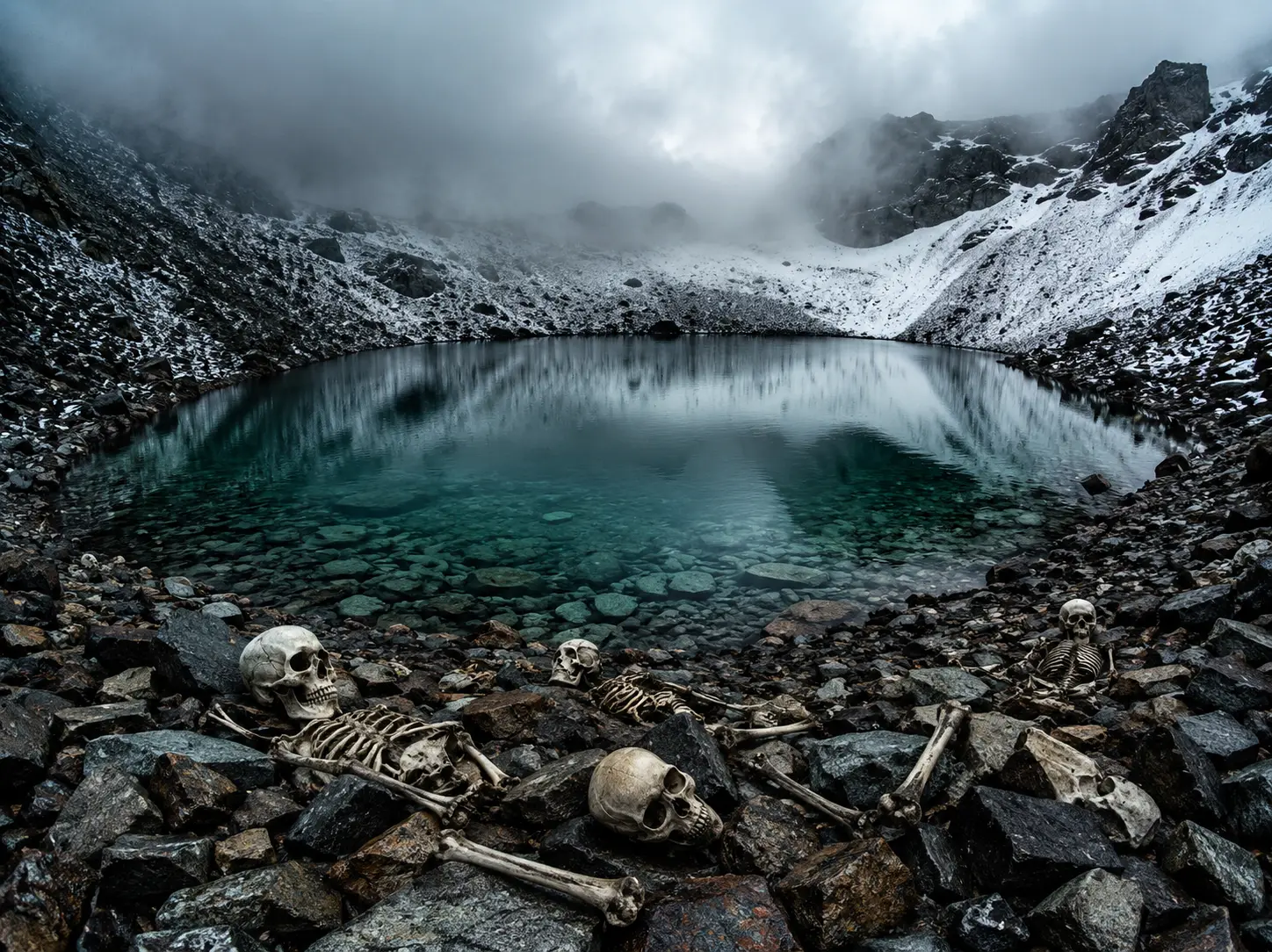
High in the Indian Himalayas lies a glacial body of water that has puzzled historians and scientists for decades. Known officially as Roopkund, this remote area in Uttarakhand attracts experienced trekkers seeking to see a rare historical anomaly. During the brief summer months when the thick ice finally melts, the remains of hundreds of ancient human skeletons become visible along the rocky shoreline.
The geographical location and altitude
Roopkund sits in the Chamoli district of Uttarakhand at an extreme altitude of 5,029 metres. The lake is relatively shallow, with a depth of about two metres, and remains completely frozen for most of the year. Due to the high elevation, the region experiences severe weather conditions, frequent hailstorms, and atmospheric oxygen levels that are significantly lower than those at sea level. The area falls within the Nanda Devi Biosphere Reserve, meaning it is heavily protected by regional environmental laws.

The initial finding of the remains
The site was formally documented in 1942 when an Indian forest ranger named Hari Kishan Madhwal found the bones during a routine patrol. According to records from the Forest Department, the initial assumption was that the skeletons belonged to soldiers attempting to cross the mountains during the Second World War.
However, subsequent examinations quickly revealed that the bones were far too old to be from the 20th century. Over 500 distinct skeletons, along with wooden artefacts, leather footwear, and iron spearheads, have been found at the site over the years.
Trending Stories
&im=FitAndFill=(700,400))
Why the S-400 fires its missiles straight up into the air
)
CJP protests rage despite Wangchuk ending strike, says Pradhan’s resignation ‘non-negotiable’ | Gravitas
)
Dharmendra Pradhan's daughter deactivates IG, LinkedIn as protesters demand her father's resignation, target her university page
)
All 28 Indian crew members safe after LPG tanker attacked in Iranian waters: Indian Embassy in Tehran
)
Russia-Ukrain War: Ukraine strikes Putin's missile factory over 1,000 km inside Russia
)
Union minister Ravneet Bittu resigns from cabinet; President Murmu accepts resignation
)
Russia-Ukraine War: Russia puts its biggest warship Admiral Nakhimov back in action
)
Israel mulls national drone ban after Iran claims to have tripled drone production | Gravitas
&im=FitAndFill=(700,400))
New Friday OTT releases (July 24, 2026): Musafir Cafe, Adarsh Baal Vidyalaya, Pallichattambi- Watch these 6 titles on Netflix, Prime Video and more
)
US imposes new sanctions against Iranian billionaire Babak Zanjani for enabling regime
)
'George Soros playbook': Understanding the foreign funding network around Sonam Wangchuk
)
Jana Nayagan box office collection: Here's how much CM Vijay's political drama mints on day 1
&im=FitAndFill=(700,400))
Why US fighter jets use seamless bubble canopies compared to Russian jets
&im=FitAndFill=(700,400))
Jennifer Winget and William Ishmael's dreamy UK intimate wedding: See inside photos
)
Russia-Ukraine War: Russia unleashes 28,000 tonne nuclear giant ship, Admiral Nakhimov
)
NEET Protests riddled with misinformation? Delhi Police block 480 Pakistan-based handles spreading 'fake news' since Operation Sindoor
)
Scientists decode rare metal that allows China's radar satellite to spy over Asia Pacific
)
He predicted COVID-19 and 2008 economic crisis, was labeled fearmonger. Now he has another dire warning
)
Iran flew IRGC men, advisers and military gear to Yemen, bolstered Houthis for Red Sea blockade: Sources
)
India to test fire three Kusha long-range surface-to-air missiles | Gravitas
)
Mysterious rope leads plumber to find gold worth Rs 23 crore in old Vienna villa
)
Russian strike on Kyiv drone expo kills 10, injures around 100. This is what we know
)
Trump says US in talks with Iran, no decision yet on major strikes. Here’s what it means
)
Pakistan suicide bombing: 15 including 12 security personnel killed in Khyber Pakhtunkhwa
)
Russia-Ukraine War: Russia unleashes 28000 tonne nuclear giant ship
)
Karim Khan ousted as ICC prosecutor over alleged sexual offence case. Details inside
)
Why more than 75,000 people watched a record Qantas flight on Flightradar24 Friday?
)
US-Iran war | CENTCOM: 12 military targets across seven Iranian provinces hit
)
Accidental overdose: UK inquest rules out foul play in Saudi Prince’s London death
)
Pakistan army chief used private oil venture to keep Iran attacks off Saudi Arabia: Report
)
US-Iran War: Trump ready to bomb Tehran, deploys B-1 bomber, envoys flee city
)
Delhi NEET protests: How Bluetooth mesh apps kept communication alive without internet
&im=FitAndFill=(700,400))
Why the specialized paint on an S-400 costs thousands of dollars per truck
What modern genetic reports reveal
For decades, researchers believed the dead were victims of a single catastrophic event, such as a severe hailstorm or an epidemic. However, recent scientific analysis completely changed this narrative. According to a comprehensive 2019 genetic study published in the journal Nature Communications, the skeletons do not belong to a single group.
Researchers conducted carbon dating and DNA analysis on 38 sets of remains. The data showed that the bones belonged to at least three distinct genetic groups, including people of South Asian descent and a group with genetic ties to the eastern Mediterranean. Furthermore, the report confirmed that these individuals did not die at the same time. The deaths occurred in multiple distinct events separated by approximately 1,000 years, adding immense complexity to the site.
Trekking rules and current accessibility
Visiting Roopkund requires high physical fitness and careful planning. The route is notoriously difficult, involving steep ascents and a high risk of altitude sickness. Due to environmental concerns and the degradation of the historical site from heavy foot traffic, the Uttarakhand state government occasionally restricts or bans camping near the lake itself.
If you intend to navigate this region, checking the latest permit requirements from the local forest office is mandatory. Trekkers must allocate several days strictly for altitude acclimatisation before attempting to reach the final ridge.