Hollywood actor explains how economic hardships plague most actors, contrary to prevailing opinion

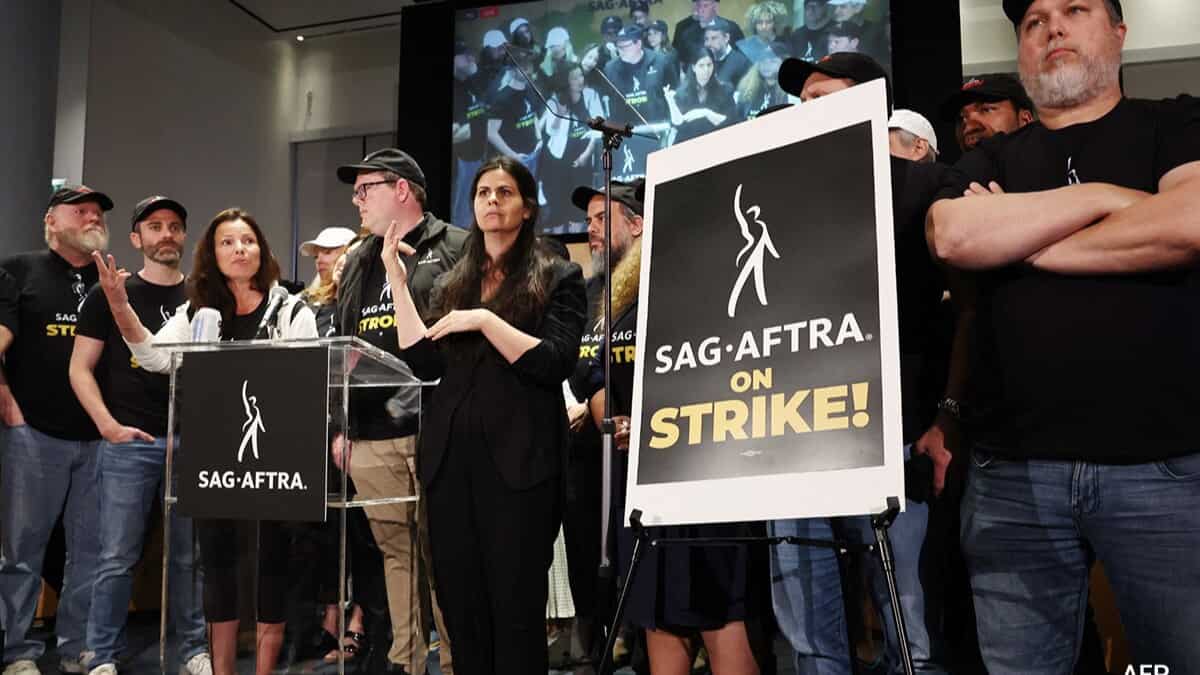
Unlike what you believe, not every actor in Hollywood is rich
Los Angeles-based actor Dominic Burgess, known for his appearances in hit TV shows like Modern Familyand Star Trek: Picard,is among the thousands of Hollywood actors who anxiously awaited the outcome of contract talks with movie studios and streaming giants. In the early hours of Thursday, their hopes were dashed as the negotiations broke down, leading to the formal declaration of a strike by the Screen Actors Guild. Expressing his unwavering support for the strike action, Burgess spoke to news agency AFP about the need for better pay and sustainable working conditions for actors. "We all want to work, but at what cost, when the salary and the residuals are no longer sustainable for actors?" he questioned.
Burgess further highlighted the financial struggles faced by actors, saying, "I have to be able to pay my rent and pay for my cat's insulin."
Also Read:'Disgusting! Shame on them': SAG-AFTRA President Fran Drescher rips into Hollywood studios

Unlike what you believe, not every actor in Hollywood is rich
Despite the opulent perception of the actor's life, Burgess shed light on the realities faced by the majority of performers. He revealed that for "99 per cent of actors," their daily lives are spent auditioning, hustling, and fighting for a chance to secure roles. To make ends meet, many actors juggle part-time jobs alongside their acting pursuits. Burgess himself worked at a local movie theater during his initial years in Los Angeles, earning a meager $7.75 per hour to supplement his acting income.
)
Three labourers killed as DU student loses control of his car, rams into them on Dwarka Expressway
)
Pentagon revives mandatory testosterone testing for male troops aged 30 and above
)
FACT CHECK: Why did PM Modi ask Xi ‘is it okay’ at BRICS Summit? New video reveals...
)
India seeks to build a full semiconductor supply chain
&im=FitAndFill=(700,400))
From Abhishek Sharma to Sahil Chauhan, 5 batters with fastest T20I hundreds
)
Indian activist-lawyer Prashant Bhushan's post brings focus on ‘conflict of interest’ appointments of ex-govt officials at Reliance, Adani groups
)
US And Denmark reach Greenland deal, Trump announces expanded military presence
)
Former India player Diana Edulji wants Smriti Mandhana to replace Harman as skipper at the earliest
)
China may have gained access to US's classified F-35 jets; parts meant for repairs diverted to Hong Kong, sparking Pentagon inquiry
&im=FitAndFill=(700,400))
Meet top 5 batters in the latest ICC T20I Rankings
)
Godfather of AI Geoffrey Hinton gives US lawmakers a one-year warning on AI
)
Shivakumar attends 79th Kalyana Karnataka Utsav in Kalaburagi
)
Trump signs Russia sanctions law: India faces fresh 100% tariff threat over Russian oil
)
Why Ranveer Singh’s Dhurandhar missed India’s Oscar entry; FFI jury member reveals what happened
)
How did an Australian river with 500 crocodiles pass the Olympic test? Here's how
)
‘Will go to any extent’: Pakistan vows to defend Saudi Arabia amid Houthi attacks
)
'He will always be ahead': India coach Gambhir says Sooryavanshi won't walk into team ahead of Samson
)
The Verdict | When precision fails: US commits war crime in Minab school strike, UN finds
)
Trump signs Russia sanctions bill into law, targets Moscow’s energy sector
&im=FitAndFill=(700,400))
New Friday OTT releases (September 18, 2026): Lust Stories 3, You+Me, Best of the Best- 8 new titles coming on Netflix, Prime Video and more
)
Fast bowler Brydon Carse faces no charges over Derby nightclub incident
)
Flying cars in UAE: Ras Al Khaimah signs deal with Chinese company to test new transport
)
Africa is splitting, and a lot sooner than estimated, giving way to a new ocean
)
'Gangsta' crab shoves knife blade at man and his dog in Florida - Watch
)
Trump bans CNN, MS NOW and Politico from White House over ‘FAKE NEWS’
)
Trump 2.0: Dark days ahead for America’s ‘imperial presidency’
)
Trump's Greenland dream comes true? POTUS announces 'Infinite Life' deal with Denmark, claims permanent US control
)
Laura Wolvaardt sets new world record for most WT20I runs in a year
)
Drone strikes cooling tower at Russia's Kursk Nuclear Plant, IAEA confirms
)
Who is Khalilur Rahman? All you need to know about 81st UN General Assembly President
&im=FitAndFill=(700,400))
Meet top 5 bowlers in latest ICC T20I rankings
)
Ukraine plans record $109 bn defence spending, nearly two thirds of budget amid Russia war
)
Russia holds first parliamentary elections since the beginning of the Ukraine war
&im=FitAndFill=(700,400))
Meet top 5 Indian batters with fastest T20I centuries
The livelihood of actors largely relies on a combination of wages from active work and residuals—payments for previous appearances in shows and films that continue to be watched by audiences.
Unfortunately, both these income sources have steadily declined over the years, as studios and networks exert greater pressure. Burgess highlighted the trend of streamers paying only the minimum "scale" rates prescribed by SAG rules, resulting in diminished earnings for actors. He shared a personal example, revealing that he was paid less for his services this year by a company he had worked for in 2012.
Also Read:Explained | The implications of SAG-AFTRA strike, and what lies ahead
SAGA-AFTRA strike
The strike by SAGA-AFTRA (Screen Actors Guild - American Federation of Television and Radio Artists) follows the ongoing Writers Guild of America (WGA) strike, which has been underway since May 3. The actors' strike, the first since 1980, marks a significant moment as actors and writers unite to pursue fair compensation and protection of their rights in the face of challenges posed by, among other things, artificial intelligence (AI).
What do actors want?
Actors are currently grappling with two significant concerns: compensation and the encroaching presence of AI technology. Residual payments play a crucial role in actors' livelihoods, providing a steady income that helps them meet essential financial requirements, including the minimum threshold necessary for health insurance eligibility, such as the annual $26,000.
To safeguard the well-being of those operating on the fringes of the industry, actors argue that the revenue generated by the entertainment business should be distributed in a manner that supports all members of the profession.
Furthermore, actors are witnessing a growing reliance on AI technology, which poses a threat to their job prospects. The increasing use of digitally generated equivalents to replace human performers raises concerns about the future of the acting profession. By initiating a strike, actors aim to ensure that their compensation remains equitable and to safeguard their positions in an industry that is increasingly exploring AI-driven alternatives.
You can now write for wionews.com and be a part of the community. Share your stories and opinions with us here.