Heeramandi: The real 'regal' story of tawaifs who inspired Sanjay Leela Bhansali's series

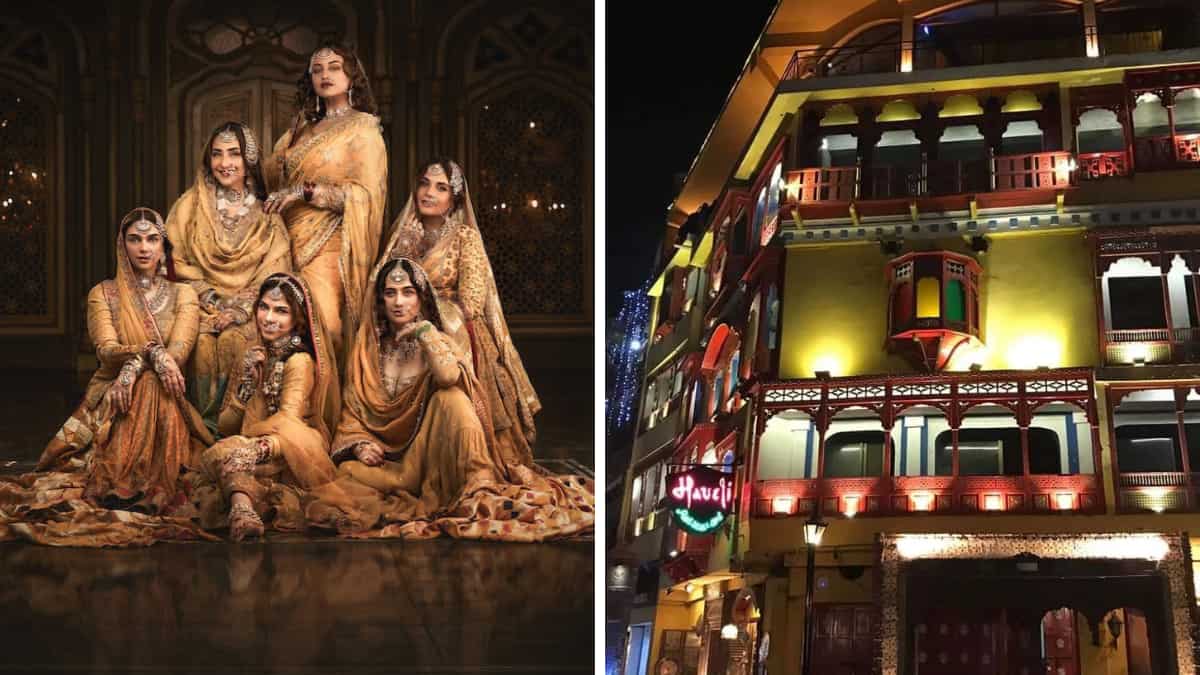
Poster of Sanjay Leela Bhansali's Heeramandi and image of brothels where the Diamond Bazaar once existed.
Bollywood is abuzz with talks of the grandeur and beauty of director Sanjay Leela Bhansali's first OTT series Heeramandi, which is being streamed on Netflix from May 1.
Though the glitz and glamour have always attracted the attention of people when it comes to Bhansali's films, this time the portrayal of female dominance in not-so-remembered lanes of Lahore has generated curiosity around the lives of women who 'truly' ruled Heeramandi.

Meandering through the lanes of the walled city of Lahore when one passes by Taxali Gate, one encounters slightly dilapidated buildings with arch-shaped balconies flanking the roads. Age-old khus curtains cover some of the doorways and windows as few of them keep thudding on a windy day.

Prostitutes peep from the khus curtains in Lahore's red-light area once known as 'Heeramandi'
&imwidth=180&imheight=135&format=webp&quality=medium)
The Royals season 2: Ishaan Khatter's series gets new director after two back-to-back exits- Report
&imwidth=180&imheight=135&format=webp&quality=medium)
Viral video shows cross falling on Colombia priest, no official confirmation | WATCH
&im=FitAndFill=(700,400)&imwidth=180&imheight=135&format=webp&quality=medium)
What is the real meaning behind Pete Hegseth's tattoos?
&imwidth=180&imheight=135&format=webp&quality=medium)
Trump’s approval ratings hit a new low, Democrats want US president to campaign more
&imwidth=180&imheight=135&format=webp&quality=medium)
France reports first human case of livestock virus Shamonda, patient dies; what we know so far
&imwidth=180&imheight=135&format=webp&quality=medium)
Two BrahMos missiles on Tejas, triple the range and 100% indigenisation, says former BrahMos CEO
&imwidth=180&imheight=135&format=webp&quality=medium)
Ilhan Omar breaks silence over alleged marriage to her brother; Trump thinks it's 'really good answer'
&imwidth=180&imheight=135&format=webp&quality=medium)
Pakistan signs another defence pact even as Makkah Alliance shows no teeth. This time, it's with Qatar, Indonesia, Turkey
&imwidth=180&imheight=135&format=webp&quality=medium)
Netanyahu dials PM Modi, invites him and Capt Smit Machchhar to light torch on Israel’s Independence Day
&imwidth=180&imheight=135&format=webp&quality=medium)
‘Russian humanitarians’ fired missiles at Kyiv: Zelensky takes swipe at Witkoff over Putin praise
&imwidth=180&imheight=135&format=webp&quality=medium)
Putin fires nuclear capable hypersonic missiles, Zelensky ready to surrender 25% territory
&imwidth=180&imheight=135&format=webp&quality=medium)
From Agni-V to Project Kusha: How are India’s indigenous missile systems and defence shield reshaping modern warfare
&imwidth=180&imheight=135&format=webp&quality=medium)
'It's a crime not to see this scene': Tehran puts Trump 'behind bars'
&imwidth=180&imheight=135&format=webp&quality=medium)
What is the ‘heat ray’ weapon? Pete Hegseth reportedly authorises DHS to test it at US-Mexico border
&imwidth=180&imheight=135&format=webp&quality=medium)
Will Rohit and Kohli play ODI World Cup 2027? BCCI president Manhas says board 'not in a position to comment'
&imwidth=180&imheight=135&format=webp&quality=medium)
Watch: India rejects ‘imprecise and unsupported’ references in UN migrant rights report
&imwidth=180&imheight=135&format=webp&quality=medium)
US to get 850 F-35 stealth fighter jets under 10-year Pentagon-Lockheed deal
&imwidth=180&imheight=135&format=webp&quality=medium)
GRAVITAS | Putin fires nuclear-capable hypersonic missiles, Zelensky ready to surrender 25% territory
&imwidth=180&imheight=135&format=webp&quality=medium)
IIFA 2026: Salman Khan warns paps, kisses little fan and hugs Kareena Kapoor at press conference
&im=FitAndFill=(700,400)&imwidth=180&imheight=135&format=webp&quality=medium)
New OTT releases this week (October 19-25, 2026): Gajab Raat to Chaar Yaar-8 titles to watch during Dussehra week on Netflix, Prime Video and more
&imwidth=180&imheight=135&format=webp&quality=medium)
US business activity grows in June, but tariffs and inflation cloud outlook
&imwidth=180&imheight=135&format=webp&quality=medium)
'That was great, who threw that punch?': Trump asks as protester punched at rally
&imwidth=180&imheight=135&format=webp&quality=medium)
Trump’s bid to put his name on everything: This time, it was Atlantic Ocean; a look at past efforts
&imwidth=180&imheight=135&format=webp&quality=medium)
Diljit Dosanjh's Oct 30 Delhi show hits roadblock, Delhi Police denies permission
&imwidth=180&imheight=135&format=webp&quality=medium)
'This is despicable': Amy Acton hits back at Vivek Ramaswamy over Ohio campaign ad featuring her estranged mother
&imwidth=180&imheight=135&format=webp&quality=medium)
'Misunderstanding should be resolved through dialogue': Uttarakhand CM Dhami intervenes in Daler Mehndi controversy, speaks to brother Mika Singh
&imwidth=180&imheight=135&format=webp&quality=medium)
Finance influencer dies by suicide in Chennai; father accuses tech CEO, who denies charge
&imwidth=180&imheight=135&format=webp&quality=medium)
One man, 8 months of work, and a river dirty again: Why Bittu Tabahi may quit
&imwidth=180&imheight=135&format=webp&quality=medium)
ENG vs SL: Harry Brook’s 202 goes in vain as Sri Lanka pull off second-highest ODI chase
&imwidth=180&imheight=135&format=webp&quality=medium)
ENG vs SL: Harry Brook breaks Shubman Gill’s record for fastest ODI double century
&imwidth=180&imheight=135&format=webp&quality=medium)
Saudi Arabia targeted yacht carrying 14 Indians in Red Sea, rescue underway, Houthis claim
&imwidth=180&imheight=135&format=webp&quality=medium)
Italy protests gone wild? Viral gelato theft, street ‘justice’ and lady in red: Bizarre videos turn violent riots into memes | Watch
This age-old bazaar of Lahore, known as Heeramandi, continues to hold a reminiscence of its lost past when art and culture - which adorned these lanes - were patronised by the kings. The women living here influenced royal courts and were not limited to the flesh trade. For the locals, today's Heeramandi is just a lane of prostitutes who are selling pleasure for a price. But this was not the case centuries ago.
Here's the story of Heeramandi:
Heeramandi came into existence after the death of the Sikh Empire's first Maharaja Ranjit Singh (reign15 April 1792 – 11 April 1801) when one of his ministers, Hira Singh Dogra, established a grain market which was near courtesan quarters, which already existed in the area during that time. Slowly, Heeramandi became synonymous with the courtesan quarters.

Painting of Punjab'sMaharaja Ranjit Singh from theTazkirat al-Umara ca 1830.
"The term Heeramandi is not very old since it emerged only in the middle of the 19th century. Heera Singh Dogra was the son of Ranjit Singh's general Dhian Singh Dogra. Heeramandi was set up in the Shahi Mohalla, which was the royal quarters of the old walled city of Lahore. The courtesans had been living in the area before the market was set up. It became famous after the grain market was set up and was called 'Heera Singh Di Mandi'," said Radha Khurana Kapuria, historian and author of Music in Colonial Punjab.
"The term had a double meaning as Diamond Bazaar (referring to the dancing girls as diamond) and over time it started being referred to just the courtesans," she told WION.
Also Read:Netizens say Richa Chadha's character in Heeramandi is an ode to Devdas
At that time, Heeramandi was ruled by women and for some, it also acted as an escape zone to save themselves from the atrocious world.
The majority of the courtesans were born into the families of the performers, known astawaifs(high-status dancing girls ) or kanjri (performers who had lower status). Few of them were even sold in the market but some willingly joined to escape their family's economic hardship and to strengthen their financial situation.
"In Punjab, the courtesans were very respected women. Thetawaifscould read and write and even the lower class Kanjri were known to be literate, which was not the case for women with respectable families," Kapuria said.
When courtesans exhibited their political prowess in royal courts
The pre-history of the powerful Heeramandi of the 19th century lies at the court of Ranjit Singh as he patronised a lot of courtesans, as well as musicians and dancers.
"The courtesans were very important in the political realm. During the time of Ranjit Singh, these courtesans were offered handsome wages, and huge land grants and held powerful positions at the Lahore court," said the historian.
"Singh also used the dancing to display the power of the Sikh regime to English and European political rivals. Some of these dancers were made to dress up as Sikh warriors to showcase their military might to the East India Company officials," said Kapuria, while sharing an anecdote.

Imageof group of courtesans in the 19th century.
Ranjit Singh is also famously known to have married two Muslim courtesans - Moran Sarkar and Gulbahar Begum - and elevated them to the status of his royal wives.
"Bibi Moran is still remembered for constructing the bridge called "Pul Kanjri" which is near Wagah Border. Gulbahar Begum has a huge lavish tomb which is in Lahore," said Kapuria.
From the royal courts to brothels: A declining fate of courtesans
After the decline of the Sikh regime, the royal status of Heeramandi was stripped by the Britishers during the colonial rule and it turned into a hub for prostitution.
Heeramandi was no longer patronised by the kings, but by the wealthy men and nobles in the city, which further aggravated its decline. It started being called “Bazaar-e-Husn” (Market of Beauty), which is a common term used for markets of flesh trade.
For the East Indian Company, Heeramandi was just another recreational place for their soldiers.
Also Read:Alia Bhatt to Rekha: Inside the star studded premiere of Heeramandi
"During the colonial period, the policies introduced placed thesetawaifson the same pedestal as the prostitutes. So, no distinction was seen between them. Also, colonial legislation like the Contagious Diseases Act of 1864was introduced," said the author of Music in colonial Punjab.
"Britishers were very paranoid about their soldiers getting sexual disease and hence imposed strict rules over any public performance of women. They even humiliated the elitetawaifs," she said.
Today, Heeramandi remains a popular red-light area of Lahore offering sex in exchange for money even as the remnants of its royal past continue to lurk in its shadow.