Red Sea attacks spark global inflation fears, disrupting supply chains

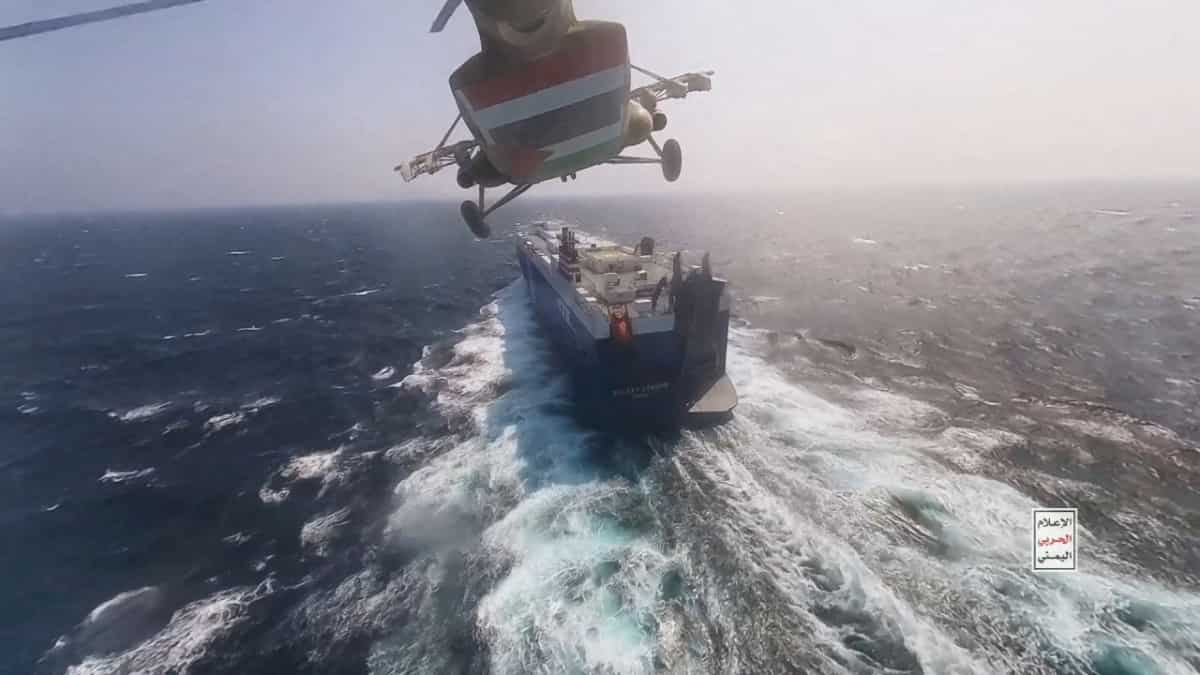
Houthi military helicopter flies over the Galaxy Leader cargo ship in the Red Sea/for representation
Soaring shipping costs and a spike in oil prices have ignited concerns about a potential revival of inflation pressures worldwide, Bloomberg reported.
Only a few days into 2024, anticipated as the year of waning inflation, manufacturers and retailers find themselves grappling with delays and increased expenses due to persistent attacks by Houthi rebels in the Red Sea, disrupting a crucial shipping route through the Suez Canal.
The resulting turmoil has doubled ocean freight rates for goods from Asia to Europe over the past four weeks, casting a shadow on hopes for a smooth economic recovery.

Geopolitical tensions push up oil prices and add to inflation fears
As geopolitical tensions escalate with persistent attacks in the Red Sea, oil prices experienced a significant surge after the US and UK led a military response.
Global benchmark Brent briefly topped $80 a barrel, marking a 4.3 per cent increase.
)
Trump 2.0: Dark days ahead for America’s ‘imperial presidency’
66 years of the Indus Waters Treaty: How India and Pakistan settled a bitter river dispute
)
Trump defends AI amid growing alarm, announces new 'AI force' and promises an 'AI czar'
)
9 women found dead near Johannesburg: South Africans rally, demand 'enough' to femicide
&im=FitAndFill=(700,400))
How many F-35s does Britain, Japan and Israel have?
)
‘Will go to any extent’: Pakistan vows to defend Saudi Arabia amid Houthi attacks
)
Nigeria: Protesters take to the streets, police fire shots
)
Raphinha hat-trick powers Barcelona to 3-1 win over Sevilla in La Liga
)
US-Iran war: Tehran draws red lines — seven demands before any peace talks
)
Cochin shipyard starts building Indian Navy's next-gen missile vessels
&im=FitAndFill=(700,400))
Meet top 5 Indian batters with fastest T20I centuries
)
Harry Brook targets long reign at top of T20I rankings after Sri Lanka sweep
)
Brigitte Bardot’s private collection set for Paris auction; key items and prices revealed
)
Pak: A series of counter terrorism operations in Khyber Pakhtunkhwa
)
Iran sets 7 conditions to end war with US: What are Tehran’s demands?
)
Pentagon revives mandatory testosterone testing for male troops aged 30 and above
)
Russia extends ban on Western food imports for two more years in extended sanctions countermeasure
)
Flying cars in UAE: Ras Al Khaimah signs deal with Chinese company to test new transport
&im=FitAndFill=(700,400))
Ananya Panday to Sharvari: 5 actresses serving major princess vibes
)
Africa is splitting, and a lot sooner than estimated, giving way to a new ocean
)
Iran rebuilding nuclear facilities? New satellite images show Tehran may be rapidly restoring bombed Parchin base
)
FACT CHECK: Why did PM Modi ask Xi ‘is it okay’ at BRICS Summit? New video reveals...
)
Trump announces ‘AI Force’ as debate grows over AI risks and regulation
)
Tirupati Laddu ghee adulterated with chemicals, says ED, supplier arrested
)
The Verdict | When precision fails: US commits war crime in Minab school strike, UN finds
)
Trump bans CNN, MS NOW and Politico from White House over ‘FAKE NEWS’
)
Mark Carney mimics Trump in hilarious moment over C$70 billion clean-energy investment; room erupts in laughter
)
Gaza under attack: Health chief's son killed in IDF strikes
)
Russia holds first parliamentary elections since the beginning of the Ukraine war
)
China may have gained access to US's classified F-35 jets; parts meant for repairs diverted to Hong Kong, sparking Pentagon inquiry
)
Reacher star Alan Ritchson opens up about alleged blackmail, suicide attempt during difficult period
&im=FitAndFill=(700,400))
‘Not the US or China’: These are the countries leading the world in arable land
)
How did an Australian river with 500 crocodiles pass the Olympic test? Here's how
)
Ed Sheeran addresses Macklemore's removal, Gaza conflict during Philadelphia concert: 'I cannot hide how I feel'
)
Arvind Kejriwal, family members, Delhi CM Rekha Gupta get SIR notices
)
Mohamed El-Erian, President of Queens' College, Cambridge, and a Bloomberg Opinion columnist, expressed concern, stating, "This is a world in which we are fragile to begin with on the supply side, and then you get this additional shock."
Supply chains vulnerable amid shipping disruptions
While the shipping disruptions are not as severe as those witnessed during the pandemic, the blockages in two critical trade arteries – the Red Sea and Central America's Panama Canal – are raising alarms within the industry.
Bloomberg cited Stephen Lamar, the President of the American Apparel & Footwear Association, who said, "This is a very dramatic reminder that supply chains continue to be very fragile," and he highlighted its potential inflationary impact across the freight industry.
Experts assess the inflationary impact and economic ramifications
Analysts are grappling with the potential inflationary impact, particularly in Europe and the US, as the disruptions unfold.
Ziad Daoud of Bloomberg Economics suggests that while the conflict in the Red Sea may not spill over into the wider region, limiting economic damage, the full extent of the inflationary impact will take time to become clear.
Economists at Allianz Trade estimate that a doubling of shipping costs could lift inflation by 0.7 percentage points for Europe and the US.
Oxford Economics projects that a permanent $10 increase in the price of a barrel of oil could add 0.22 percentage points to UK inflation and 0.29 points to global inflation in 2024.
Companies react to mitigate disruption, impact on consumers uncertain
Companies are already taking measures to mitigate the disruption caused by the Red Sea attacks.
Volvo Car AB and Tesla Inc. are among those adjusting production schedules due to supply chain disruptions.
Grocery chain Tesco Plc in the UK has warned of potential inflation pressures, anticipating extended shipping times and increased costs if vessels must circumnavigate Africa to reach Europe.
Craig Akers, Director of Operations at the Toy Shippers Association, humorously termed this period the 'canal crisis,' highlighting the uncertainty retailers and manufacturers face in the coming months.
(With inputs from Bloomberg)