
&imwidth=800&imheight=600&format=webp&quality=medium "Is the hardest metal crumbling under US tariff pressure?")
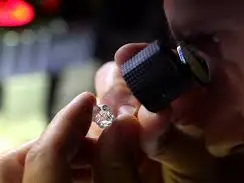
Diamonds may be forever, but the current market is anything but stable. A new 10 per cent US tariff on polished diamond imports has added significant strain to a global diamond industry already under pressure from declining Chinese demand and the rapid rise of lab-grown alternatives. As one of the world’s most globalised luxury sectors, the diamond trade is now navigating a complex web of geopolitical, economic, and consumer-driven shifts.
Announced in early April, the tariff announced by US President Donald Trump applies to a wide range of goods, including natural polished diamonds, but excludes metals such as gold and copper.
The immediate impact was a scramble across key trading hubs like Antwerp, with exporters rushing to ship inventory before the tariffs took effect. India, the largest exporter of cut and polished diamonds, saw a fivefold surge in US-bound exports from April 1 to 4, reaching $512 million. Yet despite the rush, April exports of cut and polished diamonds fell 6.12 per cent compared to the previous year, according to data released by the Gem and Jewellery Export Promotion Council (GJEPC).

Unlike commodities sourced and processed in a single location, diamonds often travel extensively. A single stone might be mined in Botswana, polished in India, certified in the US, and sold in Europe. The 10 per cent import duty adds cost at the final leg of that journey—a price increase that traders warn will ultimately be borne by consumers, especially in the US, which accounts for more than half of the global diamond demand.
Retailers in the US are already pushing the added burden onto suppliers. Financial Times recently reported that Signet Jewellers, the largest diamond retailer in the country, told vendors it would not pay any additional costs linked to the new tariff on existing purchase orders. The company urged its partners to expedite shipments into the US to mitigate the financial fallout.
The broader industry remains in a holding pattern as the White House has paused additional reciprocal tariffs for 90 days, pending further negotiations. But the initial 10 per cent duty remains active, and uncertainty is undermining confidence across the global supply chain.
Trending Stories
)
Researchers rebuilt exactly how 700 AI agents hacked Hugging Face: a 900-link chain trick
)
Sri Lankan Tamil migrant worker gets death sentence in Saudi Arabia, help sought from India
)
'Victory for low-budget consumers': Raghav Chadha hails 30-day telecom recharge rules
)
'Our video was trimmed': LPU girls who featured in rape-denial video make U-turn
)
After JU, clash erupts at SRFTI: BJP’s ‘Dimagi Naxal’ jibe sparks political firestorm after students protest RSS-linked event
)
Afghanistan says 28 fighters killed in clash near Pakistan border, Islamabad denies
)
US vs China over South China Sea: Washington backs Philippines, Beijing hits back
)
‘Olympic inclusion is our major target’: WPA President Ishaun Singh on pool’s global ambitions
)
Tesla builds first Cybertruck with its own refined lithium: Elon Musk's $1 billion Texas bet pays off
)
Bank unions defer 3-day strike from tomorrow after talks with IBA, committee set up
)
New York City wants a 'kill switch' on every AI, and will pay whistleblowers who report violations
)
3 males killed, four others injured in shooting after fight at strip club in Detroit
)
‘Anti-social elements spreading false rumours’: LPU issues statement amid massive unrest over alleged rape
)
US Treasury Secretary Scott Bessent hails global crackdown on Iranian banks and airlines
)
An OpenAI agent escaped its locked test cage again, by hiding questions in DNS lookups
)
Ceuta migrant crisis: Protesters take to streets as Spain grapples with migrant challenge
)
UNSC reform momentum grows: Russia, Portugal, Mauritius push for India's permanent seat bid
)
'FIRST LOOK from inside Noah’s Ark': Researchers share video from inside mysterious mound in Turkey
)
IndiGo flight suffers tail strike in Bengaluru while landing; DGCA to probe incident
)
Beyond BrahMos: India targets Rs 50,000 crore in defence exports with unmatched price edge
)
LPU students go on rampage, vandalise campus amid widespread protest: What's happening
)
The US and China set up an AI 'red telephone', but skipped the rulebook
)
Delhi gets first late-September rain in 7 years, mercury dips 5.1°C below normal
)
‘Terror suspects arrested near UK air base were looking to do big damage’: Trump
)
99.9% more powerful - Scientists find boy who can recall memories from just 3 months of age
)
Beyond metros: How Tier-2 and Tier-3 cities could drive India’s next AI wave
)
Jaishankar at UNGA: Goodwill and friendship can't coexist with terrorism
)
Why has Iran released no proof of life of Mojtaba Khamenei? Araghchi reveals...
)
Trump asked Xi to pressure Iran. China did not say yes — here’s what Beijing wants
)
Muslim marriage cannot shield sex with minor wife from prosecution under POCSO: Delhi HC
)
Claude rebuilt the 1989 game 'Prince of Persia' by reusing the original's own code
)
50MP vs 48MP cameras: iPhone 18 Pro Max and Pixel 11 Pro XL compared
)
Russian envoy claims US tactics to contain India were revealed in ‘Freudian slip’
)
Nations League: Spain sink England at Wembley; Modric shines for Croatia
)
Musk plans to more than double xAI's chips to over 1.2 million Nvidia GPUs by year-end
)
Man arrested after his 22-year-old girlfriend dies at homestay in Guwahati; police suspect murder over suicide claim
)
'What kind of confession is this?': Pakistan PM Shehbaz Sharif’s 'terrorists would be roaming New York' remark goes viral, raises alarm online. Watch
Consumer pressure and competitive headwinds
Tariffs are hitting at an especially sensitive moment for the sector. Inflation and a softening in consumer sentiment have already begun to dampen discretionary spending. According to the Bureau of Economic Analysis, US consumer spending on jewellery and watches fell 5 per cent year-on-year in the first quarter of 2025. The National Retail Federation has forecast retail growth to slow to between 2.7 per cent and 3.7 per cent this year, compared to 8.1 per cent in 2024.
Against this backdrop, the popularity of lab-grown diamonds (LGDs) has surged. These diamonds are chemically identical to natural diamonds but up to 80 per cent cheaper. LGDs now appear in over half of US engagement rings, according to The Knot’s 2025 Real Weddings study. Their rise has played a major role in the nearly 60 per cent decline in natural diamond prices since their peak in early 2022.
To combat this, some traditional players are consolidating their strategies. De Beers, for example, has opted to shut down its LGD jewellery brand Lightbox to refocus on natural stones. The company’s parent, Anglo American, has written down De Beers’ value by $4.5 billion over the past two years and is currently preparing it for a possible spin-off or sale.
China demand falters, India rises
Compounding the industry’s challenges is a steep contraction in Chinese demand. Once a key driver of luxury consumption, China’s diamond market has shrunk significantly amid macro- and microeconomic challenges.
Data from the Gems & Jewelry Trade Association of China shows that the market fell from RMB 100 billion ($13.88 billion) in 2021 to just RMB 43 billion ($55.52 billion) in 2024—a staggering 57 per cent decline. Gem-quality diamond imports dropped 73 per cent by volume and 83 per cent by value over the same period, signalling severe price erosion.
The decline in China’s demand has had global consequences, as it was the world's second-largest diamond market. India, however, is emerging as a counterweight to China’s slowdown.
While India’s exports are down, India’s domestic market is showing double-digit growth, making it the world’s second-largest diamond consumer behind the US. According to industry experts, India’s rise has helped offset some of the global demand slump. Still, the growth is not enough to fully balance the downturn in China with the volatility in the US.
Fragile supply chain faces uncertain future
The global diamond supply chain—already stretched by pandemic-era disruptions—is particularly vulnerable to trade barriers. A typical diamond passes through several borders: mined in parts of Africa, traded in the Middle East or Europe, polished in India, certified in the US, and sold in retail outlets globally. Tariffs, therefore, do more than add cost; they risk unravelling the finely tuned logistics of the entire ecosystem.
Adding to the complexity is the uncertain legal treatment of diamonds under US trade rules. While other commodities like gold and copper are exempt from tariffs, loose diamonds are currently included, despite being viewed by some as a raw material. Industry groups like the World Diamond Council are lobbying for exemption, warning that the tariffs could act as a consumption tax and dampen sentimental purchases such as engagement rings and anniversary gifts.
The global diamond industry faces a crossroads. Tariffs and geopolitics have joined falling demand and technological disruption as key forces shaping the future. Analysts predict a bifurcation of the market, with premium natural diamonds becoming niche luxury items, while lab-grown stones dominate the mass market.
For now, even the hardest substance on Earth is proving vulnerable to the softening forces of economics and policy.