

&imwidth=800&imheight=600&format=webp&quality=medium "India reaches 50% non-fossil fuel power capacity milestone, five years ahead of target")
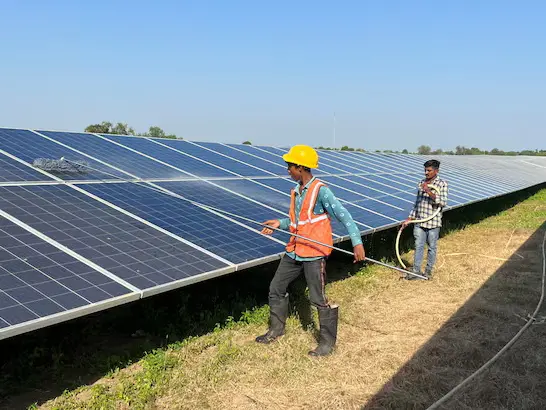
India has achieved a major climate milestone, reaching 50.1 per cent of its installed electricity capacity from non-fossil fuel sources as of June 30, 2025, surpassing its 2030 target set under the Paris Agreement five years ahead of schedule. The country’s installed capacity now stands at 485 gigawatts (GW), with over half of that, approximately 242.8 GW, coming from renewable sources, including solar, wind, and nuclear energy, as well as hydropower.
The Ministry of New and Renewable Energy (MNRE) credited the sharp increase in non-fossil fuel capacity to significant investments in solar and wind energy. India had committed to reaching 40 per cent non-fossil fuel capacity by 2030 during the Paris Agreement and later raised that target to 50 per cent in 2022. The current push has been especially driven by solar energy, which now makes up the largest share of India’s renewable energy capacity.
Renewables surge, but coal still dominates power generation
While non-fossil fuel sources now account for half of India’s electricity capacity, coal and other thermal power plants continue to dominate actual power generation. In 2024, India’s electricity production reached 2,030 terawatt-hours (TWh), with coal accounting for a record 1,517.9 TWh, despite renewables making up 240.5 TWh. This disparity reflects the intermittent nature of solar and wind power, which cannot consistently meet the country’s peak energy demand.
As renewable energy generation grows, India still relies heavily on thermal power for baseload support. For instance, even though non-fossil fuels account for 50 per cent of the installed capacity, thermal plants continue to generate over 70 per cent of the electricity, highlighting the ongoing need for stable, round-the-clock power. India's grid faces challenges in integrating renewable sources without adequate storage capacity, a gap that has been exacerbated by rapid growth in solar and wind power installations without corresponding investments in energy storage infrastructure.
Challenges and future steps
Trending Stories
&imwidth=180&imheight=135&format=webp&quality=medium)
China's counter-surveillance industry booms amid heightened espionage fears | Gravitas
&im=FitAndFill=(700,400)&imwidth=180&imheight=135&format=webp&quality=medium)
Navratri 2026: 9 days, 9 forms of Goddess Durga and 9 colours- Check the complete list
&imwidth=180&imheight=135&format=webp&quality=medium)
Trump accuses Houthis of driving up oil prices before US midterms, warns of consequences
&imwidth=180&imheight=135&format=webp&quality=medium)
Russian woman and Bihar boy's love story goes viral after she reaches India to marry him
&imwidth=180&imheight=135&format=webp&quality=medium)
Arijit Singh 9-city India stadium tour to start from January: Check venue and ticket prices
&imwidth=180&imheight=135&format=webp&quality=medium)
US Midterms 2026: In Alaska, cost-of-living anxiety meets strangest ballot in high-stakes Senate race
&imwidth=180&imheight=135&format=webp&quality=medium)
F1 set to return to Africa for first time since 1993
&imwidth=180&imheight=135&format=webp&quality=medium)
'Don't ever mess with nature!': Trump’s tiger attack post triggers social media backlash as victim's family issues heartbreaking tribute
&imwidth=180&imheight=135&format=webp&quality=medium)
CMs Vijay-Naidu meet in Vijayawada, discuss water sharing, river-linking
&imwidth=180&imheight=135&format=webp&quality=medium)
Air India Flight from Frankfurt diverted to Jaipur after hijack alert, probe on
&imwidth=180&imheight=135&format=webp&quality=medium)
1,500 drones illuminate Mumbai sky as Cordelia Cruises unveils second ship, Cordelia Sky
&imwidth=180&imheight=135&format=webp&quality=medium)
Delhi Police arrest Cockroach Janta Party's Saurav Das, Ashutosh Ranka, Ajinkya Shinde in Jantar Mantar case, to be produced before court
&imwidth=180&imheight=135&format=webp&quality=medium)
‘Rise up, young patriots!’: American singer Mary Millben says US donors funding CJP, backs Modi govt
&imwidth=180&imheight=135&format=webp&quality=medium)
Nobel Peace Prize winner Navi Pillay calls on US to 'get back to' being defender of human rights
&imwidth=180&imheight=135&format=webp&quality=medium)
France accuses Musk of ‘online harassment’ of European leaders, warns of poll interference
&imwidth=180&imheight=135&format=webp&quality=medium)
'Turn approver, resign, we'll forgive you': Rahul Gandhi claims receiving messages from CEC Gyanesh Kumar
&imwidth=180&imheight=135&format=webp&quality=medium)
MI5 chief warns Russia is UK’s ‘aggressor number one’ as Iran and AI threats grow
&imwidth=180&imheight=135&format=webp&quality=medium)
Trump reconsidering calling off Nidal Hasan's execution livestream. Here's why
&imwidth=180&imheight=135&format=webp&quality=medium)
‘My president, I mean my husband’: Trump's new press secretary Katie Zacharia's first briefing goes off the rails in 14 minutes
&imwidth=180&imheight=135&format=webp&quality=medium)
‘How many people did she illegally bring from Somalia?’ Trump targets Ilhan Omar, questions her net worth
&imwidth=180&imheight=135&format=webp&quality=medium)
Marco Rubio to visit India next week, focus on energy cooperation and strategic ties
&imwidth=180&imheight=135&format=webp&quality=medium)
US politicians mistakenly use Indian, Russian warship images for Navy's birthday posts
&imwidth=180&imheight=135&format=webp&quality=medium)
'Ouch!!! That must hurt': Kangana Ranaut hails Kamal Haasan's sharp reply to Elon Musk over Starlink row
&imwidth=180&imheight=135&format=webp&quality=medium)
Girl 'dead' for 8 hours wakes up at her own funeral, dad insists she wasn't breathing
&imwidth=180&imheight=135&format=webp&quality=medium)
Sidhu Moose Wala’s younger brother wins hearts by recreating late singer’s signature move at Toronto Hologram Show
&imwidth=180&imheight=135&format=webp&quality=medium)
UK school ditches technology, shifts from screen to pen and paper for learning
&imwidth=180&imheight=135&format=webp&quality=medium)
Durga Puja 2026: Kolkata roads get a splash of colours
&im=FitAndFill=(700,400)&imwidth=180&imheight=135&format=webp&quality=medium)
New OTT releases this week (October 12-18, 2026): Sacrifice, Koffee with Karan S9, Roadies Rebirth- 6 titles coming on Netflix, JioHotstar and more
&imwidth=180&imheight=135&format=webp&quality=medium)
Inside Aneet Padda's 24th birthday bash with rumoured boyfriend Ahaan Panday and Alia Bhatt
&imwidth=180&imheight=135&format=webp&quality=medium)
New Cold War: Why is China buying more gold? Explained
&imwidth=180&imheight=135&format=webp&quality=medium)
Netanyahu wants to join Saudi's war on Houthis, but Crown Prince denies: Report
&imwidth=180&imheight=135&format=webp&quality=medium)
Anupam Kher joins Ranbir Kapoor's Ramayana as Jatayu, new poster unveiled
&imwidth=180&imheight=135&format=webp&quality=medium)
Measles kills again: 6 dead in Pennsylvania as America faces its worst outbreak in decades | Gravitas
&imwidth=180&imheight=135&format=webp&quality=medium)
Cornell University suspends fraternity parties over 2024 gang rape allegations
India’s rapid shift towards renewable energy has highlighted critical gaps in storage capacity, which is essential for stabilising the grid when renewable generation is low or during periods of high demand. As of the end of 2024, India’s storage capacity stood at just 4.75 GW from pumped storage and 110 MW from battery storage, far below the requirements needed to handle the growing share of renewables.
To address this, the Indian government has started taking proactive steps, including policy initiatives to encourage the co-location of storage systems with solar projects. The Central Electricity Authority (CEA) has also been working to ensure that future renewable energy projects include storage, and the government has expanded viability gap funding (VGF) to support the development of battery storage. However, the execution of these projects has been slow, with challenges such as high upfront costs, import duties, and supply chain constraints—particularly China’s control over the global battery market—hindering progress.
The government is also focusing on rooftop solar installations to decentralise energy generation and improve grid stability. The PM Surya Ghar: Muft Bijli Yojana has already added 3 GW of rooftop solar capacity, with plans to add 27 GW by March 2027. Additionally, hybrid tenders that combine solar, wind, and storage are gaining traction, as they offer a more diversified and reliable energy generation profile.
India’s renewable energy push has also brought several key companies into the spotlight. Waaree Energies, NTPC Green, Inox, and Adani Green Energy are among the top players benefiting from the surge in solar and wind installations. Waaree Energies, a major solar PV module manufacturer, has reported substantial growth in sales, while NTPC Green has made significant investments in both solar and wind projects, commissioning 1.6 GW of renewable energy projects in 2024 alone.
However, the renewable energy sector still faces hurdles, such as the lack of power purchase agreements (PPAs) for older projects and grid access issues due to underinvestment in transmission infrastructure. The government is working to resolve these challenges, but timely execution remains crucial to ensure that India stays on track to meet its 2030 renewable energy targets.