

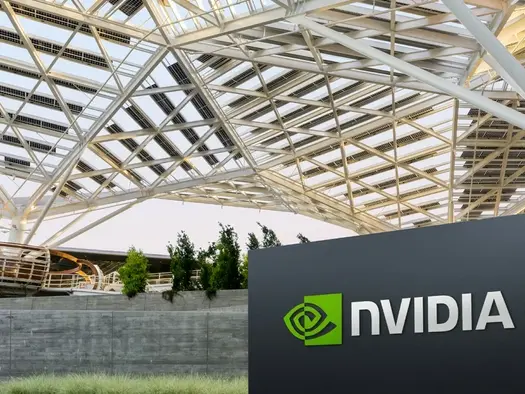
&imwidth=800&imheight=600&format=webp&quality=medium "Data centres drive Nvidia’s $44 billion revenue despite setback from China export restrictions")
Nvidia’s first-quarter earnings for fiscal year 2026 have shattered records, with the company posting a remarkable 69 per cent year-on-year revenue growth to $44.1 billion. The impressive performance was largely driven by a booming data centre business, which saw a 73 per cent rise in sales compared to the same quarter last year.
However, the quarter was not without its challenges, as Nvidia incurred a significant $4.5 billion charge due to the export restrictions on its H20 products for the China market.
The standout performer in Nvidia’s earnings report was its data centre division, which recorded a massive $39.1 billion in revenue, representing 88 per cent of the company's total revenue. The demand for Nvidia’s artificial intelligence (AI) chips, especially for large cloud providers and AI supercomputing, continues to surge.
The company also announced that Microsoft has deployed tens of thousands of Nvidia's Blackwell GPUs, with plans to increase that number to hundreds of thousands, thanks to their partnership with OpenAI.
Nvidia’s AI infrastructure products, including the breakthrough Blackwell NVL72 AI supercomputer, have seen explosive growth. “AI inference token generation has surged tenfold in just one year,” said Nvidia CEO Jensen Huang during the company’s earnings call.
As AI agents become more mainstream, Huang emphasised that the demand for AI computing will continue to accelerate, positioning Nvidia at the centre of this transformative technology shift. “Countries around the world are recognising AI as essential infrastructure—just like electricity and the internet,” he added.
Trending Stories
&im=FitAndFill=(700,400)&imwidth=180&imheight=135&format=webp&quality=medium)
Navratri 2026: 9 days, 9 forms of Goddess Durga and 9 colours- Check the complete list
&imwidth=180&imheight=135&format=webp&quality=medium)
Bigg Boss 20: Isha Rikhi evicted after three weeks in Salman Khan’s show
&imwidth=180&imheight=135&format=webp&quality=medium)
Russian woman and Bihar boy's love story goes viral after she reaches India to marry him
&imwidth=180&imheight=135&format=webp&quality=medium)
Arijit Singh 9-city India stadium tour to start from January: Check venue and ticket prices
&imwidth=180&imheight=135&format=webp&quality=medium)
‘Hernia, aneurysm, injuries’: Salman Khan reveals health struggles behind his changing physique on Koffee With Karan 9
&imwidth=180&imheight=135&format=webp&quality=medium)
F1 set to return to Africa for first time since 1993
&imwidth=180&imheight=135&format=webp&quality=medium)
'Don't ever mess with nature!': Trump’s tiger attack post triggers social media backlash as victim's family issues heartbreaking tribute
&imwidth=180&imheight=135&format=webp&quality=medium)
US judge blocks Trump administration sanctions on human rights groups supporting Gaza war crimes investigation
&imwidth=180&imheight=135&format=webp&quality=medium)
Trump's $100,000 H-1B fee: Why neither Republicans nor Democrats want to make it a 2026 US Midterm issue
&im=FitAndFill=(700,400)&imwidth=180&imheight=135&format=webp&quality=medium)
Which jobs are safest from humanoid robots?
&imwidth=180&imheight=135&format=webp&quality=medium)
‘Rise up, young patriots!’: American singer Mary Millben says US donors funding CJP, backs Modi govt
&imwidth=180&imheight=135&format=webp&quality=medium)
Nobel Peace Prize winner Navi Pillay calls on US to 'get back to' being defender of human rights
&imwidth=180&imheight=135&format=webp&quality=medium)
Iranian woman, 23, handed death sentence for ‘blasphemy’ in social media post; appeals for help
&imwidth=180&imheight=135&format=webp&quality=medium)
'Turn approver, resign, we'll forgive you': Rahul Gandhi claims receiving messages from CEC Gyanesh Kumar
&imwidth=180&imheight=135&format=webp&quality=medium)
Somaliland celebrates after Trump calls it 'a totally different country', raise hopes of US recognition
&imwidth=180&imheight=135&format=webp&quality=medium)
Afghan FM Muttaqi to CdA Yatin Patel: We attach importance to relations with India
&imwidth=180&imheight=135&format=webp&quality=medium)
'FWD Supreme' to use AI for flight and threat identification
&imwidth=180&imheight=135&format=webp&quality=medium)
‘My president, I mean my husband’: Trump's new press secretary Katie Zacharia's first briefing goes off the rails in 14 minutes
&imwidth=180&imheight=135&format=webp&quality=medium)
Mars is not for man: Human heart is too weak to survive the trip, study shows
&imwidth=180&imheight=135&format=webp&quality=medium)
‘600,000 people without electricity’: Zelensky calls for ‘strong’ US sanctions on Russia, accuses Moscow of violating Trump’s energy ceasefire
&imwidth=180&imheight=135&format=webp&quality=medium)
Sheikh Hasina warns of 'deep sense of insecurity' among Bangladesh's minorities in Durga Puja message
&imwidth=180&imheight=135&format=webp&quality=medium)
FBI refutes media report claiming Kash Patel is in Russia for talks, says he is in Virginia
&imwidth=180&imheight=135&format=webp&quality=medium)
US inflation hits 3.7% as rising fuel prices pose challenge for Trump ahead of midterms
&imwidth=180&imheight=135&format=webp&quality=medium)
IND vs WI 4th T20I: Shai Hope hundred and Keemo Paul's five-for level series for West Indies
&imwidth=180&imheight=135&format=webp&quality=medium)
Girl 'dead' for 8 hours wakes up at her own funeral, dad insists she wasn't breathing
&imwidth=180&imheight=135&format=webp&quality=medium)
'Ouch!!! That must hurt': Kangana Ranaut hails Kamal Haasan's sharp reply to Elon Musk over Starlink row
&imwidth=180&imheight=135&format=webp&quality=medium)
Three Indians killed in suspected arson attack in Germany, Romanian resident arrested
&imwidth=180&imheight=135&format=webp&quality=medium)
'Totally unacceptable': MEA slams attacks on Saudi civilian infrastructure after Indian national's death
&im=FitAndFill=(700,400)&imwidth=180&imheight=135&format=webp&quality=medium)
New OTT releases this week (October 12-18, 2026): Sacrifice, Koffee with Karan S9, Roadies Rebirth- 6 titles coming on Netflix, JioHotstar and more
&imwidth=180&imheight=135&format=webp&quality=medium)
Did the US withhold missile warnings? Ukraine questions Washington's 'bad weather' explanation after Russian strikes kill six, cut power to 600,000
&imwidth=180&imheight=135&format=webp&quality=medium)
US Singer Mary Millben alleges foreign funding for CJP, warns against anti-Modi forces: All you need to know
&imwidth=180&imheight=135&format=webp&quality=medium)
Global energy crisis hits Indian economy
&imwidth=180&imheight=135&format=webp&quality=medium)
Durga Puja 2026: Power banks, water bottles and more, a foolproof guide to pandal hopping
&imwidth=180&imheight=135&format=webp&quality=medium)
Netflix layoffs: Streaming giant to cut 1,000 jobs globally amid slow growth and declining user engagement
&imwidth=180&imheight=135&format=webp&quality=medium)
Zelensky feels betrayed by Trump, urges Musk to restore Starlink in Ukraine; Musk responds
&imwidth=180&imheight=135&format=webp&quality=medium)
'Girls are uncomfortable': Salman Khan calls out paparazzi for bad angles, speaks on PR on Koffee With Karan
&imwidth=180&imheight=135&format=webp&quality=medium)
After flydubai co-pilot attack, Air France bans Pakistani, Muslim-majority crew on Israel flights
Despite the soaring demand for Nvidia’s cutting-edge AI chips, the company was hit with a significant setback during the quarter. On April 9, 2025, the US government informed Nvidia that a licence would be required for the export of its H20 products to China.
This unexpected change in the trade policy forced Nvidia to absorb a $4.5 billion charge in the first quarter of the current fiscal year, related to excess inventory and purchase obligations. As a result, Nvidia was unable to ship an additional $2.5 billion in H2O-related sales.
These export restrictions have serious implications for Nvidia, with Huang stating that the $50 billion AI chip market in China is effectively closed to US industry. The firm’s H20 processor, which had previously been approved for export to China, had been a major contributor to Nvidia’s data centre business, and the export ban has effectively ended its Hopper data centre business in China.
Strong performance despite setbacks
Nvidia's first-quarter net income rose by 26 per cent, reaching $18.8 billion, or $0.76 per share, up from $14.9 billion in the previous year. On an adjusted basis, earnings per share (EPS) were $0.96, beating analysts’ expectations of $0.93.
In afterhours trading on Wall Street, Nvidia share price jumped as much as 6 per cent after the chip maker posted record-breaking revenue. Its stock climbed to $142.22 apiece on Nasdaq in afterhours trading, against previous close at $135.50.
The company's gross margin was reported at 60.5 per cent on a GAAP basis and 61.0 per cent on a non-GAAP basis. Excluding the $4.5 billion charge, non-GAAP gross margin would have been a staggering 71.3 per cent.
The company’s gaming division, which includes chips for 3D gaming, also showed strong growth, with revenue rising 42 per cent year-on-year to $3.8 billion. Notably, Nvidia’s chips now power the Nintendo Switch 2, a new console that integrates AI-powered DLSS technology for up to 4K gaming. Nvidia’s graphics technology, once primarily used for gaming, is now being utilised in AI applications, further highlighting the expanding reach of its chips.
In addition, Nvidia’s automotive and robotics business saw a 72 per cent increase in revenue, totalling $567 million. The division's growth was driven by increased demand for self-driving car chips and robotics software, including the company’s breakthrough in humanoid robotics.
Nvidia had also introduced its Isaac GR00T N1, the world’s first open humanoid robot foundation model, and announced plans to expand its role in robotics development.
Nvidia’s professional visualisation division, which provides chips for 3D design and AI-powered design workstations, reported a 19 per cent increase in revenue to $509 million.
Guidance and expansion plans
Looking ahead, Nvidia expects revenue for the second quarter of fiscal 2026 to be around $45 billion, give or take 2 per cent, with a substantial $8 billion in lost sales due to the H20 export restrictions. Despite the loss of the China market, Nvidia remains optimistic about the future of its AI infrastructure and the continued global demand for its products.
Gross margins are projected to be in the range of 71.8 per cent to 72.0 per cent, with Nvidia targeting mid-70 per cent margins later in the year as it continues to scale its AI offerings.
Nvidia is also focused on expanding its global presence. The company recently unveiled plans to build AI factories in the US and Saudi Arabia, as well as launching the Stargate UAE AI infrastructure cluster in Abu Dhabi.
The firm has also expanded partnerships with major tech giants such as Oracle, Google, and Microsoft, and its Blackwell cloud instances are now available on AWS, Google Cloud, Microsoft Azure, and Oracle Cloud Infrastructure.
While the export restrictions are a significant hurdle for Nvidia, the company remains well-positioned at the forefront of the AI revolution. As countries worldwide increasingly view AI as essential infrastructure, Nvidia’s leadership in AI computing, combined with its expanding global footprint, positions the company for continued success in the coming years.
In the meantime, Nvidia continues to focus on delivering innovative products and expanding its partnerships to meet the surging demand for AI chips and infrastructure, with eyes on the future growth of AI technologies across the globe.