China's economic woes deepen as private sector struggles with challenges surrounding unemployment

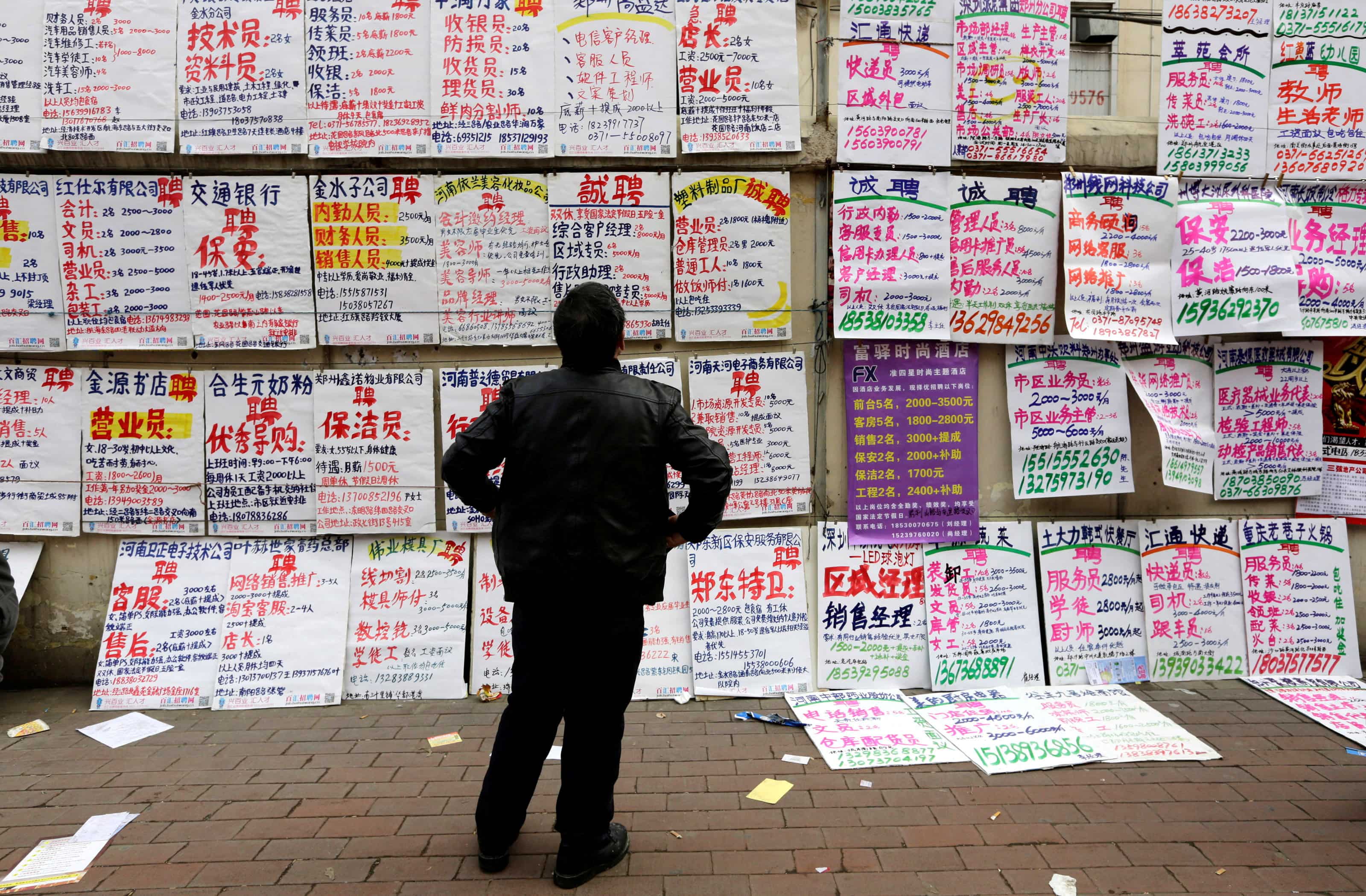
A man looks at job information at an employment fair beside a street in Zhengzhou, Henan province
Amid an ongoing real estate crisis, a privately run aluminium producer in Guangdong, China's manufacturing hub, has thrust the challenges faced by private businesses into the spotlight. Golden World Innovation Aluminium, overwhelmed by the economic headwinds, has suspended production, compelling its staff to take five months of leave with reduced salaries, the South China Morning Post reported.
Unemployment pressures mount despite official figures
China's economy showed few positive signs in 2023, defying support measures and putting significant pressure on employment. Official unemployment figures remain within the government target of 5.5 per cent, but signs of companies implementing unpaid leave or reductions indicate underlying challenges. Analysts call for more policy support to revive domestic demand and stabilise manufacturing production. The Foshan government's labour market report in November pointed to hefty pressure on manufacturing industries due to economic headwinds.

Private sector struggles impact China's economic growth
The private sector, historically the backbone of China's economic growth, is yet to fully recover. Fixed-asset investment in the private sector contracted by 0.5 per cent in the first 11 months of the year, in contrast to a rise of 6.5 per cent in the state sector.
Golden World Innovation Aluminium, once thriving during the property sector's heyday, is now grappling with declining orders amid the real estate crisis. The slump has become a major drag on the economy, affecting various sectors.
Real estate crisis hits multiple sectors
The slump in the real estate market has had a cascading effect on industries beyond aluminium production. Yaxin Iron and Steel Group in Henan announced a suspension of production, and Raymond Zheng, owner of a piling company, placed most of his staff on unpaid leave.
The funding chain in various industries is broken, leading to solvency problems and compromising the quality of construction projects. Despite these widespread issues, China is still on track to meet its growth target for the year.
Challenges persist despite economic growth pledges
China's top leadership, at the central economic work conference, emphasised development as the top political priority and pledged efforts to consolidate economic growth. However, challenges such as high youth unemployment, weak business expectations, a drop in exports, a bleak manufacturing sector recovery, and rising local government debts loom large.
According to the South China Morning Post, Peng Peng, the executive chairman of the Guangdong Society of Reform, urged increased supportive policies to address the severity of the economic situation.
Wide-ranging impact on various sectors
The economic slowdown is not confined to specific industries; electronics, plastics producers, and the printing industry have also felt the pinch. Simatelex, a Hong Kong-based electronics producer, closed its Shenzhen factory after 38 years, affecting hundreds of workers.
Plastics manufacturers Shenli and Forward, as well as Good Printing, have closed their Shenzhen factories, impacting thousands of jobs. The closures have not only economic ramifications but also affect nearby businesses relying on the workers.
China struggles to replace real estate as economic pillar
The challenge lies in finding emerging industries powerful enough to replace real estate as a pillar for the national economy. Paris-based investment bank Natixis highlights this concern, emphasising that China has yet to identify industries capable of filling the void left by the real estate sector.
The Guangzhou Institute of Greater Bay Area warns of investment conditions' deterioration and funding difficulties for private businesses in 2024 if confidence is not revived.
Policy room available, but challenges loom
While China maintains a growth target for the year, concerns persist about a protracted weakness in private investment. A report by the Guangzhou Institute of Greater Bay Area urges caution, stating that if confidence isn't revived, private entrepreneurs may continue to face challenges.
Xu Qiyuan from the Chinese Academy of Social Sciences emphasised the need for additional gauges beyond the urban surveyed unemployment rate to better reflect the real job pressures.
WATCH WION LIVE HERE