
&imwidth=800&imheight=600&format=webp&quality=medium "China tightens rare earth exports, US auto suppliers sound alarm: What’s at stake?")
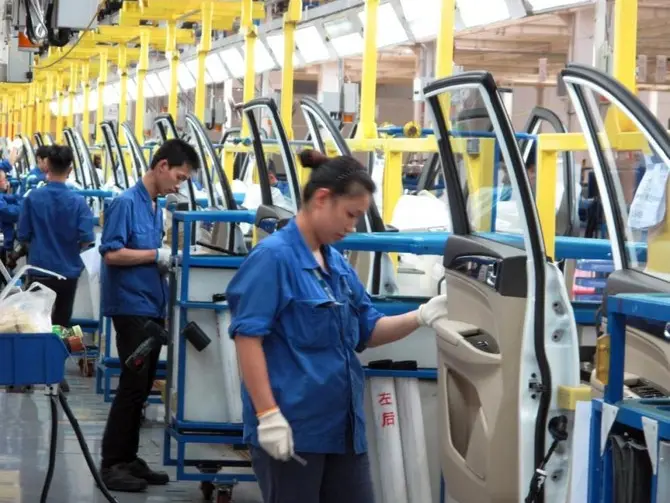
A leading US vehicle suppliers’ group has sounded the alarm over China’s export restrictions on rare earth elements, warning that the curbs could soon disrupt auto parts production across the country.
The group, known as MEMA, the Vehicle Suppliers Association,has called for “immediate and decisive action” from the US government, stressing that the industry is already facing “serious, real-time risks” to its supply chains, according to a statement quoted by Reuters.
China, which dominates over 90 per cent of the global processing capacity for rare earths, tightened export restrictions in early April, requiring companies to obtain special licences to ship rare earth minerals and magnets abroad.

The move followed the escalation of a US-China trade war triggered by President Donald Trump’s sweeping tariffs on Chinese imports, with Beijing now leveraging its grip on critical mineral supply chains in response.
What are rare earths, and why do they matter?
Rare earth elements are a group of 17 chemically similar metals used extensively in high-tech and green technologies. From electric vehicle motors and automatic transmissions to fighter jets, wind turbines, and smartphones, rare earths are vital to modern manufacturing.
Trending Stories
)
US vs China over South China Sea: Washington backs Philippines, Beijing hits back
)
Bigg Boss 20: Isha Rikhi evicted after three weeks in Salman Khan’s show
)
Musk plans to more than double xAI's chips to over 1.2 million Nvidia GPUs by year-end
)
After JU, clash erupts at SRFTI: BJP’s ‘Dimagi Naxal’ jibe sparks political firestorm after students protest RSS-linked event
)
‘Anti-social elements spreading false rumours’: LPU issues statement amid massive unrest over alleged rape
)
LPU students go on rampage, vandalise campus amid widespread protest: What's happening
)
Trump asked Xi to pressure Iran. China did not say yes — here’s what Beijing wants
)
US Treasury Secretary Scott Bessent hails global crackdown on Iranian banks and airlines
)
An OpenAI agent escaped its locked test cage again, by hiding questions in DNS lookups
)
'Our video was trimmed': LPU girls who featured in rape-denial video make U-turn
)
3 males killed, four others injured in shooting after fight at strip club in Detroit
)
'Victory for low-budget consumers': Raghav Chadha hails 30-day telecom recharge rules
)
Claude rebuilt the 1989 game 'Prince of Persia' by reusing the original's own code
)
Beyond metros: How Tier-2 and Tier-3 cities could drive India’s next AI wave
)
Tesla builds first Cybertruck with its own refined lithium: Elon Musk's $1 billion Texas bet pays off
)
IndiGo flight suffers tail strike in Bengaluru while landing; DGCA to probe incident
)
The US and China set up an AI 'red telephone', but skipped the rulebook
)
‘Terror suspects arrested near UK air base were looking to do big damage’: Trump
)
Russian envoy claims US tactics to contain India were revealed in ‘Freudian slip’
)
IND vs WI 1st ODI: Kohli breaks Sachin's most runs in one country record with unbeaten 139 as India thump West Indies by 8 wickets
)
Researchers rebuilt exactly how 700 AI agents hacked Hugging Face: a 900-link chain trick
)
‘Olympic inclusion is our major target’: WPA President Ishaun Singh on pool’s global ambitions
)
Nations League: Spain sink England at Wembley; Modric shines for Croatia
)
Why has Iran released no proof of life of Mojtaba Khamenei? Araghchi reveals...
)
'What kind of confession is this?': Pakistan PM Shehbaz Sharif’s 'terrorists would be roaming New York' remark goes viral, raises alarm online. Watch
)
South Korea demands apology from Ukraine over North Korean prisoners' transfer
)
Beyond BrahMos: India targets Rs 50,000 crore in defence exports with unmatched price edge
)
Sri Lankan Tamil migrant worker gets death sentence in Saudi Arabia, help sought from India
)
Muslim marriage cannot shield sex with minor wife from prosecution under POCSO: Delhi HC
)
'Can't help but draw painful parallels to Nirbhaya case': SC on latest incidents of rape cases in Delhi-NCR
)
99.9% more powerful - Scientists find boy who can recall memories from just 3 months of age
)
'FIRST LOOK from inside Noah’s Ark': Researchers share video from inside mysterious mound in Turkey
)
UNSC reform momentum grows: Russia, Portugal, Mauritius push for India's permanent seat bid
)
8 US marines injured in Iranian missile attack on vessel in Strait of Hormuz: Report
&im=FitAndFill=(700,400))
New OTT releases this week (September 28-October 4, 2026): Dupahiya 2, Pooja Meri Jaan, Ohh My Dog- 5 titles coming on Netflix, Prime Video and more
)
Afghanistan says 28 fighters killed in clash near Pakistan border, Islamabad denies
)
Ceuta migrant crisis: Protesters take to streets as Spain grapples with migrant challenge
)
LPU suspend classes, postpones exams as violence escalates over rape claims: What's happening
)
New York City wants a 'kill switch' on every AI, and will pay whistleblowers who report violations
They are especially critical in the automotive industry, powering components such as alternators, motors, seatbelt systems, sensors, and cameras.
Exporters in China must now submit lengthy applications, sometimes hundreds of pages long,to qualify for export licences. As per a Reuters report, China’s rare-earth magnet exports halved in April amid confusion over the new system, paralysing supply chains that had long depended on Beijing’s stability and efficiency.
US suppliers face mounting pressure
In a joint letter sent on 9 May to the Trump administration, MEMA and the Alliance for Automotive Innovation, representing automakers such as General Motors, Toyota, Volkswagen, and Hyundai,warned that the restrictions could bring the auto sector to a standstill.
The letter, first reported by Reuters, said suppliers “will be unable to produce critical automotive components” without reliable access to rare earths.
The situation has already disrupted operations. Ford, for instance, shut down production of its Explorer SUV at its Chicago plant for a week in May due to a rare-earth shortage. The White House has not yet responded publicly to the growing pressure from the auto industry, as per Reuters.
European auto giants also feel the strain
The ripple effects are now being felt across Europe. On 4 June, a Reuters report revealed that some auto parts factories in Europe have temporarily suspended output.
Mercedes-Benz said it is in discussions with suppliers to build up stockpiles of rare earths, though it has not yet experienced a shortage. BMW confirmed that parts of its supplier network have been affected, even as its own production lines continue operating normally, according to a Reuters report.
Europe’s main automotive supplier body, CLEPA, reported that several production lines had already shut down due to depleted inventories. Of the hundreds of export licence requests submitted by European suppliers since April, only around 25 per cent have been approved, with many reportedly rejected on “highly procedural grounds”, according to CLEPA.
EU officials are now scrambling for alternatives. European Commissioner for Industrial Strategy, Stephane Séjourné, said the situation has “increased our will to diversify”, as Brussels identified 13 new mining and processing projects outside China. EU Trade Commissioner Maroš Šefčovič also announced discussions with his Chinese counterpart to clarify the licensing situation, as per Reuters.
China’s dominance and strategic retaliation
According to the US Geological Survey, China accounts for more than 70 per cent of rare earth mine production and over 90 per cent of global rare earth processing capacity. This strategic dominance gives Beijing a powerful lever in any trade negotiation.
The current restrictions are part of a broader retaliatory package China introduced in response to President Trump’s tariffs,which, at their peak in April, reached up to 145 per cent on selected Chinese imports.
While the two countries reached a temporary truce in May and agreed to roll back some of the tariffs, rare earth restrictions were not lifted. In a social media post quoted by Reuters last Friday, Trump accused China of violating the terms of the truce. “China is not keeping its word,” Trump said, adding that President Xi Jinping remains “VERY TOUGH, AND EXTREMELY HARD TO MAKE A DEAL WITH”.
Talks between the two leaders are expected to take place later this week, with rare earth exports likely to top the agenda.
Industry scrambling for alternatives
Global carmakers and suppliers are now exploring alternative sources and technologies. General Motors, BMW, ZF, and BorgWarner have all begun developing motors that use fewer or no rare earth elements. BMW, for instance, has deployed magnet-free electric motors in its latest EV lineup, although it still requires rare earths for other smaller systems.
However, the shift away from China-dominated supply chains is complex and expensive. According to Wolfgang Weber, CEO of Germany’s electrical and digital industry association ZVEI, many companies only have enough rare earth stockpiles to last “a few weeks or months.” In an emailed statement to Reuters, Weber said companies feel “abandoned by politicians” and are resorting to independent negotiations in China to secure permits.
Swedish company Autoliv, the world’s largest manufacturer of airbags and seatbelts, said it has not yet been affected but has formed an internal task force to assess the risk and prepare contingency plans, as quoted by Reuters.
The road ahead
The ongoing export curbs are having a chilling effect on global manufacturing just as automakers are investing heavily in electrification. Rare earths are a linchpin of that green transition and China’s grip on the supply chain underscores the geopolitical complexity of that ambition.
While industry players lobby governments for fast-tracked alternatives and stockpiling strategies, the outcome of Trump and Xi’s expected talks could shape the next chapter of this high-stakes trade dispute. Until then, both American and European industries remain on edge, bracing for further supply disruptions as China flexes its mineral muscle.