

&imwidth=800&imheight=600&format=webp&quality=medium "China’s Q2 GDP grows 5.2%, beating forecast even as Trump’s tariff risks rise")
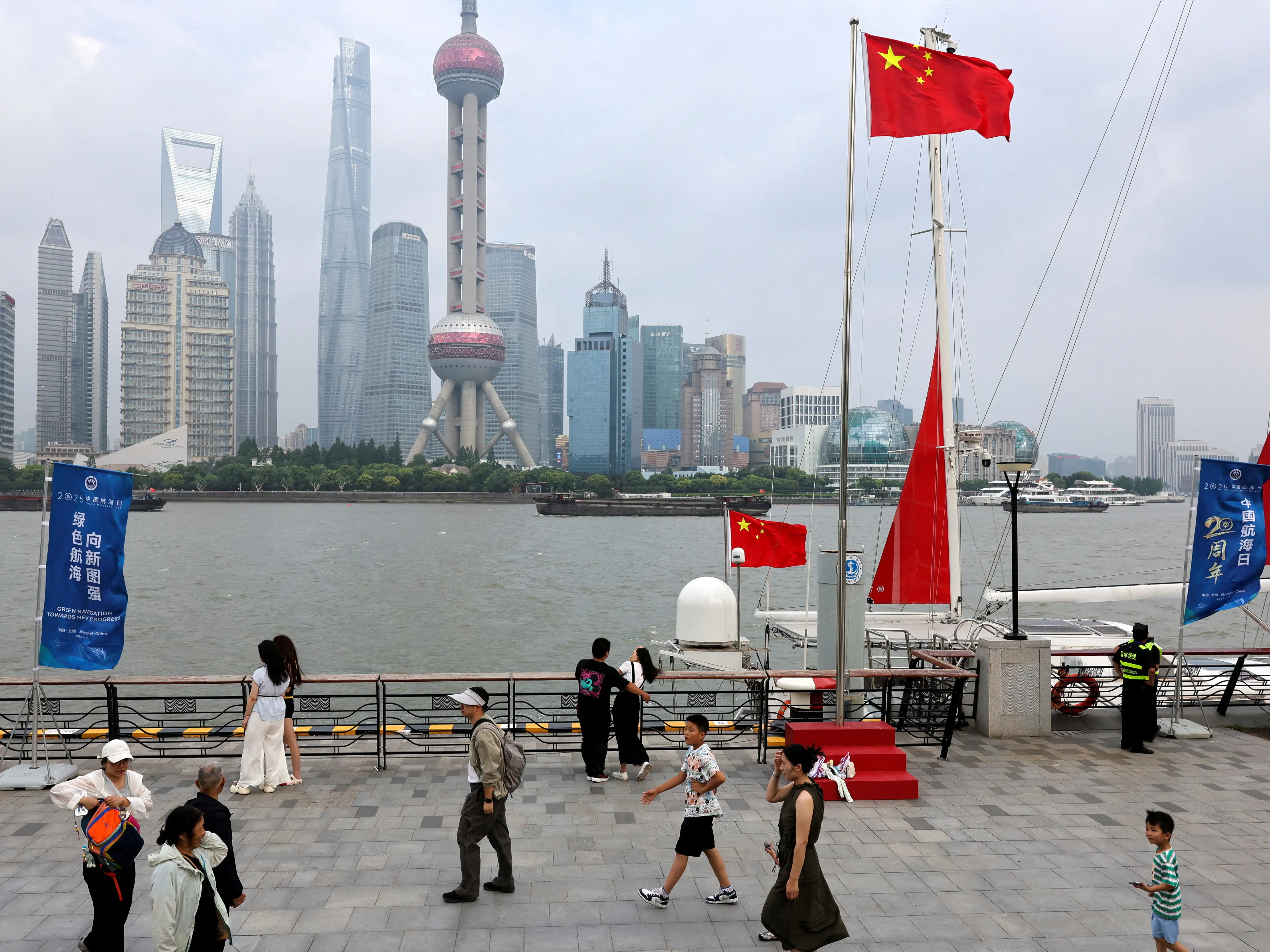
China’s economy grew faster than expected in the second quarter of 2025, offering a show of resilience in the face of mounting US tariff threats. But despite beating forecasts, the data points to a slowing economy that faces deep-seated challenges, with analysts warning of deflationary pressures and flagging consumer confidence.
According to data released on Tuesday by China’s National Bureau of Statistics and cited by Reuters, gross domestic product expanded by 5.2 per cent year-on-year between April and June. While this was a slowdown from the 5.4 per cent growth seen in the first quarter, it narrowly surpassed the 5.1 per cent median forecast in a Reuters poll.
Economists say the better-than-expected growth offers Beijing a short-term cushion against a more severe slowdown. Zhiwei Zhang, chief economist at Pinpoint Asset Management, told Reuters the second-quarter growth was partly due to the front-loading of exports ahead of looming tariff deadlines. “The above-target growth in Q1 and Q2 give the government room to tolerate some slowdown in the second half of the year,” Zhang added.
Quarterly momentum slows, stimulus bets rise
On a quarter-on-quarter basis, China’s GDP rose 1.1 per cent in April-June, slowing slightly from a 1.2 per cent expansion in Q1 but ahead of expectations for a 0.9 per cent increase, as per Reuters.
This solid start to the year has emboldened Beijing to stick with its official full-year growth target of around 5 per cent, though policymakers are preparing contingency plans as risks mount. A high-stakes Politburo meeting scheduled for late July is widely expected to chart the country’s economic policy for the rest of 2025.
Trending Stories
&imwidth=180&imheight=135&format=webp&quality=medium)
'I ended 8 wars': Trump slams Nobel Peace prize decision, claims award was his due
&imwidth=180&imheight=135&format=webp&quality=medium)
Adéla gives KATSEYE’s Lara Raj and Megan Skendiel a shout-out at Fonda Theatre in LA
&imwidth=180&imheight=135&format=webp&quality=medium)
SC questions closure of 57 Delhi Metro stations, asks Centre to resume services in regulated manner
&imwidth=180&imheight=135&format=webp&quality=medium)
Why was CJP founder Abhijeet Dipke detained? What Delhi Police said
&im=FitAndFill=(700,400)&imwidth=180&imheight=135&format=webp&quality=medium)
Rakul Preet Singh birthday special: 7 times the Ramayana actress served glamorous looks
&imwidth=180&imheight=135&format=webp&quality=medium)
Flydubai co-pilot developed extremist views while studying in Australia: UAE prosecutors
&imwidth=180&imheight=135&format=webp&quality=medium)
'I am not going to be watching it': JD Vance on livestream of Nidal Hasan's firing squad execution
&imwidth=180&imheight=135&format=webp&quality=medium)
'Ouch!!! That must hurt': Kangana Ranaut hails Kamal Haasan's sharp reply to Elon Musk over Starlink row
&im=FitAndFill=(700,400)&imwidth=180&imheight=135&format=webp&quality=medium)
Happy Birthday Rekha: Watch these 7 evergreen Bollywood hits on Netflix, Prime Video and more
&imwidth=180&imheight=135&format=webp&quality=medium)
Delhi on high alert for CJP protest: Delhi police to use body cams to 'prove whether we did anything’; Pink Force, RAF, 35,000 personnel deployed
&imwidth=180&imheight=135&format=webp&quality=medium)
TCS leads tech gains, lifts market sentiment
&imwidth=180&imheight=135&format=webp&quality=medium)
All 22 Indian seafarers safe in attack on Panama-flagged tanker off UAE coast
&imwidth=180&imheight=135&format=webp&quality=medium)
Dhurandhar: The Revenge album submitted for Grammy consideration; But what does it mean?
&imwidth=180&imheight=135&format=webp&quality=medium)
'Modi is a dictator': Abhijeet Dipke claims govt 'scared' of youth, slams stringent measures ahead of CJP Jantar Mantar protest
&imwidth=180&imheight=135&format=webp&quality=medium)
Thai queen becomes first reigning monarch to fly jet solothailand #queen #wion
&imwidth=180&imheight=135&format=webp&quality=medium)
J&K Government orders major police reshuffle, transfers 100 officers across UT
&imwidth=180&imheight=135&format=webp&quality=medium)
Ryan Reynolds’ private messages reveal his blunt views on Justin Baldoni from Blake Lively’s legal case
&imwidth=180&imheight=135&format=webp&quality=medium)
‘Right to protest must be protected, but...’: Delhi Police reveals why it denied CJP permission for October 10 Jantar Mantar protest
&imwidth=180&imheight=135&format=webp&quality=medium)
Delhi protest: Metro curbs, train cancellations, traffic diversions as protesters seek CEC Gyanesh Kumar’s resignation

Kamal Haasan slams Elon Musk over Starlink delay row: 'Indian people, will decide our own future - not Western'
&imwidth=180&imheight=135&format=webp&quality=medium)
Trump honours Microsoft CEO Satya Nadella with top technology honour amid immigration scrutiny
&imwidth=180&imheight=135&format=webp&quality=medium)
Trump announces Russian diesel deal as Zelensky criticises move
&imwidth=180&imheight=135&format=webp&quality=medium)
New York protests erupt as Trump administration defends ICE shooting
&imwidth=180&imheight=135&format=webp&quality=medium)
‘250? Cool.’: Shai Hope takes swipe at Shubman Gill’s Instagram caption after Ranchi T20I masterclass
&imwidth=180&imheight=135&format=webp&quality=medium)
Two-thirds of competitive GOP candidates split with trump ahead of November midterms
&im=FitAndFill=(700,400)&imwidth=180&imheight=135&format=webp&quality=medium)
Food shortages, suicide attempts and more: USS Abraham Lincoln returns to US after 321 day deployment — What happened aboard the US carrier?
&imwidth=180&imheight=135&format=webp&quality=medium)
‘Never-ending flow of cheap labour’: JD Vance hits back at Indian-origin Congresswoman over US green card curbs for major tech companies
&imwidth=180&imheight=135&format=webp&quality=medium)
'Spent Rs 2,000 cr to elect Trump': Elon Musk bought US President's loyalty by writing the biggest political cheque in human history
&imwidth=180&imheight=135&format=webp&quality=medium)
'Even Indira Gandhi didn't do this': Abhijeet Dipke, Saurav Das and Ashutosh Ranka detained from inside their flight | Watch video
&imwidth=180&imheight=135&format=webp&quality=medium)
Shreyas Iyer blames dew for West Indies' record run chase in 2nd T20I in Ranchi
&imwidth=180&imheight=135&format=webp&quality=medium)
Powerful 7.7 magnitude earthquake strikes Panama, tsunami warning issued
&imwidth=180&imheight=135&format=webp&quality=medium)
Ella Langley’s Oklahoma show abruptly cancelled over safety concerns after threat report
&imwidth=180&imheight=135&format=webp&quality=medium)
UK navy hit by espionage scandal: Sailor accused of spying for Russia | Gravitas
&im=FitAndFill=(700,400)&imwidth=180&imheight=135&format=webp&quality=medium)
New Friday OTT releases (October 9, 2026): Reporting Live, Animals, Take Charge of My Heart- 6 new titles coming on Netflix, JioHotstar and more
&imwidth=180&imheight=135&format=webp&quality=medium)
'Jantar Mantar not the story of India': BJP's Sambit Patra claims 'anarchists' tried to hold Delhi captive
&imwidth=180&imheight=135&format=webp&quality=medium)
Rahul Gandhi calls Modi, Shah ‘cowards’ amid CJP protest crackdown in Delhi
&imwidth=180&imheight=135&format=webp&quality=medium)
100,000 strikes in 3 years: How October 7 redefined Israel's war
&imwidth=180&imheight=135&format=webp&quality=medium)
Katie Zacharia likely to succeed Karoline Leavitt as Trump's White House press secretary
&imwidth=180&imheight=135&format=webp&quality=medium)
Pakistan denies reports of PAF jets being used in attacks against Iran-backed Houthis in Yemen
&imwidth=180&imheight=135&format=webp&quality=medium)
Panama president declares ‘major disaster’ after powerful 7.7-magnitude earthquake; over 80 aftershocks recorded
In response to slowing momentum and tariff threats from US President Donald Trump, Beijing has already stepped-up policy support. According to Reuters, the government has increased infrastructure spending, expanded consumer subsidies, and the central bank cut interest rates in May while injecting liquidity into the financial system.
Analysts expect further monetary easing in the coming months. Some even predict an increase in deficit spending if the economy slows sharply in the second half of the year.
Structural headwinds persist
Despite the headline GDP beat, many analysts see worrying signs beneath the surface. According to Reuters, producer prices fell in June at their fastest pace in nearly two years, underscoring entrenched deflationary pressures in China’s industrial sector.
Zichun Huang, China economist at Capital Economics, argued the GDP data “probably still overstate the strength of growth,” warning that the effect of current fiscal support may soon fade. “With exports set to slow and the tailwind from fiscal support on course to fade, growth is likely to slow further during the second half of this year,” Huang told Reuters.
Indeed, a Reuters poll projects China’s GDP growth to decelerate to 4.5 per cent in the third quarter and 4.0 per cent in the fourth, reflecting deepening challenges from the trade war and domestic weakness. Looking further ahead, the same poll forecasts growth to slip to 4.6 per cent in 2025, below Beijing’s target, and to ease further to 4.2 per cent in 2026.
Mixed activity data underscores fragile recovery
Official June activity data released on Tuesday painted a mixed picture. As per Reuters, industrial output rose 6.8 per cent year-on-year, accelerating from 5.8 per cent in May and beating forecasts. But retail sales growth lost steam, suggesting that consumer sentiment remains subdued.
Meanwhile, fixed-asset investment grew 2.8 per cent in the first half of 2025 compared to the same period last year, slowing from 3.7 per cent in January-May and missing analysts’ forecast of 3.6 per cent.
One of the most persistent drags on the economy remains the property sector. Investment in real estate fell 11.2 per cent year-on-year in the first six months, worsening from a 10.7 per cent decline in January-May. Separate data also showed new home prices in June fell at their fastest monthly pace in eight months, highlighting the difficulty Beijing faces in reviving demand despite multiple rounds of support measures.
Trade truce offers only temporary relief
Exports showed some resilience in June as factories rushed to ship goods under a fragile trade truce with the United States. But this is seen as temporary, with risks of renewed tariff escalation after an August deadline. As per Reuters, both sides have so far avoided the sharpest trade blows through short-term deals, but tensions remain high, leaving China’s export outlook highly uncertain.
For Beijing, the challenge is to rebalance the economy away from its heavy dependence on investment and exports, and to unlock stronger consumer spending despite households’ caution during an era of slowing growth and geopolitical risk.