
&imwidth=800&imheight=600&format=webp&quality=medium "BYD leads aggressive discounting shakes China’s auto market amid fears of industry meltdown")
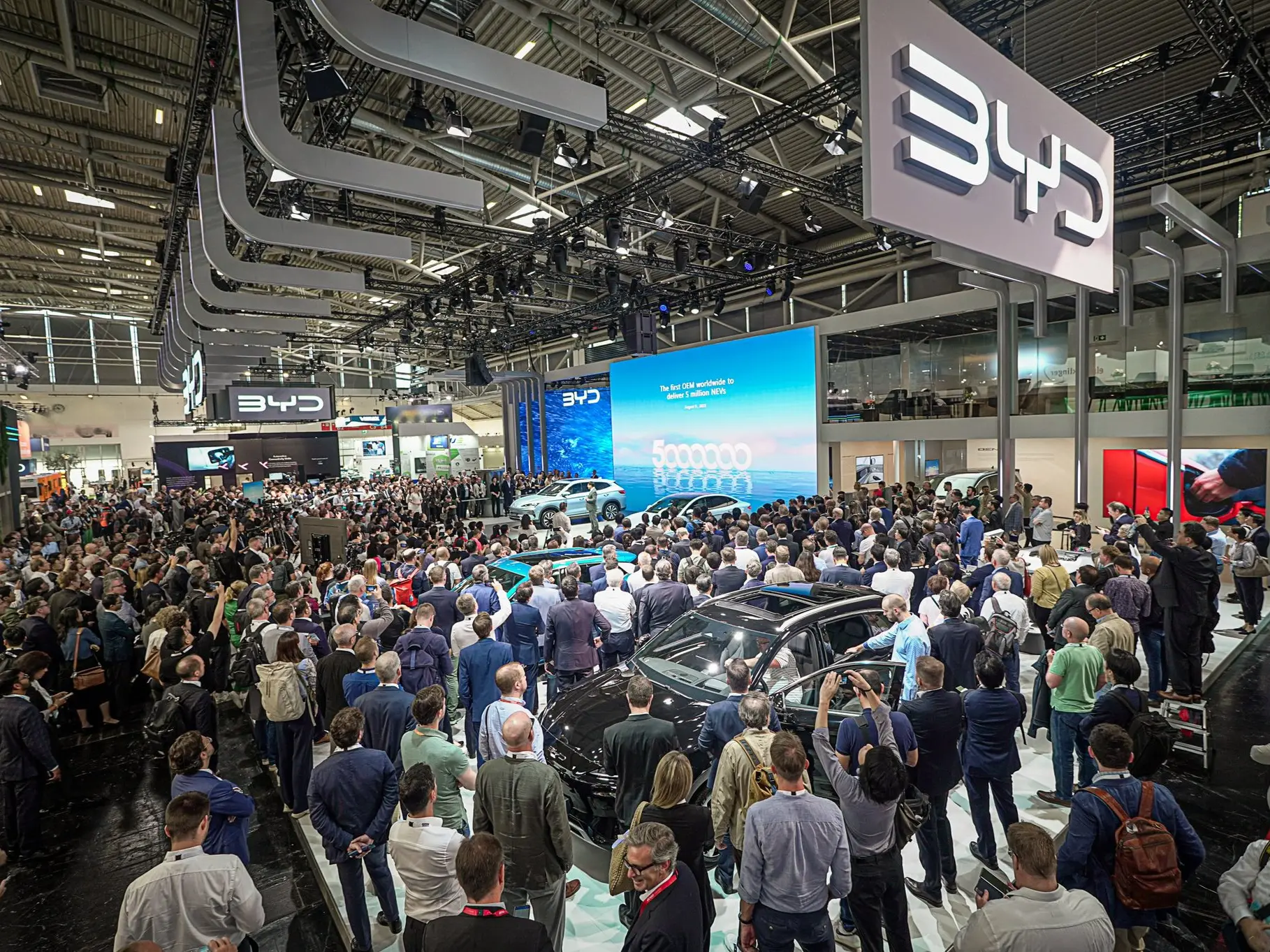
China’s electric vehicle (EV) industry is spiralling into a new phase of disruption as a brutal price war, led by market giant BYD Co., forces automakers into unsustainable discounting strategies.
Despite surging vehicle sales, the industry faces a sobering reality: profits are thinning, weaker players are folding, and Beijing is stepping in to curb what it now calls “rat race competition”.
BYD delivered nearly 382,500 vehicles in May, its best monthly performance of the year, yet the company’s stock continues to plunge. In just the past week, its Hong Kong-listed shares dropped another 5 per cent, following a steeper 15 per cent decline earlier.

The paradox of rising sales and falling share prices highlights the mounting strain from relentless discounting that has gripped China’s EV sector over the past two years.
Other major EV players, including Xpeng, Geely, and Leapmotor, are slashing prices in a bid to stay relevant. Price cuts across various models have reached up to 34 per cent, with compact models like BYD’s Seagull now retailing for as little as 55,800 yuan ($7,750).
The broadening scope of price reductions is beginning to mirror the intensity of earlier price wars in China’s overheated real estate market, an ominous parallel noted by several industry veterans.
Trending Stories
)
US Supreme Court backs Trump administration's use of SAVE database to check voter citizenship
)
Exclusive | 'We always want to improve': Suruchi, Kamaljeet after winning Asian Games gold
)
WATCH | As Shehbaz Sharif claims Pakistan’s ‘victory’ during 2025 conflict, Indian diplomat R Srinivas laughs at UN
)
10,000 gather in support of 87-year-old forcefully evicted from home of 71 years
)
Nigeria Navy moves to boost oil security, tackle crude theft and infrastructure threats
)
Saudi Arabia, Turkey and Pakistan to hold urgent military talks amid intensifying Houthi attacks
)
Bollywood mourns Mushtaq Khan: Sunny Deol, Rajpal Yadav and others pay tribute
)
Army chief reviews operational preparedness along LoC, visits mega eye camp in Tangdhar
)
Pentagon quietly adds 37 wounded troops to Iran war tally without explaining when or how
&im=FitAndFill=(700,400))
New Friday OTT releases (September 25, 2026): Don’t Be Shy, Hunkkaar: The Roar, Mango Pachcha- 6 movies and TV shows on Netflix, Prime Video and more
)
Ex-Liverpool forward Mohamed Salah banned from driving in United Kingdom for six months
)
India-New Zealand FTA is ‘an expression of trust’, NZ High Commissioner Patrick John Rata says
)
Watch: PM Modi joins Bhajan Clubbing event in Delhi on Deendayal Upadhyaya's birth anniversary
)
Scientists detect first radio signals directly from faraway planet
)
'We do not wish to continue. It's America that must choose': Iran president Pezeshkian calls on US to end war
)
99.9% more powerful - Scientists find boy who can recall memories from just 3 months of age
)
'A terrorist country is asking me that question?': Jaishankar hits back at Pakistani journalist at UN; flags attacks on commercial shipping
)
Red Sea crisis: Houthis promise not to target European ships; UNSC condemns Saudi attacks
)
'Blockbuster' nor'easter develops an eye similar to hurricanes as warnings are issued
)
Meet Adrian Abraham: 9-year-old Indian-origin guitar prodigy aiming for a Guinness World Record
)
Myanmar training camp case: US national, 6 Ukrainians allowed to meet their families abroad
)
'Making history': Xi Jinping praises Trump as US-China leaders dine at White House
)
Bias or safety concerns? Bengaluru CEO says firm will not hire men from UP, Bihar, Rajasthan, MP. Here's why
)
‘Not just a local tragedy’: Nepal PM Shah warns UN of growing climate threat, says Nepal floods were 'a warning to the world'
)
Beijing to Washington! Ivanka Trump makes a style statement in Chinese designer Guo Pei for President Xi Jinping’s White House welcome
)
Trump-Xi summit wrap: Big pageantry, Iran talks, few major developments and more meetings planned
)
‘It is all possible’: Putin weighs next steps on Ukraine talks, rules out Europe conflict
)
US court backs Pentagon's decision to exclude Anthropic over Claude AI restrictions
)
'FIRST LOOK from inside Noah’s Ark': Researchers share video from inside mysterious mound in Turkey
&im=FitAndFill=(700,400))
‘Absolutely savage, sickening’: Zelensky slams Russia as daytime strikes kill 5 in Kyiv
)
'What kind of confession is this?': Pakistan PM Shehbaz Sharif’s 'terrorists would be roaming New York' remark goes viral, raises alarm online. Watch
)
Tesla is preparing something big for Optimus: new Gen 3 models surface in app
)
Outrage erupts after 3-year-old is married to 60-year-old man in Pakistan, link to her sister's murder being probed
)
OpenAI AI Agents hacked 4 websites before Hugging Face, researchers reveal
)
‘Attack on Mecca a red line for Pakistan’: Shehbaz Sharif warns Houthis at UN
While Chinese consumers initially benefitted from more affordable electric cars, the long-term risks are becoming more visible. Frequent and unpredictable pricing has begun to erode consumer trust, with many buyers hesitating in anticipation of further price cuts. Dealerships in several provinces have already gone under, and concerns are mounting over deteriorating service quality and thinning after-sales support.
Mounting overcapacity and shrinking margins
A key driver of the ongoing crisis is massive overcapacity. China’s EV makers are collectively operating at under 50 per cent production capacity, with too many players chasing too few consumers in a saturated domestic market.
Although the number of new energy vehicle (NEV) manufacturers has begun to shrink—2024 marked the first year exits outpaced new entrants—the industry remains bloated and fragmented.
Even as Chinese automakers shift their focus to exports to absorb excess production, foreign markets are tightening. The US has effectively shut its doors to Chinese EVs with 100 per cent import tariffs, while Japan and South Korea are reportedly weighing similar measures.
Meanwhile, Europe’s recently imposed tariffs have yet to dent Chinese competitiveness: BYD outsold Tesla in the EU for the first time in April.
Beijing is increasingly concerned. Authorities summoned major automakers to the capital last week, urging them to stop selling vehicles below cost and to avoid irrational pricing.
Regulators also voiced concern about “zero-mileage” cars being sold as second-hand, a tactic used by some companies to inflate sales numbers. Yet this is not the first time policymakers have tried to rein in the sector. A 2023 industry pact to end price wars collapsed within days due to antitrust concerns, and discounting resumed unabated.
Profitability under pressure, even for industry leaders
Despite its dominance, BYD is not immune to the fallout. While the company posted a 49 per cent increase in annual net profit last year, analysts now estimate its true net debt may be far higher than reported—possibly over 323 billion yuan ($45 billion), based on supply chain finance arrangements that have come under scrutiny.
Meanwhile, even well-established brands are being forced into strategic pivots. Geely-backed Zeekr and others are increasingly offering advanced driver-assist features for free, effectively using software to differentiate instead of further lowering prices. However, such moves may not be enough to offset the heavy toll of operating in an environment where margins are being relentlessly compressed.
The average car price in China has fallen nearly 19 per cent over the past two years, with battery-only EVs seeing a 21 per cent drop and hybrids down 27 per cent. This deflationary trend sharply contrasts with rising car prices in markets like the US, where average EV prices now exceed $59,000.
For now, China’s EV industry continues to produce and sell at scale, but the path forward looks increasingly precarious. Without a sustained rebound in consumer demand or meaningful industry consolidation, the sector’s growth may continue to mask deeper structural imbalances. Beijing’s calls for “self-regulation” may not be enough to restore order in a market where scale, price, and survival are tightly intertwined.