World population reaches eight billion today

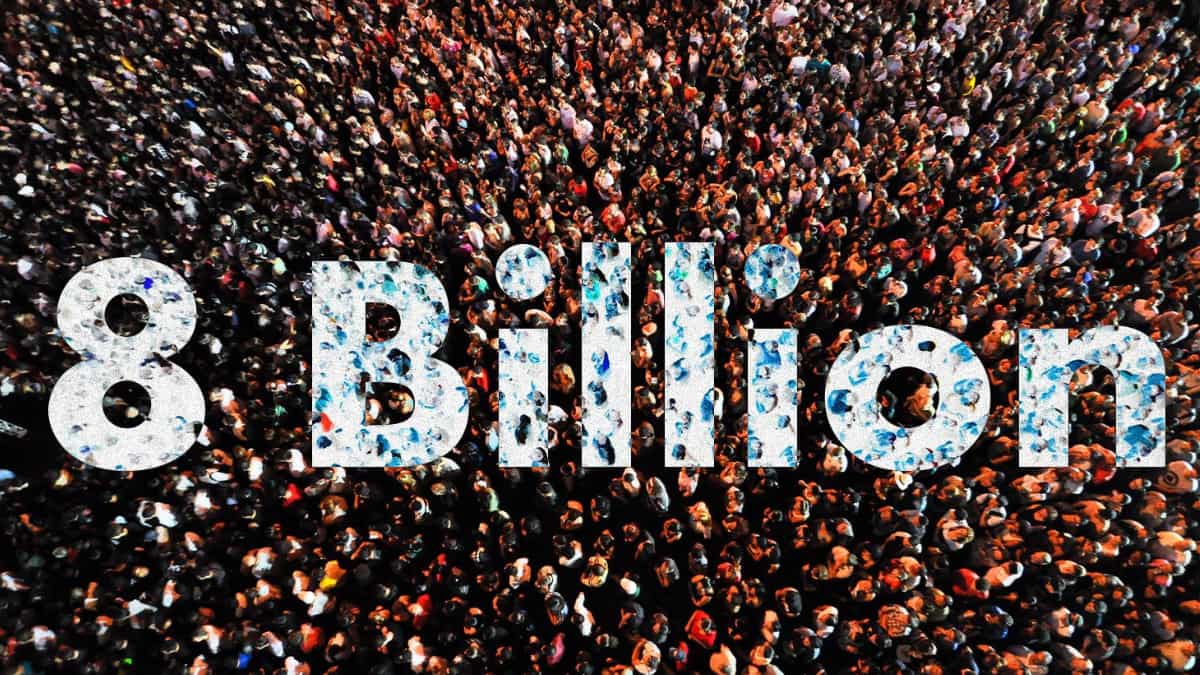
World population reaches 8 billion today
The UN says that the global population has hit eight billion, in just 11 years after crossing the seven billion mark, which is seen as a milestone in human development. The UN has also projected that after the big boom in the second half of the 20th century, population growth will begin to slow down.
The latest estimates by the United Nations show that the global population could grow up to 8.5 billion in 2030, 9.7 billion in 2050, and 10.4 billion in 2100. In its annual World Population Prospects report, the UN mentioned that "The world's population continues to grow, but the pace of growth is slowing down."
Also Read |G20 Summit 2022 in Bali | PM Modi receives traditional welcome in Indonesia

Population growth of any region is based on two factors, declining levels of mortality and life expectancy at birth. Globally, life expectancy has increased and reached 72.8 years in 2019, which is almost a 9-year of increment since 1990.On the other hand, further reductions in mortality will increase life expectancy to an average of 77.2 years globally in 2050.
Life expectancy at birth in males and females is taken into account separately; in 2019, female life expectancy exceeded male expectancy by 5.4 years globally. With female life expectancy standing at 73.8 years and male life expectancy at 68.4 years, female survival advantage is observed across all regions and countries.
The number of 8 billion may look promising but further projections by the UN shows that the global population is gradually slowing down. Though the global population took 12 years to reach 8 billion from 7 billion, it will take approximately 15 years for it to reach 9 billion.
)
800 million years old - Scientists discover 'fingerprints' of supercontinent Gondwana in ancient rocks
)
'He is popular...': Malaysian PM Anwar Ibrahim's praise for PM Modi during bilateral meeting | WATCH
)
BRICS Summit 2026: Consensus on joint declaration, diplomatic win for India
&im=FitAndFill=(700,400))
Why Chinese PL-15 air-to-air missiles use dual-pulse motors compared to European interceptors
&im=FitAndFill=(700,400))
Why do air defence missiles explode near their target instead of hitting it?
)
Why asking questions could be more important than memorising answers
)
Osama Bin Laden ‘planned’ to target India, CIA reveals dozens of declassified documents
)
BRICS Summit 2026: Chinese president Xi Jinping departs from New Delhi after attending BRICS summit
)
Houthis launch cross-border strike on Saudi Arabia as Yemen war escalates
)
Bigg Boss 20: Qazi Touqeer gets a special ‘rockstar’ moment from Salman Khan
)
BRICS Summit 2026: Iran's Pezeshkian praises PM Modi at BRICS
)
Ramanathaswamy temple takes centre stage as PM Modi welcomes world leaders at BRICS
)
BRICS Summit day 1: New Delhi declaration adopted with full consensus, big diplomatic win for India
)
Why does your body need time to adjust after a long journey?
)
PM Modi and China's Xi offered to help resolve Russia-Ukraine war: Kremlin
)
War is making Russia stronger? How Ukraine is shaping Moscow’s next generation of weapons
&im=FitAndFill=(700,400))
Meet top 5 batters fastest to 3000 runs in T20Is
)
Why going digital does not always mean becoming more efficient
)
BRICS Summit 2026: PM Modi addresses Day 2 of 18th BRICS summit
)
BRICS Summit 2026: Global leaders of BRICS nations attend main open session
)
BRICS Summit 2026: PM Modi, Xi reach key consensus on ties, China to assume BRICS chairmanship in 2027
)
Who is the smiling man beside Modi, Putin and Xi at BRICS Summit 2026?
)
From severe mobility problems to recovery: Madhuri the elephant’s journey of wildlife care
)
'Iran won't surrender': Pezeshkian sends blunt message to US while attending BRICS Summit in India
)
BRICS Summit 2026: PM Modi to hold bilateral with leaders of seven countries
)
Why dehydration is the hidden cause of travel fatigue on long flights
)
Why do wild animals need quiet places to survive?
)
IND vs AFG, 1st T20I: When and where to watch live streaming in India?
)
Could staying indoors all day affect your health?
)
‘Partners, not rivals’: Xi outlines four point plan for stronger India-China ties
)
Top 5 places to visit in Goa beyond its famous beaches
)
Trump says Canada eager to reach a deal, it could come ‘fairly soon’ if Ottawa treats US farmers better
)
9-year-old Chennai prodigy clears Cambridge IGCSE grade 10 exams
)
How does the loss of forests affect the way wildlife lives and moves?
)
Did Iran President Pezeshkian touch feet of Hindu spiritual leader at Delhi event as shown in viral video?
)
Humans may lose control of AI: Anthropic CEO calls for slowdown, Altman, Musk back him
)
Why does your skin need protection from UV rays?
The UN has also projected that India will surpass China as the world's most populous country in 2023. It has also been estimated that countries of sub-Saharan Africa are expected to continue to grow through 2100 and will contribute more than half of the global population increase of 2050.
The results ofthe UN report also show that the 46 least developed countries (LDCs) are among the world's fastest-growing unlike Latin America, Europe and Northern America, which are projected to reach their peak and then will begin to decline before 2100.
The effects of COVID-19 have also played a role in affecting components of population change, including fertility, mortality and migration. Global life expectancy at birth fell to 71.0 years in 2021 from 72.8 years in 2019, mostly due to the pandemic.
The COVID-19 pandemic has also affected many data collection processes worldwide, which is why the UN has told countries to give priority to the national censuses, as such data will be critical in development planning and achieving the Sustainable Development Goals (SDGs).
(With inputs from agencies)
WATCH WION LIVE HERE
You can now write for wionews.com and be a part of the community. Share your stories and opinions with us here.