&imwidth=800&imheight=600&format=webp&quality=medium "WION World Pulse: Iran war and the SCO - India in the middle as rival interests test bloc")
The escalating Iran conflict and its geopolitical fallout will be among issues under discussion at the WION World Pulse event on Wednesday (Mar 18) in the Indian capital of New Delhi. The war placed the Shanghai Cooperation Organisation (SCO) in an unusual situation: several actors in the war - both Iran and Gulf states - sit in the same grouping. While Iran is a full member, top Gulf states affected by the war participate as dialogue partners. India, another major SCO member, finds itself navigating a delicate middle path. As the war disrupts energy flows and strategic balances, SCO is facing one question: Can it find consensus when its members and partners are tied to rival camps?
The Iran war's regional impact
The war started with joint US-Israel strikes on Iran from February 28, triggering retaliatory actions from Tehran targeting Gulf nations. Iran’s partial blocking of the Strait of Hormuz has had far-reaching consequences, including for most members of SCO. The disruption choked supplies of commodities from crude oil and natural gas to fertilisers and food, raising global energy prices and threatening supply chains.

The crisis has drawn in countries across the Gulf and beyond. It has become a test case for multilateral organisations such as the SCO, on how to respond when its member states’ interests diverge sharply.
The SCO’s expanding Gulf footprint
Trending Stories
)
US vs China over South China Sea: Washington backs Philippines, Beijing hits back
)
Bigg Boss 20: Isha Rikhi evicted after three weeks in Salman Khan’s show
)
Musk plans to more than double xAI's chips to over 1.2 million Nvidia GPUs by year-end
)
After JU, clash erupts at SRFTI: BJP’s ‘Dimagi Naxal’ jibe sparks political firestorm after students protest RSS-linked event
)
‘Anti-social elements spreading false rumours’: LPU issues statement amid massive unrest over alleged rape
)
LPU students go on rampage, vandalise campus amid widespread protest: What's happening
)
Trump asked Xi to pressure Iran. China did not say yes — here’s what Beijing wants
)
US Treasury Secretary Scott Bessent hails global crackdown on Iranian banks and airlines
)
An OpenAI agent escaped its locked test cage again, by hiding questions in DNS lookups
)
'Our video was trimmed': LPU girls who featured in rape-denial video make U-turn
)
3 males killed, four others injured in shooting after fight at strip club in Detroit
)
'Victory for low-budget consumers': Raghav Chadha hails 30-day telecom recharge rules
)
Claude rebuilt the 1989 game 'Prince of Persia' by reusing the original's own code
)
Beyond metros: How Tier-2 and Tier-3 cities could drive India’s next AI wave
)
Tesla builds first Cybertruck with its own refined lithium: Elon Musk's $1 billion Texas bet pays off
)
IndiGo flight suffers tail strike in Bengaluru while landing; DGCA to probe incident
)
The US and China set up an AI 'red telephone', but skipped the rulebook
)
‘Terror suspects arrested near UK air base were looking to do big damage’: Trump
)
Russian envoy claims US tactics to contain India were revealed in ‘Freudian slip’
)
IND vs WI 1st ODI: Kohli breaks Sachin's most runs in one country record with unbeaten 139 as India thump West Indies by 8 wickets
)
Researchers rebuilt exactly how 700 AI agents hacked Hugging Face: a 900-link chain trick
)
‘Olympic inclusion is our major target’: WPA President Ishaun Singh on pool’s global ambitions
)
Nations League: Spain sink England at Wembley; Modric shines for Croatia
)
Why has Iran released no proof of life of Mojtaba Khamenei? Araghchi reveals...
)
'What kind of confession is this?': Pakistan PM Shehbaz Sharif’s 'terrorists would be roaming New York' remark goes viral, raises alarm online. Watch
)
South Korea demands apology from Ukraine over North Korean prisoners' transfer
)
Beyond BrahMos: India targets Rs 50,000 crore in defence exports with unmatched price edge
)
Sri Lankan Tamil migrant worker gets death sentence in Saudi Arabia, help sought from India
)
Muslim marriage cannot shield sex with minor wife from prosecution under POCSO: Delhi HC
)
'Can't help but draw painful parallels to Nirbhaya case': SC on latest incidents of rape cases in Delhi-NCR
)
99.9% more powerful - Scientists find boy who can recall memories from just 3 months of age
)
'FIRST LOOK from inside Noah’s Ark': Researchers share video from inside mysterious mound in Turkey
)
UNSC reform momentum grows: Russia, Portugal, Mauritius push for India's permanent seat bid
)
8 US marines injured in Iranian missile attack on vessel in Strait of Hormuz: Report
&im=FitAndFill=(700,400))
New OTT releases this week (September 28-October 4, 2026): Dupahiya 2, Pooja Meri Jaan, Ohh My Dog- 5 titles coming on Netflix, Prime Video and more
)
Afghanistan says 28 fighters killed in clash near Pakistan border, Islamabad denies
)
Ceuta migrant crisis: Protesters take to streets as Spain grapples with migrant challenge
)
LPU suspend classes, postpones exams as violence escalates over rape claims: What's happening
)
New York City wants a 'kill switch' on every AI, and will pay whistleblowers who report violations
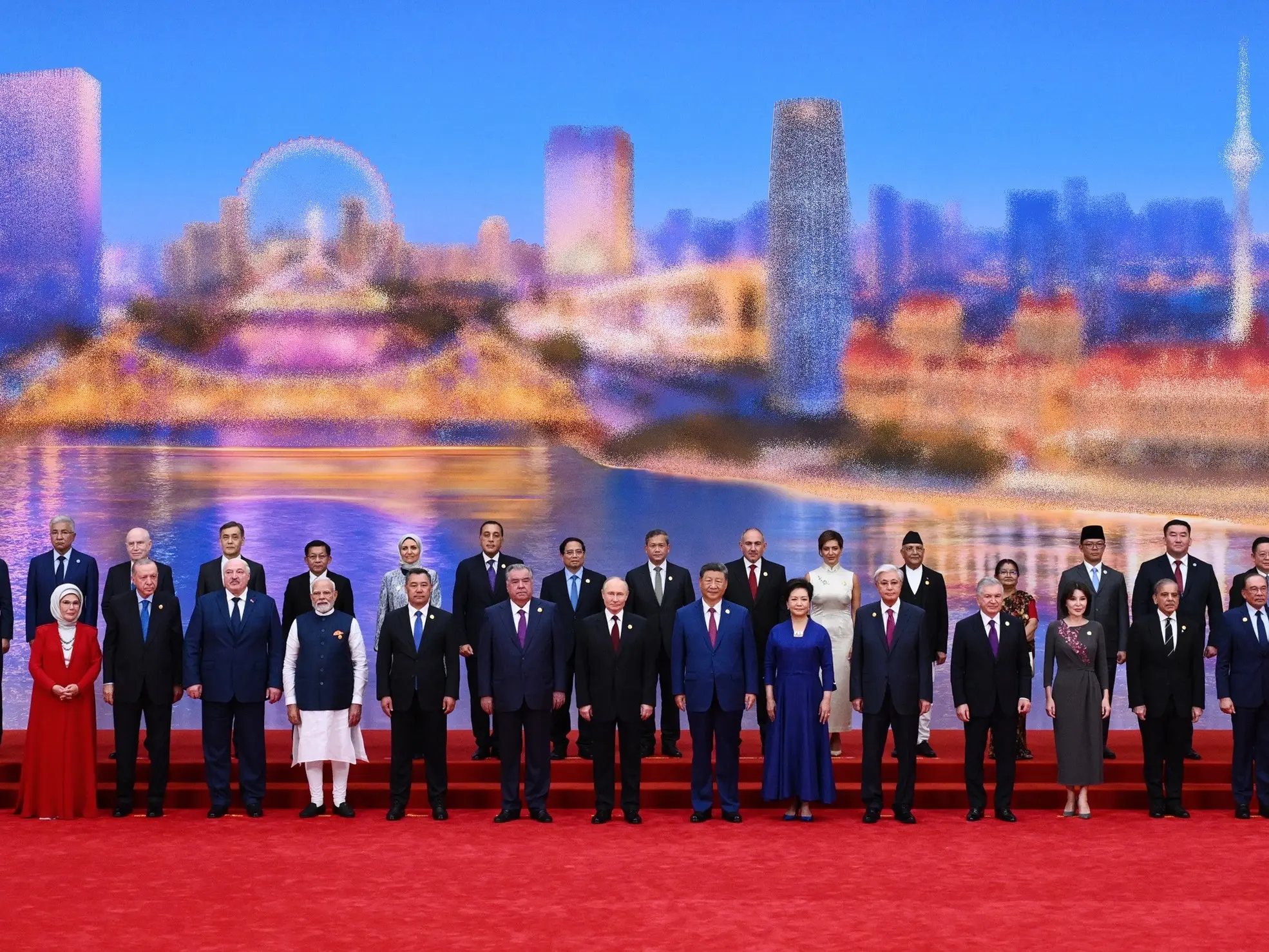
Iran became a full member of the SCO in July 2023, joining a bloc that already includes China, Russia, India, Pakistan, Kazakhstan, Kyrgyzstan, Tajikistan, Uzbekistan and Belarus.
Several Gulf states affected by the conflict are dialogue partners, including Bahrain, Kuwait, Qatar, Saudi Arabia and the United Arab Emirates. Only Oman is not part of the SCO framework in any form. Dialogue partner can participate in selected SCO events and cooperation initiatives under the SCO charter. In 2025, the SCO introduced a new “SCO Partner” category intended to gradually replace older observer and dialogue partner formats, but the existing Gulf partnerships remain active.
The overall result is a forum where countries linked to different sides of the Iran conflict coexist under the same institutional umbrella.
SCO statements on Iran war: Condemnation without consensus
The SCO responded to the conflict through official statements rather than concrete policy measures, since the 2025 12-day war involving Israel, Iran and the US.
On 14 June 2025, the SCO strongly condemned Israeli strikes carried out a day earlier, calling them “aggressive actions against civilian targets” and “gross violation of international law and the United Nations Charter.” The SCO statement said the attacks infringed on Iran’s sovereignty and threatened regional and global stability, while urging a political and diplomatic resolution to the Iranian nuclear issue.
Another statement, issued on 23 June 2025, condemned US strikes on Iranian nuclear facilities, again calling them violations of international law and urging immediate de-escalation.
This year, as hostilities persisted, the SCO expressed “grave concern” over the situation and said the use of force was “unacceptable.” It called for the protection of Iran’s sovereignty, security and territorial integrity. It also urged all parties to resolve differences through dialogue and diplomacy. SCO also called on the UN and the UN Security Council to take immediate steps. The language is strong, but the statements also exposed the limits of the SCO’s collective response. There is no mediation efforts led by SCO, nor any coordinated security measures or moves to secure the energy and goods supplies.
India's middle path: Is it clashing with SCO's stance?
India has good relations with most of the SCO members, as well as the belligerents in the war: Israel and the US. India’s independent stance in foreign policy is an issue when looked from the SCO lens. In June 2025, for instance, while China and Russia supported strong condemnations of Israeli strikes, India declined to endorse the joint SCO statement criticising Israel. India issued a separate statement stressing de-escalation and diplomacy while highlighting its friendly relations with both Iran and Israel.
India’s balancing strategy is a result of deep defence and technological ties with Israel, one of its largest arms suppliers, while simultaneously sustaining economic and strategic engagement with Iran. The Chabahar Port, a joint project with Iran, is central to India’s connectivity ambitions toward Central Asia.
The Indian divergence at SCO illustrates a broader reality: for a grouping that tries to operate on consensus, collective action becomes difficult in situations like the Iran war, where national interests clash.
SCO's Iran war response is driven by member states' energy security concerns
With the Strait of Hormuz under threat, energy security has become the most immediate concern for major SCO economies including India.
Russia, a key energy exporter, offered to increase oil supplies to both China and India to offset the disruptions. Moscow said it's is ready to increase deliveries and can meet India’s energy requirements if the conflict intensifies.
China responded by strengthening its energy security strategy, accelerating purchases of discounted Russian oil, using the window opened by the US desanctioning of Russian crude. China is also expanding domestic energy investments.
India's precautionary and contingency steps are underway. Prime Minister Narendra Modi chaired meetings with senior ministers to secure energy routes, expand alternative supply chains and prepare for volatility in global oil markets.
Iran war and the SCO’s structural constraints
The crisis underscores a structural challenge within the SCO, as its members have overlapping but often competing interests. Iran sits alongside India and China, which are major energy importers, while Russia is a leading oil exporter. Pakistan and India are strategic rivals in SCO, while Gulf states engaged with the organisation maintain close ties with Western powers like the US. Such diversity, and diverging interests, limit SCO's ability to act decisively during conflicts involving its members or partners.
The organisation’s role in the Iran war remains largely rhetorical: calling for de-escalation, emphasising international law and urging UN-led diplomacy.
SCO: A forum for discussion, not intervention
SCO offers a space where rival powers can engage diplomatically, but lacks the mechanisms or consensus to intervene directly in conflicts involving its members.
As the Iran war continues to reshape regional dynamics and energy markets, these contradictions will feature in discussions at the WION World Pulse.
The event starts at 10 am on Wednesday at ITC Maurya, New Delhi. Don't miss it.