WION Exclusive: Hasina says she reads father’s unfinished memoir while planning Dhaka return

&imwidth=600&imheight=450&format=webp&quality=medium "WION Exclusive: Hasina says she reads father’s unfinished memoir while planning Dhaka return")
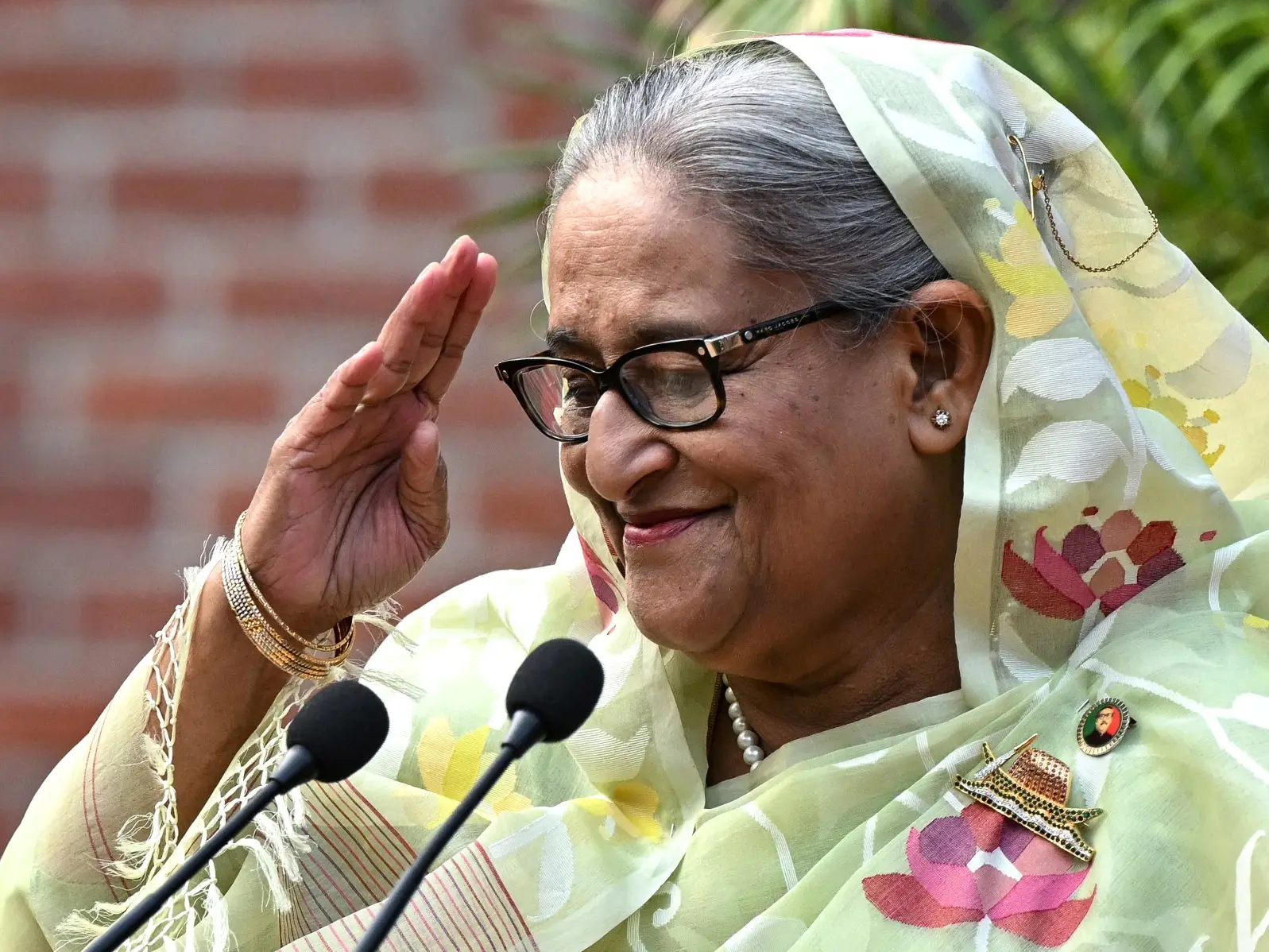
Sheikh Hasina Photograph: (AFP)
In a written interview with WION's Sidhant Sibal, the former Bangladesh prime minister said life away from the country ‘is never easy’ and that Bangladesh is in her thoughts ‘every moment’
Far from Dhaka, Sheikh Hasina describes a quieter routine than the one that defined fifteen years in power: newspapers from home, political briefings, and long hours with the books her father left behind. In a written interview with WION's Sidhant Sibal, the former Bangladesh prime minister said life away from the country ‘is never easy’ and that Bangladesh is in her thoughts ‘every moment’. She follows Bangladeshi and international media, economic reports and analysis, and stays in contact with people who, she says, know the situation on the ground.
Reading, she insisted, is not an escape. Among the books closest to her are Bangabandhur Osomapto Attojiboni, Sheikh Mujibur Rahman’s unfinished autobiography, and Karagarer Rojnamcha, his prison diaries. “These writings are not only personal documents,” she said. “They are records of struggle, sacrifice, patience and faith in the people. They remind us why Bangladesh was created.” The interview also returns to a private geography of grief. After the 1975 assassination of her father and most of her family, India gave her “safety, shelter and human kindness”. Nizamuddin Dargah in Delhi, she said, has “a very special place” in her memory. She goes there, when she does, “as a human being, as a daughter who lost her family, and as someone who seeks strength through prayer”, not for politics. Asked whether she would visit the shrine again before any homecoming, she offered no comment.
The former Bangladesh PM plans to return to her country in December, as she has a ‘responsibility to my people and to millions of Awami League supporters who have been deprived of their political voice’.
Sidhant Sibal: You are planning a political comeback from exile. How will it happen? Is December confirmed, that you will be back in your country?
Sheikh Hasina: Bangladesh is passing through a grave national crisis. Democratic space has been closed. The judiciary is being used for political revenge. Media freedom has been restricted. Law and order have weakened. Minorities feel unsafe. Extremist forces have regained space. The economy has suffered. Factories have closed, unemployment has risen, investment has fallen, prices are hurting ordinary families, and electricity and gas shortages have returned. I do not see my return as a personal political comeback. I see it as part of a larger struggle to restore democracy, constitutional government, and the right of the people of Bangladesh to choose their government freely. My intention is clear. I want to return to my homeland because I have a responsibility to my people and to millions of Awami League supporters who have been deprived of their political voice. But we are not yet at the stage of announcing a specific date, time, or point of entry. Such a decision is not only political. It also involves security, organisation, and the safety of people on the ground.
Sidhant Sibal: If you go back, do you think your life will be under threat?
Trending Stories
&imwidth=280&imheight=210&format=webp&quality=medium)
&imwidth=280&imheight=210&format=webp&quality=medium)
&imwidth=280&imheight=210&format=webp&quality=medium)
&im=FitAndFill=(700,400)&imwidth=280&imheight=210&format=webp&quality=medium)
&imwidth=280&imheight=210&format=webp&quality=medium)
&imwidth=280&imheight=210&format=webp&quality=medium)
&imwidth=280&imheight=210&format=webp&quality=medium)
&imwidth=280&imheight=210&format=webp&quality=medium)
&imwidth=280&imheight=210&format=webp&quality=medium)
&imwidth=280&imheight=210&format=webp&quality=medium)
&imwidth=280&imheight=210&format=webp&quality=medium)
&imwidth=280&imheight=210&format=webp&quality=medium)
&im=FitAndFill=(700,400)&imwidth=280&imheight=210&format=webp&quality=medium)
&imwidth=280&imheight=210&format=webp&quality=medium)
&imwidth=280&imheight=210&format=webp&quality=medium)
&imwidth=280&imheight=210&format=webp&quality=medium)
&imwidth=280&imheight=210&format=webp&quality=medium)
&imwidth=280&imheight=210&format=webp&quality=medium)
&imwidth=280&imheight=210&format=webp&quality=medium)
&imwidth=280&imheight=210&format=webp&quality=medium)
&imwidth=280&imheight=210&format=webp&quality=medium)
&imwidth=280&imheight=210&format=webp&quality=medium)
&imwidth=280&imheight=210&format=webp&quality=medium)
&imwidth=280&imheight=210&format=webp&quality=medium)
&imwidth=280&imheight=210&format=webp&quality=medium)
&imwidth=280&imheight=210&format=webp&quality=medium)
&im=FitAndFill=(700,400)&imwidth=280&imheight=210&format=webp&quality=medium)
&imwidth=280&imheight=210&format=webp&quality=medium)
&im=FitAndFill=(700,400)&imwidth=280&imheight=210&format=webp&quality=medium)
&imwidth=280&imheight=210&format=webp&quality=medium)
&imwidth=280&imheight=210&format=webp&quality=medium)
&imwidth=280&imheight=210&format=webp&quality=medium)
&im=FitAndFill=(700,400)&imwidth=280&imheight=210&format=webp&quality=medium)
&imwidth=280&imheight=210&format=webp&quality=medium)
&imwidth=280&imheight=210&format=webp&quality=medium)
Sheikh Hasina: Yes, I am aware of the risk. But threats to my life are not new. In 1975, I lost my father, my mother, my brothers, and almost my entire family. I survived only because I was abroad. After returning to Bangladesh, I faced military rule, dictatorship, conspiracies, imprisonment, and repeated assassination attempts. There have been at least 19 attempts on my life. The most brutal was the grenade attack on 21 August 2004. It was carried out in broad daylight at my public rally when I was Leader of the Opposition. Twenty-four people were killed and more than three hundred were injured. I myself was injured and lost hearing in one ear. My party leaders and workers formed a human shield around me. Many of them sacrificed their lives to save mine. So personal danger is not new to me. If I had thought only about my own safety, I would never have entered politics. I would never have returned to Bangladesh. I would never have fought dictatorship, terrorism, and conspiracy. But today my concern is not only about myself. I am concerned about ordinary Awami League leaders and workers, journalists, intellectuals, minorities, women, students, cultural activists, and every citizen who is being punished because of political belief. But fear cannot decide my duty. My life has long moved beyond calculations of personal safety. My responsibility is to Bangladesh and to its people.
Sidhant Sibal: You are in India now. How do you spend your time? Do you read books? Any specific books?
Sheikh Hasina: Life away from one’s own country is never easy. Bangladesh is in my thoughts every moment. I follow developments in Bangladesh closely. I read Bangladeshi newspapers, international media, reports, political analysis and economic updates. I remain in contact with people who know the situation on the ground. I also spend time reading. I read history, politics, economics, international affairs and books related to Bangladesh’s Liberation War and democratic struggle. I often return to the writings and speeches of Bangabandhu because his vision for Bangladesh continues to guide me. Among the books closest to me are Bangabandhur Osomapto Attojiboni and Karagarer Rojnamcha. I also read the diaries of the Father of the Nation. These writings are not only personal documents. They are records of struggle, sacrifice, patience and faith in the people. They remind us why Bangladesh was created and what kind of country Bangabandhu wanted to build. For me, reading is not an escape from politics. It is part of preparation. Bangladesh is passing through a very difficult period, and I spend much of my time thinking about how the country can be rescued from political revenge, economic decline, institutional breakdown and extremism.
Sidhant Sibal: Since historic Nizamuddin Dargah has had a historic connection with your family, and it was here you went before going back to Bangladesh in the 1980s, do you visit that place?
Sheikh Hasina: Nizamuddin Dargah has a very special place in my memory and in my family’s history. My relationship with India is not only political. India has been connected with some of the most painful and important moments of my life. After the assassination of my father and most of my family in 1975, India gave me safety, shelter and human kindness at a time of unimaginable grief. I will always remember the compassion of the Indian people during that dark period. Places like Nizamuddin carry spiritual and historical meaning. They are places of prayer, reflection, humility and remembrance. When I visit such a place, I do not go there for politics. I go there as a human being, as a daughter who lost her family, and as someone who seeks strength through prayer. These memories are deeply personal to me.
Sidhant Sibal: And will you go to Nizamuddin Dargah before coming back to Bangladesh in December?
Sheikh Hasina: I have no comment on this at this stage.
Sidhant Sibal: How do you think history will remember you?
Sheikh Hasina: I hope history will remember one simple truth: I believed in the capacity of the people of Bangladesh, and I worked to prove what Bangladesh can achieve. During my five terms as Prime Minister, my central goal was always the welfare of ordinary people. After the 2008 election, during nearly sixteen consecutive years in government, we placed Bangladesh on a strong foundation through long-term planning, disciplined implementation, and people-oriented development. We raised the economy from about 70 billion dollars to about 450 billion dollars. Per capita income increased from 482 dollars to 2,784 dollars. Poverty declined from 41 percent to 18.7 percent, and extreme poverty declined from 25.1 percent to 5.6 percent. Bangladesh achieved developing country status and became recognised as one of the fastest-growing economies in the world. We brought electricity to every citizen. Power generation capacity rose from 3,782 megawatts to more than 28,000 megawatts. We built the Padma Bridge with our own resources. We built Metro Rail, Rooppur Nuclear Power Plant, Matarbari Deep Sea Port, Karnaphuli Tunnel, expressways, Digital Bangladesh, and Bangabandhu Satellite. We established nearly 15,000 community clinics to bring healthcare to people’s doorsteps. We reduced maternal and child mortality. We expanded education, women’s participation, social safety nets, housing for landless families, and support for the poor. We introduced 145 social safety net programmes and brought millions of people under different allowance schemes. We also fought terrorism with zero tolerance. We modernised law enforcement, built counterterrorism capacity, and proved that a Muslim-majority country can fight militancy while protecting faith, secularism, democracy, and pluralism. No government is perfect. My government was not perfect either. There were criticisms and mistakes, and history will judge all of them. But no one can deny that Bangladesh changed. No one can deny that the lives of ordinary people improved. My father believed in the capacity of the Bengali nation. I also believed in my people. We showed the world: yes, Bangladesh can. If Bangladesh becomes a prosperous, democratic, peaceful, secular, and inclusive country, that will be the greatest legacy I could hope for.
Sidhant Sibal: Do you think the Awami League enjoys support in the country?
Sheikh Hasina: Absolutely. The Awami League remains the strongest political force in Bangladesh. It is a historic political organisation rooted in the Language Movement, the Liberation War, and every democratic struggle of Bangladesh. Under the leadership of the Father of the Nation, Bangabandhu Sheikh Mujibur Rahman, this party led the birth of Bangladesh. No ban, false case, death sentence, or political conspiracy can erase it from the hearts of the people. It is rooted in every village, every ward, every union, every district, and every community of Bangladesh. Those who are now occupying power know this very well. That is why they barred the Awami League from political activities. That is why they kept us out of the election. They did not defeat the Awami League at the ballot box. They removed the Awami League before the people could speak. Information from Bangladesh’s own intelligence sources showed that if the Awami League had been allowed to contest the last election, we would have received around 63 percent of the vote. That is why they were afraid. That is why they imposed restrictions, filed false cases, shut down our activities, and staged an election without us. But banning a party does not remove its supporters. Closing party offices does not erase people’s memory. Filing cases does not change people’s experience. People know how to compare. They know what Bangladesh was under the Awami League and what Bangladesh has become now. Under the Awami League, there was stability, development, electricity, infrastructure, investment, security, and hope. Now there is fear, unemployment, price rise, terrorism, minority persecution, and institutional collapse. Whenever there is a free, fair, and inclusive election, the Awami League will win an overwhelming majority. I have no doubt about that.
Sidhant Sibal: Who do you think was responsible for the political upheaval in your country in August 2024?
Sheikh Hasina: The events of July and August 2024 cannot be explained simply as a spontaneous student movement. That is an incomplete and misleading picture. At the beginning, there were students with concerns about the quota issue. I have never said that young people should not express their views. My government had already abolished the quota system in 2018. When the High Court later annulled that decision in 2024, my government appealed. We invited students for dialogue. Ministers spoke with them. We accepted reasonable demands. We chose legal process, political engagement, and patience. But what began around a student demand was quickly hijacked by forces whose objective was not quota reform. Their objective was to overthrow an elected Awami League government through street violence and chaos. Muhammad Yunus himself later described the movement as “meticulously designed.” That statement alone shows this was not a simple spontaneous protest. The first death was Sabuj Ali, a Dhaka College activist of Bangladesh Chhatra League, the student wing of the Awami League, who was killed on 16 July. After that, violence was deliberately escalated. Government offices were attacked. Public infrastructure was destroyed. Metro Rail was attacked. Police stations were burned. Weapons were looted. Law enforcement officers were killed, tortured, and even hanged from flyovers. Prisons were attacked and militants escaped. Several forces were responsible: opposition political actors, radical groups, militant elements, and those who wanted to use student emotion as a cover for power seizure. I have also said before that questions about external involvement must be investigated carefully with evidence. But one thing is clear: this was not an ordinary protest movement. It was a coordinated political operation. My government had a responsibility to maintain law and order and protect lives, public property, state institutions, and ordinary citizens. In any country, when police stations are burned, officers are killed, prisons are attacked and weapons are looted, law enforcement must respond according to the situation and within the law. Every loss of life is tragic. That is why, while I was still in office, I formed a Judicial Inquiry Commission on 18 July 2024 headed by Justice Khondker Diliruzzaman of the High Court Division of the Supreme Court of Bangladesh. On 1 August, I expanded it into a three-member commission by adding Justice K.M. Zahid Sarwar and Justice Mohammad Showkat Ali Chowdhury. I wanted the truth to come out. But after 5 August, the illegal interim government stopped that inquiry, gave indemnity to those involved in the violence, and used fabricated narratives to criminalise the Awami League. That tells you who wanted truth and who wanted political revenge. The responsibility for August 2024 lies with those who transformed a student issue into violent regime change, those who planned it, financed it, encouraged it, protected it, and later used it to seize power. Bangladesh needs justice, but justice must come through a credible, independent investigation, not through propaganda and kangaroo trials.
Sidhant Sibal: How do you think history will remember Yunus?
Sheikh Hasina: Power exposed the difference between Muhammad Yunus’s international image and what he did to Bangladesh. After grabbing power through a meticulously designed movement, he did not try to heal Bangladesh. He did not restore democracy. He did not protect citizens. He unleashed mob violence, protected violent actors, and turned revenge into state policy. First, he destroyed Bangladesh’s political culture. Politics became a matter of banning opponents, filing false cases, using the judiciary as a weapon, staging trials, and silencing millions of citizens. The Awami League, the party that led Bangladesh’s Liberation War, was criminalised. Its leaders and workers were killed, jailed, driven into hiding, or buried under fabricated cases. Second, he attacked the history and identity of Bangladesh. Under his watch, the symbols of the Liberation War were destroyed. Freedom fighters were humiliated. The memory of Bangabandhu was targeted. Dhanmondi 32, the historic residence of the Father of the Nation, was attacked and demolished in phases. He spoke of pressing a “reset button.” In reality, that meant trying to erase the Liberation War, erase Bangabandhu, and erase the secular foundation of Bangladesh. Third, he destroyed institutions. Judges were forced to resign under mob pressure. Courts became instruments of revenge. The administration was politicised. Law enforcement was weakened. Media freedom was crushed. Cultural institutions were attacked. Minorities were left exposed. A country we built on secularism and equal citizenship was pushed toward fear and communal politics. Fourth, he opened the door to extremism. Convicted and accused militants were released or allowed to escape. Banned organisations began operating openly. Terrorists who had been kept under control during my government found space again.
At the same time, law enforcement and intelligence officers who fought terrorism were dismissed, jailed, or harassed. Those who protected Bangladesh from terrorism were punished, and those linked to extremism were rewarded. Fifth, his mismanagement damaged public health and cost innocent children their lives. We had almost brought measles to the point of elimination. Our vaccination programme was a global model. But under his administration, vaccine procurement was disrupted, warnings were ignored, and the health system was neglected. More than a thousand children died from a preventable disease because of his administrative failure. That is not an accident. That is a crime against the people. Sixth, he used power for personal protection and institutional benefit. After he came to power, cases against him were removed one after another: his labour conviction, labour-law cases, Anti-Corruption Commission case, personal tax cases, and tax cases involving his Grameen network. Grameen Kalyan’s BDT 666 crore tax liability was removed. Grameen Bank received a five-year tax exemption. The government stake in Grameen Bank was cut from 25 percent to 10 percent, weakening public oversight. Approvals and privileges were rushed for Yunus-linked institutions, including a hospital and medical college project, Grameen University, a digital wallet licence, and manpower export authorisation. His associates and network were placed in sensitive positions. So, what was his so-called revolution? It was not for the people. It was for power, protection, and personal benefit. Look at Bangladesh today. The economy has weakened. Investment has fallen. Factories have closed. Jobs have disappeared. Prices have risen. Law and order have collapsed. Women and children are unsafe. Minorities live in fear. Terror networks are reappearing. The development journey of Bangladesh has been derailed. History will not judge him by his Nobel Prize alone. History will judge him by what he did when he held power. And I believe history will remember Muhammad Yunus as a man who created a fake image of peace abroad but destroyed peace at home; a man who spoke of empowering the poor but used power to protect himself; a man who claimed moral authority but presided over revenge, mob violence, institutional destruction, extremism, and the deaths of children. In the end, people will remember him as a selfish power monger who destroyed a peaceful, rising Bangladesh through meticulous design for his own benefit. Bangladesh will recover. The people will recover their country. But the damage he has done will remain a dark chapter in our history.
