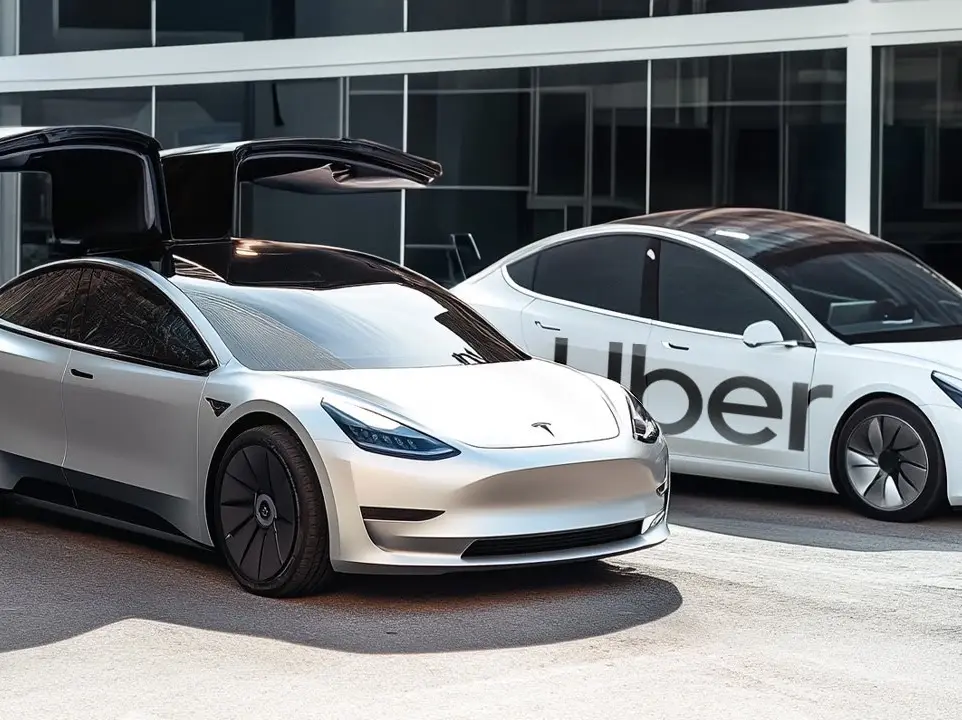
Uber built an empire on not owning cars! It's about to buy 120,000 of them

&imwidth=600&imheight=450&format=webp&quality=medium "Uber built an empire on not owning cars! It's about to buy 120,000 of them")
Uber built an empire on not owning cars! It's about to buy 120,000 of them Photograph: (X)
Uber is committing more than $10 billion to autonomous vehicles — around $7.5 billion to procure robotaxis outright and over $2.5 billion in equity stakes in Lucid, Rivian and others — targeting 120,000 autonomous vehicles and the largest share of global AV trips by 2029. It reverses the asset-light model the company was built on, and arrives alongside a weak profit forecast.
Uber's founding proposition was that a transport company need not own vehicles. Drivers supplied the cars, Uber supplied the software, and the absence of a fleet on the balance sheet was the whole point. That proposition is now being abandoned at a cost of more than $10 billion.
The Commitment
Uber will invest over $10 billion in autonomous vehicles, according to reporting by the Financial Times. Roughly $7.5 billion is allocated to procuring the vehicles themselves, with more than $2.5 billion going into equity investments in Lucid, Rivian and other manufacturers.
The target is 120,000 autonomous vehicles deployed over the coming years, with robotaxis operating in 15 cities. Chief executive Dara Khosrowshahi has said Uber intends to carry the largest share of autonomous vehicle trips globally by 2029.
Why The Model Had To Change
The asset-light structure worked because the marginal cost of adding capacity was borne by drivers. Uber matched supply to demand through pricing and took a cut. It never had to finance a car.
Trending Stories
)
)
)
)
)
)
)
)
)
)
)
)
)
)
)
)
)
)
)
)
)
)
)
)
)
)
)
)
)
)
)
)
)
)
&im=FitAndFill=(700,400))
)
)
)
)
Autonomous vehicles break that arrangement at its foundation. There is no driver to buy the vehicle, insure it, maintain it or absorb its depreciation. Somebody has to own the fleet, and if Uber does not, then whoever does owns the customer relationship — and Uber becomes a booking layer on top of someone else's asset, in a market where the asset is the scarce thing.
Waymo's expanding presence across US cities and Amazon's Zoox scaling its purpose-built vehicles have made that risk concrete. Both operate their own fleets and their own apps. A rider who opens Waymo directly has no reason to open Uber at all.
The Diversification Strategy
Khosrowshahi has been explicit about not wanting dependence on any single autonomous vehicle developer: ‘We want to make sure that we’re not dependent on one partner.' Hence equity stakes across multiple manufacturers rather than an exclusive arrangement with one.
The bet is that autonomous driving technology will eventually commoditise — that several companies will field capable systems, and the durable advantage will belong to whoever aggregates demand across all of them. That is the position Uber already holds with human drivers, and the strategy is to hold it again with machines.
It is a coherent thesis. It is also expensive, and it requires Uber to be right about commoditisation. If one developer establishes a decisive technical lead instead, Uber will have spent $10 billion assembling a fleet built on inferior technology.
The Financial Backdrop
The commitment was disclosed alongside a weak profit outlook, and the two are connected. Capital expenditure on this scale changes what Uber is as a business: from a software platform with high margins and minimal assets, to a capital-intensive fleet operator carrying vehicles, depreciation and financing costs on its own books.
That transition mirrors what is happening across the technology sector this year. Meta's free cash flow fell 91 per cent as AI capital expenditure passed $31 billion in a quarter. Alphabet's went negative. OpenAI has raised projected compute spending to roughly $750 billion through 2030. In each case a company built on software economics is discovering that the next phase requires buying physical infrastructure at a scale the old model never contemplated.
For Uber the physical infrastructure has wheels, and there will be 120,000 of them.
