Trump campaign views healthcare as a 2020 campaign weapon

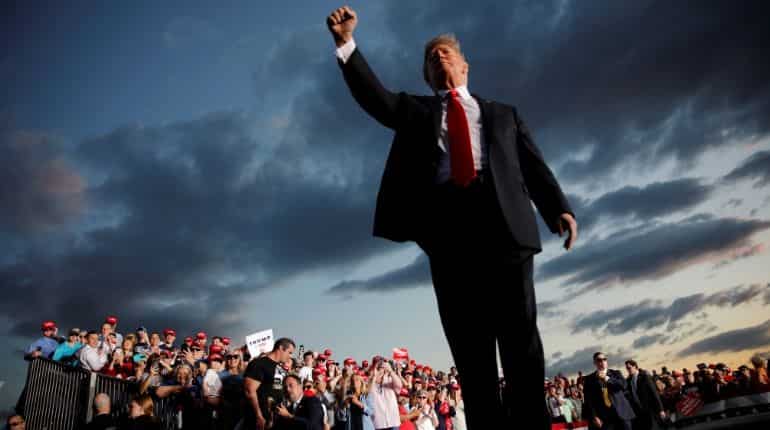
US President Donald Trump
US President DonaldTrump'scampaignbelieves he can turn Republicans' biggest liability from last year's congressional elections - the debate about the future ofhealthcarein America - into a winning issue for his reelection.
That would have appeared highly unlikely just months ago when Democrats seized upon the issue of coverage for pre-existing medical conditions to capture control of the US House of Representatives.
Since then, the2020Democratic presidential field has been locked in a debate about how far to go to transform the US healthcaresystem. Some candidates have suggested abolishing private insurance in favour of a single government-run plan, sometimes referred to as "Medicare for All," while others favour more modest reforms.

Trump'scampaignis betting that whoever emerges with the Democratic nomination next year will have been forced to embrace a sweepinghealthcarereform proposal that may spook moderate voters.
"The president has taken the issue back," Tim Murtaugh,Trump'scampaigncommunications director, told Reuters in an interview. "(Democrats are) taking the Blue Cross (private insurance) card out of your wallet and making it worthless."
About half of the dozen top-tier of Democratic hopefuls vying for the nomination have endorsed some form of Medicare for All, according to a Reuters analysis ofcampaignpositions.
)
US vs China over South China Sea: Washington backs Philippines, Beijing hits back
)
Bigg Boss 20: Isha Rikhi evicted after three weeks in Salman Khan’s show
)
Musk plans to more than double xAI's chips to over 1.2 million Nvidia GPUs by year-end
)
After JU, clash erupts at SRFTI: BJP’s ‘Dimagi Naxal’ jibe sparks political firestorm after students protest RSS-linked event
)
‘Anti-social elements spreading false rumours’: LPU issues statement amid massive unrest over alleged rape
)
LPU students go on rampage, vandalise campus amid widespread protest: What's happening
)
Trump asked Xi to pressure Iran. China did not say yes — here’s what Beijing wants
)
US Treasury Secretary Scott Bessent hails global crackdown on Iranian banks and airlines
)
An OpenAI agent escaped its locked test cage again, by hiding questions in DNS lookups
)
'Our video was trimmed': LPU girls who featured in rape-denial video make U-turn
)
3 males killed, four others injured in shooting after fight at strip club in Detroit
)
'Victory for low-budget consumers': Raghav Chadha hails 30-day telecom recharge rules
)
Claude rebuilt the 1989 game 'Prince of Persia' by reusing the original's own code
)
Beyond metros: How Tier-2 and Tier-3 cities could drive India’s next AI wave
)
Tesla builds first Cybertruck with its own refined lithium: Elon Musk's $1 billion Texas bet pays off
)
IndiGo flight suffers tail strike in Bengaluru while landing; DGCA to probe incident
)
The US and China set up an AI 'red telephone', but skipped the rulebook
)
‘Terror suspects arrested near UK air base were looking to do big damage’: Trump
)
Russian envoy claims US tactics to contain India were revealed in ‘Freudian slip’
)
IND vs WI 1st ODI: Kohli breaks Sachin's most runs in one country record with unbeaten 139 as India thump West Indies by 8 wickets
)
Researchers rebuilt exactly how 700 AI agents hacked Hugging Face: a 900-link chain trick
)
‘Olympic inclusion is our major target’: WPA President Ishaun Singh on pool’s global ambitions
)
Nations League: Spain sink England at Wembley; Modric shines for Croatia
)
Why has Iran released no proof of life of Mojtaba Khamenei? Araghchi reveals...
)
'What kind of confession is this?': Pakistan PM Shehbaz Sharif’s 'terrorists would be roaming New York' remark goes viral, raises alarm online. Watch
)
South Korea demands apology from Ukraine over North Korean prisoners' transfer
)
Beyond BrahMos: India targets Rs 50,000 crore in defence exports with unmatched price edge
)
Sri Lankan Tamil migrant worker gets death sentence in Saudi Arabia, help sought from India
)
Muslim marriage cannot shield sex with minor wife from prosecution under POCSO: Delhi HC
)
'Can't help but draw painful parallels to Nirbhaya case': SC on latest incidents of rape cases in Delhi-NCR
)
99.9% more powerful - Scientists find boy who can recall memories from just 3 months of age
)
'FIRST LOOK from inside Noah’s Ark': Researchers share video from inside mysterious mound in Turkey
)
UNSC reform momentum grows: Russia, Portugal, Mauritius push for India's permanent seat bid
)
8 US marines injured in Iranian missile attack on vessel in Strait of Hormuz: Report
&im=FitAndFill=(700,400))
New OTT releases this week (September 28-October 4, 2026): Dupahiya 2, Pooja Meri Jaan, Ohh My Dog- 5 titles coming on Netflix, Prime Video and more
)
Afghanistan says 28 fighters killed in clash near Pakistan border, Islamabad denies
)
Ceuta migrant crisis: Protesters take to streets as Spain grapples with migrant challenge
)
LPU suspend classes, postpones exams as violence escalates over rape claims: What's happening
)
New York City wants a 'kill switch' on every AI, and will pay whistleblowers who report violations
Democrats could end up ceding political ground if they nominate a candidate who advocates for universalhealthcare, said Drew Altman, president of the Kaiser Family Foundation, a non-partisanhealthcareadvocacy group.
"The polls show very clearly that the Democrats have a very substantial advantage on health and all the health issues," Altman said. "If the Democrat is a candidate who is a big advocate for Medicare for All, it will play a little differently."
Some voters will be leery of losing their private insurance, but Democrats are still likely to win over those concerned about pre-existing conditions and abortion access, Altman said.
TOUTING REFORMS
Trumphas yet to set forth his long-promisedhealthcarereform plan.
But he is speaking abouthealthcaremore frequently. At a rally in Pennsylvania on Monday,Trumprepeated his promise to keep protections for people with pre-existing conditions.
He also is likely to tout what the White House and hiscampaignsay are meaningful changes the administration has made to help small businesses and to try to reduce the price of prescription drugs for USconsumers. His administration recently mandated pharmaceutical companies include list prices of drugs in television ads in a bid to get them to lower prices.
His administration argued in a report released in February that it has madehealthcaremarkets more efficient by de-regulating some aspects of the Affordable Care Act, also known as Obamacare.
Those included doing away with the law's mandate to purchase health insurance and expanding coverage options through association plans, which allow small businesses to band together to purchase insurance.
"The president can point to real results onhealthcare," Murtaugh said.
ButTrumpalso has provided Democrats with fodder they are likely to use to challenge hishealthcareclaims, and they are sure to argue thatTrumpwill cost millions of Americans their coverage.
The president already backed a proposal in Congress that would have reduced protections for pre-existing conditions - despite his continued insistence that he does not want to eliminate those rules. And he has proposed reductions to Medicaid and Medicare funding.
Hiscampaignwill be forced to navigate those decisions as well as dispel voters' worry thatTrumpwants to gut the existing Obamacare framework with no effective replacement.
Trumpsaid in a local media interview in Pennsylvania this week he would roll out a newhealthcareplan soon. The White House did not respond to a request for comment on the timing.
Providing such a plan will be critical to winning over voters next year, said Michael Steel, a former top aide to former Republican House Speaker John Boehner.
Steel said that while he thinks Democrats are "overreaching" on the issue, "we'll need our own conservative cost-containment plan to truly go on offence. And we don't have that yet."
WORRIED VOTERS
Chris Kofinis, a Democratic strategist and former chief of staff to Senator Joe Manchin, a moderate from West Virginia,
saidTrump'scampaignunderestimates the depth of voter anxiety overhealthcarecosts and coverage.
Branding Democratic proposals as "socialist" will not be persuasive, he said.
"They're wrong if they think they can win this as an ideological debate," Kofinis said, adding that his own work with voter groups has shown some appetite for a large-scale overhaul of the UShealthcaresystem.
Kofinis warned that Democrats risk losing their edge on the issue, however, if they fail to heed the lesson of the 2018 midterm elections and instead become preoccupied with investigations ofTrump.
Last year, Democrats took 40 seats to regain the House, a victory largely fueled by voter concerns over losing coverage if Republicans dismantled Obamacare.
Murtaugh believes that Democrats did not act quickly enough to turn their electoral victories into action.
"The big conversation was abouthealthcareand what are they talking about? Impeachment," Murtaugh said. "They won the election, but they haven't done a damn thing with it."