South Africa's Foreign Minister Naledi Pandor sees India's G20 leadership as opportunity for Global South

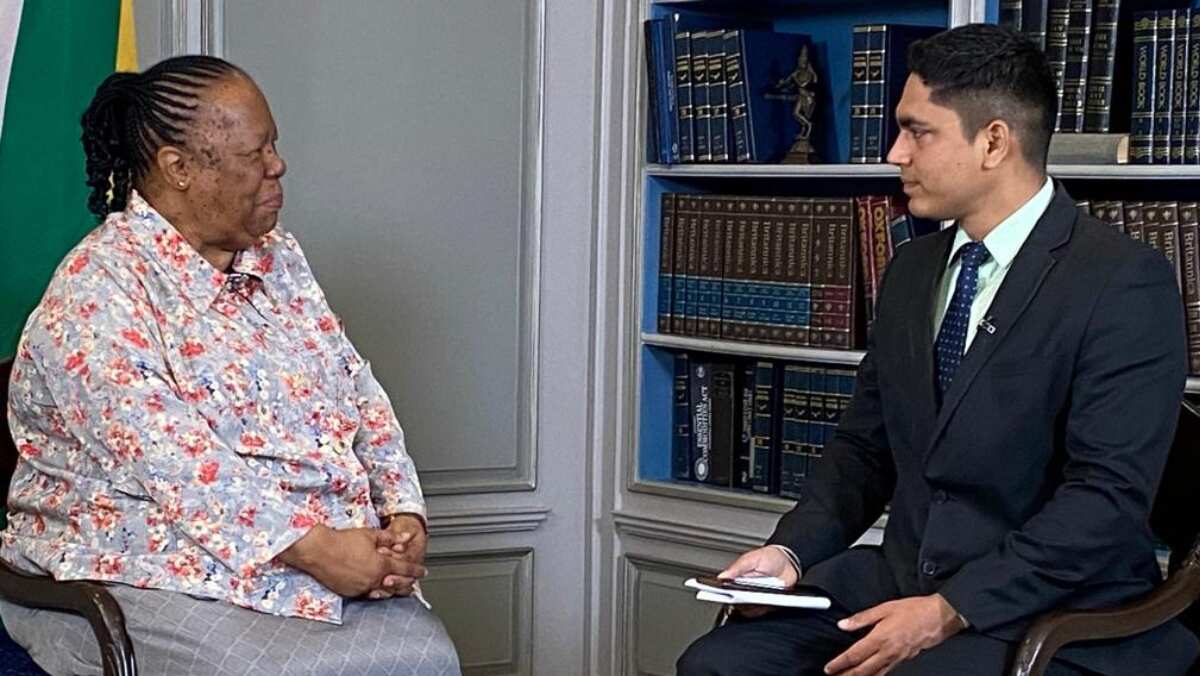
South African foreign minister Naledi Pandor sees India's G20 leadership as opportunity for Global South
South African Foreign Minister Naledi Pandor has expressed her belief that India's leadership in the G20 is an opportunity for developing countries to set their issues on the world stage.
Speaking to our diplomatic correspondent Sidhant Sibal, the minister said, "India chairing G20 is an important moment for countries of the south because essentially the leadership from Indonesia and now India indicates that the Global South is able to lead the global Institutions."
She spoke about how the Russia-Ukraine conflict has impacted the world and Africa. Recalling how South Africa during apartheid "settled that struggle by negotiation" foreign minister speaking to our diplomatic correspondent Sidhant Sibal said,"We sat down with persons who are essentially our enemies... But in the end, encouraged by the world, we sat down and negotiated a settlement."

Backing BRICS to be a "convening group to draw the parties together", amid the conflict, Pandor said, "our leaders...prime minister Modi, president Xi, president Ramaphosa, and president Lula, we need to see them coming together and really assuming a very critical leadership role at this time." Remember, South Africa is the chair of the grouping this year and will be hosting the summit in August. The grouping is also looking at expansion. The transcription for the story was done by Vivek Sinha.
Here is the complete interview:
WION: How do you see the Indian Presidency of this mega grouping (G20)?
&im=FitAndFill=(700,400)&imwidth=180&imheight=135&format=webp&quality=medium)
What is the real meaning behind Pete Hegseth's tattoos?
&imwidth=180&imheight=135&format=webp&quality=medium)
India-US ties: Marco Rubio seeks India's oil & energy co-operation Ad Ad options Learn more
&imwidth=180&imheight=135&format=webp&quality=medium)
SBI confirms data breach: 3,897 records flagged on dark web. Is your money safe?
&imwidth=180&imheight=135&format=webp&quality=medium)
Man marries off wife of 17 years to her lover in Uttar Pradesh
&imwidth=180&imheight=135&format=webp&quality=medium)
Boeing 737 MAX10 gets FAA certification, deliveries expected to begin in 2027
&imwidth=180&imheight=135&format=webp&quality=medium)
Shastri backs Shami comeback; lauds Bhuvi and warns Bumrah on format workload ahead of World Cup
&imwidth=180&imheight=135&format=webp&quality=medium)
US midterms 2026: Red seats once deemed safe now appear shaky as Republicans spend big on ads
&imwidth=180&imheight=135&format=webp&quality=medium)
WATCH | Albania protesters set Supreme Court on fire as anti-Rama riots escalate
&imwidth=180&imheight=135&format=webp&quality=medium)
'Tap dancing through a minefield': Musk backs SpaceX-Tesla merger as AI boom fuels rocket firm's first profit
&imwidth=180&imheight=135&format=webp&quality=medium)
Dandiya Nite ’26: Indian High Commissioner hails diaspora as bridge between India and Nigeria
&imwidth=180&imheight=135&format=webp&quality=medium)
Trump says Ilhan Omar 'could go to jail' amid federal probe, calls Somalia a 's***house'
&imwidth=180&imheight=135&format=webp&quality=medium)
Punjab CM Bhagwant Mann allegedly detained for three hours at Delhi airport, fined ₹50,000: AAP
&imwidth=180&imheight=135&format=webp&quality=medium)
What the Mecca Joint Defence Agreement says about withdrawal and military support. Read full text of the pact here
&imwidth=180&imheight=135&format=webp&quality=medium)
Musk ordered Starlink restrictions that caught Ukraine off guard amid escalating tensions: Report
&imwidth=180&imheight=135&format=webp&quality=medium)
India vs New Zealand T20I Series 2026: Complete schedule, match timings, squads and live streaming details
&imwidth=180&imheight=135&format=webp&quality=medium)
Trump calls Le Pen France’s ‘conservative voice’ after riots, but holds back on endorsement
&imwidth=180&imheight=135&format=webp&quality=medium)
Trump considers removing White House press corps to restore historic indoor swimming pool
&imwidth=180&imheight=135&format=webp&quality=medium)
Ukrainian soldier rescued by a drone chopped off own leg while hiding for 491 days
&imwidth=180&imheight=135&format=webp&quality=medium)
US-Iran war | Tehran: Must end port blockade, oil sanctions and regional attacks
&im=FitAndFill=(700,400)&imwidth=180&imheight=135&format=webp&quality=medium)
Priyanka Chopra to Shilpa Shetty: 6 Bollywood actresses and their fitness secrets
&imwidth=180&imheight=135&format=webp&quality=medium)
'US will never part with niche technology' former IAF assistant chief on India's fighter jet ambitions
&imwidth=180&imheight=135&format=webp&quality=medium)
Pujara says 'Samson and Vaibhav cannot be in Playing XI' for India on NZ tour
&imwidth=180&imheight=135&format=webp&quality=medium)
'What's wrong with you? Are you a sick person?': Trump at it again as he snaps at reporters, faces backlash
&imwidth=180&imheight=135&format=webp&quality=medium)
Over 100 US lawmakers urge FBI to probe foiled Hindu temple shooting as hate crime
&im=FitAndFill=(700,400)&imwidth=180&imheight=135&format=webp&quality=medium)
New OTT releases this week (October 19-25, 2026): Gajab Raat to Chaar Yaar-8 titles to watch during Dussehra week on Netflix, Prime Video and more
&imwidth=180&imheight=135&format=webp&quality=medium)
Ukrainian drone airlifts wounded soldier in what is likely a world first
&imwidth=180&imheight=135&format=webp&quality=medium)
Trump says he wants Zelensky to 'make a deal' with Russia, asks Putin to release American prisoner Stephen Hubbard
&imwidth=180&imheight=135&format=webp&quality=medium)
The Verdict | Trump, Putin and Xi: A superpower triangle that could reshape global diplomacy
&imwidth=180&imheight=135&format=webp&quality=medium)
India moves to buy 10,000 more AI chips for a national compute pool open to startups
&imwidth=180&imheight=135&format=webp&quality=medium)
'They are not even telling us' - Mysterious metallic object discovered in Minnesota field
&imwidth=180&imheight=135&format=webp&quality=medium)
Cattle-feed bran in biscuits, detergent in milk: FSSAI acts against 3 companies
&imwidth=180&imheight=135&format=webp&quality=medium)
US midterms 2026: With Republicans spending big, Bloomberg opens his wallet for Democrats. Here's how much he is pouring
&imwidth=180&imheight=135&format=webp&quality=medium)
Iran rejects US talks until demands are met, rules out moving enriched uranium out of the country
&imwidth=180&imheight=135&format=webp&quality=medium)
Feds obtain DNA evidence that could prove Ilhan Omar married her brother: Report
&imwidth=180&imheight=135&format=webp&quality=medium)
Ramayana advance booking: Ranbir Kapoor, Yash's film cross $500K ahead of Diwali release
Naledi Pandor: Thank you for the opportunity. I think that India chairing G20 is an important moment for countries of the south because essentially the leadership from Indonesia and now India indicates that the Global South is able to lead the Global Institutions and shape the characters of global affairs. So for us, the chairing by India is really an opportunity for developing countries to set the issues of the developing world on the agenda of the world stage. And I think India has done so very very well in the theme that it has chosen and in the manner in which the presidency has conducted the G20 affairs up to now.
WION: The meeting happens at a time when the conflict in Europe is raging, the Russian-Ukraine war. Do you think that dominated the foreign ministers meeting because we could not get the joint statement as the consensus on two paragraphs was lacking?
Naledi Pandor:Well, I think the matter of Russia and Ukraine is an emotive issue for a number of the more powerful G20 countries and we are concerned that this particular terrible development is detracting from the core purpose of the G20. But I must congratulate India for its maturity and for its ability to keep a focus on the core issues. I think that the statement that the chairperson finally unveiled really contained a large set of issues especially the development priorities which we do require to be placed on the global stage. So, I don't believe that India lacks the leadership capability to ensure that the core development issues are not neglected.
WION: The Indian side chairing the grouping in fact what are your expectations when it comes to India?
Naledi Pandor: I am hoping that the co-purpose for which the G20 was established will be returned to focus, we have lost track. The G20 is not the United Nations. It is a grouping of developed and developing countries which come together in order to share perspectives on how we improve the character of the world. How we improve the livelihood of the most marginalized, and which issues we take up as the core focal issues as this gathering of very powerful countries. We have the largest population; we have the biggest economies, so I am hoping that India will insist that G20 has a purpose, and it must maintain that purpose & not be distracted by one issue that the western world is involved in.
WION: You've said a very important line 'Not be distracted by that one issue.' But does that issue have the potential to divide the grouping and was South Africa on board with the consensus essentially that was derived at the meeting?
Naledi Pandor: Indeed, we were, we support the chair's statement. We thought the inclusion of the two paras would be satisfactory. It was disappointing that they were rejected. We are worried about the Ukraine-Russia war. But of course, we do believe, as I am an African I know there are many conflicts in Africa that are totally ignored at the moment. It says though, there's only one part of the world where there's a conflict. And this is disturbing because as we said in our comments during the meeting, if we're worried about war and peace, it must be a worry for all humanity and not a part of humanity. And I think what we really need to be careful about is distracting the G 20. I believe that India is correct in its view, which we share, that we should exhaust all manner of diplomacy in order to have a peaceful settlement between Russia and Ukraine. And I think the insufficient effort is being diverted to seeking peace.
WION: Ma'am, you have multiple times referred to the conflict in Europe. What's your government... your country stands for when it comes to the ongoing conflict or if you can elaborate on that.
Naledi Pandor: Well, when you introduced our discussion, you mentioned the historic relationship between India and South Africa. You know that the people of India and successive governments supported our struggle for freedom against apartheid. And we settled that struggle through negotiation, eventually. We sat down with persons who are essentially our enemies who killed and arrested our fathers and mothers who denied us educational opportunities and denied us basic human rights. But in the end, encouraged by the world, we sat down and negotiated a settlement. So we have appropriated as a constitutional value, the settlement of disputes by negotiations. So our call on Russia and Ukraine is to let us use diplomacy and, on the world, we are saying the United Nations should be allowed to lead a process of diplomacy. We are worried that the United Nations has been marginalized in this current conflict. And we seriously believe that the secretary-general needs to play a leading role because the UN is the global body of all of us. But it is not being given the place to play that role of leadership in seeking peace. So our own aspect as South Africa is we believe the two countries must sit down around the table and peacefully negotiate an outcome.
WION: Similar sentiments by New Delhi, we saw the Indian prime minister saying that this is not an era of war. How do you see India playing a role when it comes to resolving the conflict?
Naledi Pandor: I think that we are looking forward to India, Brazil, South Africa and China playing a leading role in drawing the parties together, because one of our members is Russia as BRICS. And we think that four leaders actually have a very vital role that they could play in becoming a convening group to draw the parties together. So I think our leaders Prime Minister Modi, President Xi, President Ramaphosa, and President Lula, we need to see them coming together and really assuming a very critical leadership role at this time because I believe leadership is missing. And you need this kind of charismatic leadership that is devoted to peace.
WION: South Africa participated with Russia, and China for military exercises, at a time when one country has been involved in a conflict.
Naledi Pandor: Well, we are not at war with Russia. I think that's important. It is tragic that there is a conflict and armed conflict underway in the 21st century. We had hoped after the Second World War, we would not see such conflicts, but we are not at war with Russia. We have a relationship with Russia and China, with India... Brazil and many other countries. We had a military drill with the United States in October of last year, and with other countries in the course of 2021. Nobody raised questions at that time. We are not providing Russia with arms. We're not participating in any way in the conflict. We're not providing either side. We're not involved in the conflict and so to define the military drill, which is a pure naval exercise... I think it's wrong and it's just political posturing. I know that those who support Ukraine want every other country to take their side on the issue. We have chosen that we do not take sides, we encourage settlement and negotiation. We don't wish to become a party to the conflict by choosing sides.
WION: You mentioned the word "those", which we all know... what it means. Have you or your country come under pressure when it comes to those countries which have been on the other side of the party because the Russian foreign minister here in Delhi said that the Western countries have been calling countries in the Global South and telling them that you will be spared if you vote at the UN for the resolution.
Naledi Pandor: Well, certainly we've been called many times every time there's a resolution at the UN. You receive phone calls, but we've made it clear that we will abstain until we see a resolution seriously proposing negotiations. Until we see a UN resolution that accords with our own perspective on how we manage and settle disputes. We are unable to vote in support. So we have had phone calls back so you can't be bullied. Each of us is a sovereign nation. We have our policy perspectives, and we have to uphold those policies.
WION: South Africa is chairing the BRICS grouping, what is the focus like for your country? And also, is there any plan for the expansion of the grouping?
Naledi Pandor: Well, with respect to our plan, as you know, South Africa is part of the African continent. And we've always in our foreign policy asserted that our duty and task is to enhance the character of Africa. So, our theme for the BRICS year is BRICS and Africa, we would like to very firmly attach BRICS countries to African progress. And we have suggested that we do that with a focus on sustainable development, as well as on inclusive growth. These are two aspects that Africa has to do much more on. India has made great progress in the development, great progress in inclusive economic growth. We wish to draw lessons from the experience of China, as well as near-eradicated poverty, which is a huge problem on (our) continent. So this is why we said BRICS and Africa, this is the core theme, sustainable development, which is the UN Sustainable Development Goals and then inclusive growth because you want our economies to grow and inequality to be reduced. The key priorities out of that are of course human resource development, which is skills. If you don't have skills, you can't really achieve your development aspirations. And then, you know, we're all experiencing the problem of climate change. And one of the issues that we have said we'll pursue is what we call a just transition to a cleaner future. So that just transition means the people go with you. So, you don't close down coal mines. People have no jobs, you reduce the use of coal, but you introduce people to solar and other energy resources, and they become the new entrepreneurs. So it's just a movement, just a transition. The third element is we must collaborate and prepare for future health emergencies. We all came out of COVID-19, and Africa was particularly hard hit. We were the last to get vaccines. Everybody ordered the vaccines except India. I'm going to say India allowed us to purchase vaccines from India early in the pandemic, but many countries kept vaccines away from Africa. So we were lost in the queue. Now, we've said we must develop the capability to innovate, research and produce vaccines. So we would like research and innovation to be a key priority in our context, then of course, women's development is very important to us. We must have more gender equality, and investment in financial inclusions. And so these are the key priority areas that we have signalled as part of our BRICS mandate.
WION: Plans for expansion. Looking to get more members.
Naledi Pandor:That's a big, big debate as, as you know, the five countries came together as a progressive forum. There are a lot of commonalities. India and South Africa experience colonialism and came out of it. Brazil has had the experience of, you know, fighting for a democracy that many military coups and so on, now they're a strong, democratic nation. China has come out of a very difficult period of poverty. And Russia, of course, has had to withstand the Second World War and other experiences. So we come from a history of struggle and have come together to try and shape a common global agenda. Now, when you have people interested in joining your organization, one of the first questions do they reflect our characteristics and interests. So, while we are ready to discuss expansion, we believe that it's very important that we shape a set of criteria that we would utilize to look at the various countries that are interested. I think it's a plus for BRICS that there are countries that say they want to join you and they're actually writing everywhere we go. We are asked about this. So it will be something our leaders will discuss at the summit in August and after that, we'll have guidance from....
WION: But how many countries have sent you the invite that they want to be part...
Naledi Pandor: Will, on my desk, I suspect 12 letters. And I suspect other foreign ministers have had approaches from their own region.
WION: Any names so far..
Naledi Pandor: See they've come out publicly. Saudi Arabia is one... United Arab Emirates, Egypt, Algeria, and Argentina, so it's a growing list of Mexico and Nigeria. So, there's huge interest worldwide. And once we've shaped the criteria, we will then make the decision.
WION: Now coming to the bilateral aspect of the relationship as we started off a historical relationship that continues till date if you can talk about the relationship where it goes, and also this year is a significant year, 30 years of the establishment of relationship and the cheetah pact, which has been on the headlines here in Delhi. We can talk about that as well.
Naledi Pandor: Yes, we were so thrilled that we were able to provide cheetahs to India because this is going to revive the cheetah population, which is an endangered species worldwide. So we were thrilled that we could have this exchange, which enhances sustainability in the world of our fauna and flora. We hope we'll have more such exchanges, and I was thrilled to see the story on the front pages in India. We hope we will collaborate even further on preserving our biodiversity. And we wish to draw on India's experience for example, in renewable energy resources, which we are introducing now in South Africa. Our relationship is very expansive with India, so trade relationship. I think we could do much more there. We've been talking about that with Minister Jaishanker. But I think as well, the people-to-people exchange should be broadened as you know, many persons of Indian origin now live in South Africa, the African country with the largest Indian population that originates from India. So it's an important part of our own being and culture as South Africa. So we want stronger people to people to exchange greater trade links. And of course, we would like to really draw on sectoral experiences such as digital competence and bring more digitization to South Africa and Africa. We are also a gateway to the continent. And we'd like India to use that opportunity to work closely with South Africa.
WION: The Indo-Pacific vision is something that has been the talk of the town, at least here in Delhi. Washington, more and more countries are being part of it coming out with Outlook. In fact, the IORA is planning an outlook on the Indo-Pacific. What's South Africa's view on the Indo-Pacific?
Naledi Pandor: I believe it's a very important part of the planet. And of course, we shouldn't forget that the Indian Ocean and the Pacific Ocean straddle many countries both developed as well as developing. So, what we would not like to see happen is the Indo-Pacific becoming an area of military supremacy by some and neglecting the development opportunity. We would like as was proposed by early leaders in India, that the Indo-Pacific should be a zone of peace and development. This is what we hope for. IORA's own focus is one of peace and development. And what is wonderful about IORA is that it includes African countries that have the Indian Ocean as part of their territorial waters. So I am concerned when I see discussions about the Indo-Pacific region that excludes the African continent, because then what essentially people are talking about is a zone of military influence rather than an ocean of peace and development.
WION: United Nations Security Council reform is another thing which is close to the Indian government. Idia, we are the fifth largest economy soon to be the largest populated country on the planet. Do you see or do you think that the UN today is dysfunctional because of a lack of reform, it reflects the world of the previous century.
Naledi Pandor: Well, I would be hesitant to use the term dysfunctional. I think it has many failings and they are related to the fact that it tends to still be a cake in that it is the UN that we established after the Second World War, and we haven't changed it given the post-colonial era that we are now in. So I do think it's in need of reform, fairly radical reform. And this is something that we fully support with India. I would, however, like the reform to be defined, what exactly we mean, how we see representation in the Security Council what the role of the general assembly should be, how we democratize decision-making, and how we ensure regional representation. So I would want a more defined debate. I think at the moment, it's at the level of rhetoric. It's not quite a concrete discussion on clear outcomes that you've all stipulated. so, we would like to move towards even a draft text so that we know what we are all talking about. And is there a commonality of thinking or are we very far apart?
WION: And do you back India's permanent position at the United Nations Security Council?
Naledi Pandor: I think a country of the size and power of India should be represented with their African countries that should have representation as well and I am sure we share that belief with our colleagues here in India.
WION: Moving to a domestic focus. South Africa recently was put on the Grey list of the FATF, your reaction to this development?
Naledi Pandor: Well, of course, we were very concerned we had been alerted to this likelihood some time ago and we began to look at our financial institutions and particularly the concerns about likely money laundering failures that we're not sufficiently exercising oversight on institutions that are utilized either for funding of terrorism activities, or money laundering. We've had, unfortunately, several years of a great deal of corruption in South Africa. It's something our government has been battling. But it is clear from the alert from FATF that we need to do much more. We have passed the necessary legislation. And we're now looking at further steps. So that we satisfy the requirements of this financial authority. We believe we should come out of the Greylisting. And we're going to work hard to address all the areas of inadequacy.
WION: You mentioned corruption. This has been an issue in your country. There have been power shortages as well. Do you think that this will prevent investors to invest in your country which can impact your economy?
Naledi Pandor:Well, I think we've done rather well in the past four years on foreign direct investment because President Ramaphosa has been categorical in his fight against corruption. He has strengthened all prosecutorial institutions, has set up mechanisms against corruption, and people are on trial, and they will go to prison if they've committed any criminal act. So we are acting against corruption, and I think investors can see that action is being taken. On the power shortages. This is a very worrying situation steps again have been taken. So it's not as though the government is just sitting back and watching either thing happen. We have increased the power supply, and we will do even more. The President announced a range of steps in his address to the nation earlier this year. So we are acting. We're not standing still South Africa is on the move. And we will address all the challenges confronting our country.
WION: Additionally, just a last question. There has been some kind of advisor by the US mission, saying that people should be prepared for any eventuality when it comes to 72 hours, some kind of deadline that has been issued. Keep the perishable food with you. How do you see such kind of advisory coming from the US side?
Naledi Pandor: I find it very odd. I was surprised by it. But just four or five weeks ago, the United States issued another advisory that there isa terrorist attack pending in South Africa, but nothing happened. But I suppose they have a duty when they become worried about something you know, to alert their citizens. What we find odd is before issuing such statements, a country that we regard as a friendly country does not speak to the government, they just issue these statements and cause everybody to be anxious, and then nothing happens. So you know, it's almost become like the boy who cries wolf. It's a rather unfortunate situation, I think.
WATCH WION LIVE HERE
You can now write for wionews.com and be a part of the community. Share your stories and opinions with us here.