Rare right whale calf expected to succumb to serious injuries sustained after being hit by boat

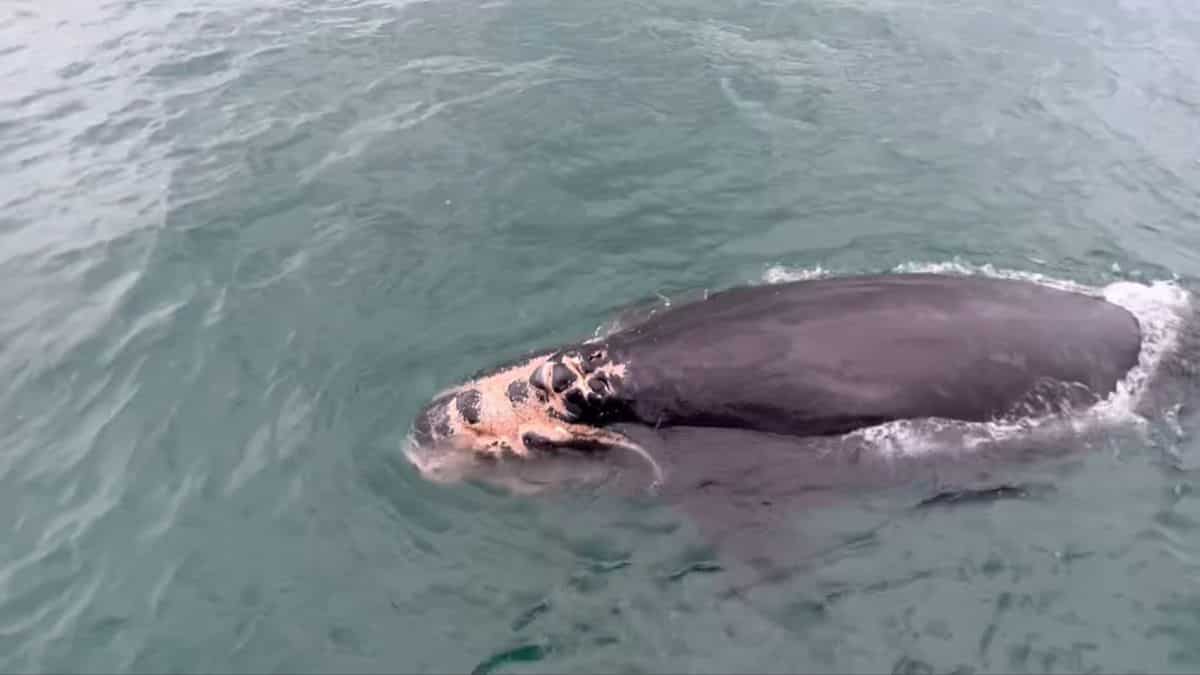
Right whale calf
A rare North Atlantic right whale calf seen off the coast of South Carolina, will probably succumb to the fatal injuries it sustained on its head, mouth, and lips likely caused by a boat propeller, saidofficials.
The National Oceanic and Atmospheric Administration released a statement on Wednesday (Jan 10) saying that the calf, which was spotted with its mother on Jan 3 and had serious injuries, "is likely to die as a result".
The videos uploaded by people on the internet, according to the International Fund for Animal Welfare (IFAW), revealed that the calf had several propeller wounds on its head, mouth, and left lip.

The injuries that arecaused by a vessel’s propellercould hinder the calf's capacity to nurse.
As of January 10, the calf had not been located.
"Blunt force trauma, lacerations, and death are likely outcomes of a collision with a vessel," IFAW animal rescue veterinarian Dr Sarah Sharp said in a statement. "Vessels of all sizes are at risk of harming the critically endangered right whale."
)
Trump administration refunds $100 billion in tariffs after Supreme Court ruling
)
The Royals enter the Doctor Who universe: King Charles and Queen Camilla beam into Commonwealth Games in TARDIS
)
'I was almost trafficked in Paris,' says Australian woman, shares terrifying ordeal - 'I am on the black market'
)
After NEET protests, CJP holds crucial strategy meet in Maharashtra to chart national expansion
)
Ukrainian astronomers see gargantuan objects dashing at 39,600 kmph on the Moon - 'They can reach Earth in 20 minutes'
)
India avoids higher US tariff, secures lower 10% rate. Here's how
)
'Affront to our sovereignty': Bangladesh slams India over Sheikh Hasina's Delhi press conference
)
Lightning bolt strikes football field in Thailand, killing a player during a match
)
Mark Zuckerberg apologises to Indian government over harmful content, platform errors amid PM video row
)
Sajeeb Wazed raises Indian security concerns, calls Bangladesh a 'failed state'
&im=FitAndFill=(700,400))
New OTT releases this week (August 3-9, 2026): Main Vaapas Aaunga, Uyir, Operation Safed Sagar- 6 titles coming on Netflix, Prime Video and more
&im=FitAndFill=(700,400))
Who is Shreya Kalra? Meet the social media star who lifted the Lock Upp 2 trophy
)
Planning to study or work in the US? One missing document could now cost Indians their US visa or green card
)
The genetic roots of Tamils: 75,000 DNA markers decoded in latest study of Sangam-era settlement
)
Squadron Leader Bhawana Kanth scripts history as Indian Air Force gets its first woman ‘Top Gun’ pilot
)
UP gangster Atiq Ahmed's son, on way to meet jailed brother, killed in road accident in Jhansi
)
'I would like to support...': Sonam Wangchuk reveals if he will join Jharkhand student protesters in Ranchi
)
Several Indian states ban analogue paneer: Experts explain what it is and the health risks | WION Decodes
)
Trump says Iranian school bombing photos could be AI-generated - 'I don’t think...'
)
'Dhoni Made Fleming Great': Panesar says ECB made the wrong choice for England Test coach
)
Ex top Pakistan official blames economic woes on China: Here's how CPEC became a failure
)
‘Pakistan called for ceasefire, we kept them waiting’: Ex-CDS Anil Chauhan recalls Operation Sindoor
)
Munir-protege Mohsin Naqvi’s claim of unearthing huge scam triggers tremors in Pakistan’s power corridors
)
What’s happening in Nepal? How did a local clash turn into communal violence? WION Decodes
&im=FitAndFill=(700,400))
From Jos Buttler to Kieron Pollard, 5 highest run-scorers in T20 cricket
)
Strait of Hormuz deal with Oman being ‘finalised’: Iran’s foreign ministry
)
CJP's Saurav Das alleges YouTubers broke into his house, seeks Delhi Police action
&im=FitAndFill=(700,400))
Why Russian tanks are much lighter compared to US tanks
)
India deploys joint outbreak response team as Chandipura virus spreads in Gujarat, Rajasthan
"This serious injury and likely death of this critically endangered calf is utterly tragic but completely avoidable," IFAW Senior Campaign Manager Kathleen Collins said in a statement.
"Collisions with vessels are one of the leading causes of death for the North Atlantic right whale. Being aware while on the water and slowing vessels down when whales are in the area is the best way to save this critically endangered species," Collins further said.
According to scientists, North Atlantic right whales typically feed and breed within 30 miles of Atlantic Canada and the US East Coast. Due to habitat overlap with shipping channels and other human activities, the critically endangered species is susceptible to vessel strikes and entrapment in fishing gear.
“These are identifiable, preventable threats, and they’re caused by humans,” said Regina Asmutis-Silvia, executive director and senior biologist at Whale and Dolphin Conservation. “So there’s somewhat of a responsibility for us to mitigate them.”
For centuries, the whales' slow cruising speed, tendency to drift when harpooned, and dense blubber that is used in soaps, leathers, and cosmetics, made them easy prey for whalers. The species was first hunted in the 9th century, which continued thereafter until it was prohibited in the year 1935 to tackle its declining population.
However, human caused incidents in the ocean continue to put the species at risk. Scientists estimate that there are fewer than 360 right whales left alive in the North Atlantic.
(With inputs from agencies)