

&imwidth=800&imheight=600&format=webp&quality=medium "Nvidia's Nemotron 3 Ultra vs Google's Gemma 4 12B: Understanding the difference between two new species of AI")
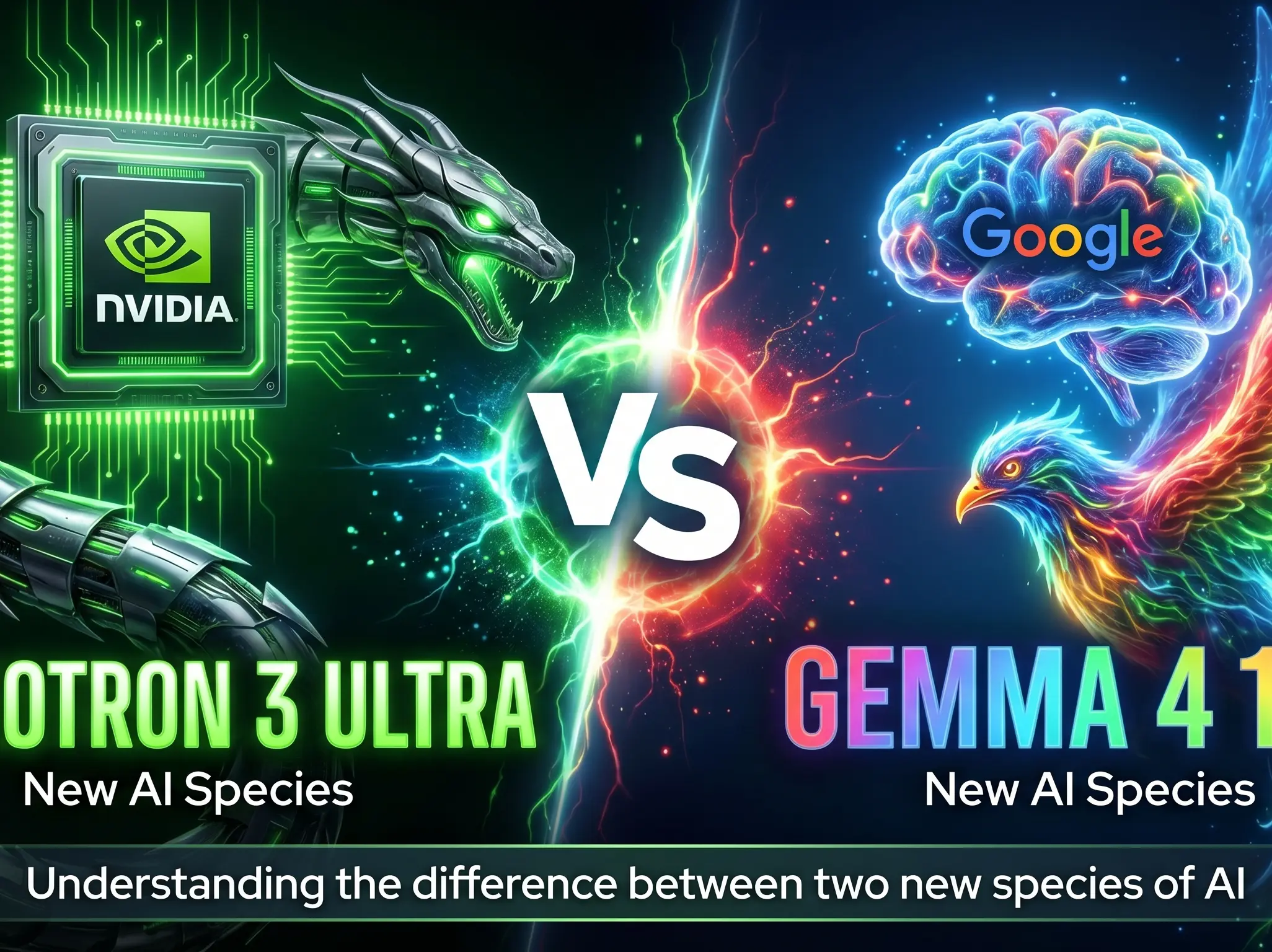
Within 48 hours of each other in the first week of June 2026, Nvidia and Google quietly released two open-source AI models that represent fundamentally different visions of what free AI should look like. One is a 550-billion-parameter reasoning beast unveiled on a Taipei stage. The other is a 12-billion-parameter compact model that runs on a regular office laptop. They are not competitors. They are different species and understanding the difference matters.
Nvidia unveiled Nemotron 3 Ultra on June 1 at Computex 2026 in Taipei. Google followed with Gemma 4 12B on June 3. The timing felt like a coincidence, but the contrast was too instructive to ignore.
Nvidia Nemotron 3 Ultra: The Cloud-Scale Reasoning Machine
Nemotron 3 Ultra is a 550-billion-parameter model but that number requires a qualifier. Only 55 billion parameters are active per token. Nvidia built it using a Mixture-of-Experts (MoE) architecture, which means the model activates only the relevant subset of its brain for any given task rather than running the entire network. This design decision is why it can deliver over 300 tokens per second and run 3 to 6 times faster than competing models at similar quality levels.
The architecture itself is a hybrid Mamba-Transformer MoE, a combination of state-space models and attention mechanisms that lets the model handle context windows of up to 1 million tokens. For reference, 1 million tokens is roughly the size of a 750-page book that the model can hold in memory and reason over simultaneously. This is not a chatbot. This is infrastructure for complex, long-running AI agents.
On the Artificial Analysis Intelligence Index, which measures reasoning ability, programming, general knowledge, and agent performance, Nemotron 3 Ultra scores 48, the highest score ever achieved by an American open-weight model. To put that in perspective, Google's larger Gemma 4 31B scores 39 on the same index. Nvidia's model outperforms it by 12 points while being significantly faster. China's Kimi K2.6 currently sits at 54, but Nemotron closes the gap considerably.
Trending Stories
&im=FitAndFill=(700,400)&imwidth=180&imheight=135&format=webp&quality=medium)
Priyanka Chopra to Shilpa Shetty: 6 Bollywood actresses and their fitness secrets
&imwidth=180&imheight=135&format=webp&quality=medium)
Ramayana advance booking: Ranbir Kapoor, Yash's film cross $500K ahead of Diwali release
&imwidth=180&imheight=135&format=webp&quality=medium)
AUS vs SA: Boland grabs opportunity with both ends to help Australia dominate
&imwidth=180&imheight=135&format=webp&quality=medium)
‘Nuclear-use decision should be taken by humans’: India flags AI risks at UN
&imwidth=180&imheight=135&format=webp&quality=medium)
Two Indians among 28 arrested in California over alleged voter registration fraud, DOJ says
&imwidth=180&imheight=135&format=webp&quality=medium)
'It's a joy to see the makers bring it on such a grand scale': SS Rajamouli on Ramayana
&imwidth=180&imheight=135&format=webp&quality=medium)
Pujara says 'Samson and Vaibhav cannot be in Playing XI' for India on NZ tour
&imwidth=180&imheight=135&format=webp&quality=medium)
Indian Air Force turns to homegrown firefighting robot developed under iDEX programme
&imwidth=180&imheight=135&format=webp&quality=medium)
PCB omits Atherton, Hussain from tri-series commentary panel over Imran Khan interview row
&im=FitAndFill=(700,400)&imwidth=180&imheight=135&format=webp&quality=medium)
New OTT releases this week (October 19-25, 2026): Gajab Raat to Chaar Yaar-8 titles to watch during Dussehra week on Netflix, Prime Video and more
&imwidth=180&imheight=135&format=webp&quality=medium)
Flying car race: Alef Aeronautics welcomes Tesla Roadster '11 years' later, but are the two models the same?
&imwidth=180&imheight=135&format=webp&quality=medium)
'Whatever I can do to end this war': Trump floats China Summit with Putin and Xi, questions Zelensky's role in peace talks
&imwidth=180&imheight=135&format=webp&quality=medium)
Kim Jong Un death rumours: State media shares photos to prove dictator is alive amid reports of brain haemorrhage
&imwidth=180&imheight=135&format=webp&quality=medium)
US midterms 2026: From Pooja Sethi to Vivek Ramaswamy, here are Indian-origin candidates to watch out for
&imwidth=180&imheight=135&format=webp&quality=medium)
Mariah Carey wins $20 million legal battle over brother’s defamation lawsuit against her bestselling memoir
&imwidth=180&imheight=135&format=webp&quality=medium)
Far-left parties, global networks among 54 groups linked to France protests, only 16 are youth outfits: Report
&imwidth=180&imheight=135&format=webp&quality=medium)
Feds obtain DNA evidence that could prove Ilhan Omar married her brother: Report
&imwidth=180&imheight=135&format=webp&quality=medium)
Dussehra 2025: Why is Ravana not burnt but worshipped in these places of India?
&imwidth=180&imheight=135&format=webp&quality=medium)
'We feel like Mr India': Gujarat’s undercover SHE team guard garba nights at Navratri
&imwidth=180&imheight=135&format=webp&quality=medium)
Baby orangutan rescued in India returns to Indonesia
&imwidth=180&imheight=135&format=webp&quality=medium)
Prince Harry, Meghan Markle never accepted Queen Elizabeth’s terms for royal exit: Report
&imwidth=180&imheight=135&format=webp&quality=medium)
India moves to buy 10,000 more AI chips for a national compute pool open to startups
&im=FitAndFill=(700,400)&imwidth=180&imheight=135&format=webp&quality=medium)
Ghaziabad is world's fastest-growing city; Surat, Patna, Rajkot also feature on list
&imwidth=180&imheight=135&format=webp&quality=medium)
Netanyahu rival Benny Gantz quits Israel election race, vows to push for unity government
&imwidth=180&imheight=135&format=webp&quality=medium)
Pete Hegseth meets Benjamin Netanyahu during unannounced visit to Israel ahead of election
&imwidth=180&imheight=135&format=webp&quality=medium)
India begins National Red List Assessment of 1,211 bird species to boost conservation
&imwidth=180&imheight=135&format=webp&quality=medium)
Dark fantasy, violence, adult themes: BBFC data reveals animation's shift towards older audiences
&im=FitAndFill=(700,400)&imwidth=180&imheight=135&format=webp&quality=medium)
What is the real meaning behind Pete Hegseth's tattoos?
&imwidth=180&imheight=135&format=webp&quality=medium)
WATCH | Albania protesters set Supreme Court on fire as anti-Rama riots escalate
&imwidth=180&imheight=135&format=webp&quality=medium)
Trump calls on New Mexico to become 'New America', claims 'home values and incomes would rise'
&imwidth=180&imheight=135&format=webp&quality=medium)
'They are not even telling us' - Mysterious metallic object discovered in Minnesota field
&imwidth=180&imheight=135&format=webp&quality=medium)
US Midterm 2026: What do opinion polls and prediction markets say less than two weeks before voting
&imwidth=180&imheight=135&format=webp&quality=medium)
Cattle-feed bran in biscuits, detergent in milk: FSSAI acts against 3 companies
&imwidth=180&imheight=135&format=webp&quality=medium)
WATCH | Japan launches historic mission to collect samples from Mars' moon Phobos
&imwidth=180&imheight=135&format=webp&quality=medium)
Shastri backs Shami comeback; lauds Bhuvi and warns Bumrah on format workload ahead of World Cup
Nvidia released the full model weights on Hugging Face for free. The training recipe is also publicly available in the NeMo repository. Enterprises can download and run it in production at no licensing cost. Glean, the enterprise search company, has already integrated Nemotron 3 Ultra into its platform, citing its cost efficiency for complex agentic workflows.
Google Gemma 4 12B: The Laptop-Scale Multimodal Pioneer
Gemma 4 12B is a completely different kind of animal. At approximately 11.95 billion parameters, it is small enough to run entirely on a standard enterprise laptop using just 16GB of VRAM or unified memory, the kind of memory that comes standard on a modern MacBook Pro with an M-series chip. No cloud subscription. No API calls. No data leaving your machine.
What makes Gemma 4 12B technically remarkable is its encoder-free unified architecture. Traditional multimodal AI models bolt on separate processing modules — an image encoder, an audio encoder and stitch their outputs together before feeding them to the language model. Gemma 4 12B eliminates all of that. Raw audio waveforms and visual patches flow directly into the core language model backbone without any secondary processing stage. The result is lower latency, lower memory overhead, and a single model that natively understands text, images, audio, and video.
The context window is 256,000 tokens, considerably smaller than Nemotron's 1 million, but entirely appropriate for the kinds of tasks this model is designed for. On mathematical reasoning benchmarks, Gemma 4 12B posted 77.5 percent on AIME 2026 and 79.7 percent on MATH-Vision, numbers that approach Google's own larger 26B MoE model. For a 12B model running locally on consumer hardware, those are genuinely surprising results.
Google released Gemma 4 12B under an Apache 2.0 license, one of the most permissive open-source licenses available and made it immediately available on Hugging Face and Kaggle. It integrates with standard deployment frameworks including vLLM, SGLang, MLX, and llama.cpp.
Two Models, Two Different Problems They Are Solving
The comparison is not really about which model is better. It is about what problem you are trying to solve.
Nemotron 3 Ultra is built for developers and enterprises running large-scale agentic AI systems, multi-step workflows, autonomous coding agents, complex document analysis over massive context windows. It requires serious hardware infrastructure to deploy, but once deployed, it delivers near-frontier performance at open-source pricing. This is the model you reach for when you are building AI pipelines that need to reason over thousands of pages of documentation, write and execute code autonomously, or manage complex multi-agent orchestration.
Gemma 4 12B is built for a completely different scenario: the edge, the device, the individual. A journalist who wants to run a private transcription and analysis model without sending recordings to a third-party server. A doctor who needs a diagnostic reasoning tool that processes patient data entirely on-premises. A developer in a bandwidth-constrained environment building a multimodal application that needs to work offline. For these use cases, Gemma 4 12B is not a compromise, it is the right choice.
Why This Week Matters for Open Source AI
The release of both models in the same week is not just news. It marks a maturation point in the open-source AI ecosystem. Until recently, the dominant narrative was that open-source models lagged behind closed frontier models by a generation. That gap has narrowed dramatically.
What Nvidia and Google have collectively demonstrated is that open-weight AI can now cover both ends of the performance spectrum, from a 12B model running on consumer hardware to a 550B model matching or exceeding proprietary frontier performance on reasoning benchmarks, without a licensing fee, without an API key, and without dependency on any cloud provider.
That is a structural shift. Developers who previously had to choose between capability and cost now have credible open alternatives at both ends. The next wave of AI applications will increasingly be built not on top of closed APIs but on models like these, deployed locally, customised freely, and owned entirely by the teams building them.
Two models, released within 48 hours, pointing in opposite directions. Both of them, in their own way, signal where AI is heading next.
