International Space Station did 540-degree flip, turned upside down: Mishap more serious than earlier reported

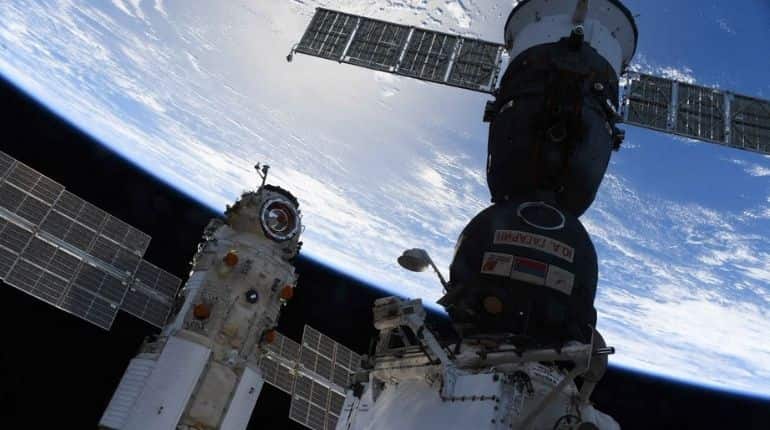
International Space Station
The International Space Station (ISS) did a 540-degree flip after jet thrusters of a newly arrived Russian research module inadvertently fired a few hours as per a new report.
Zebulon Scoville, the flight director who was in charge at NASA's mission control centre in Houston has revealed in a report by 'TheNew York Times' that the mishap more serious than earlier reported.
“We had two messages, just two lines of code, saying that something was wrong,” Scoville said adding that engineers first considered it to be a false message.

"And then I looked up at the video monitors and saw all the ice and thruster firings. This is no kidding. A real event. So let’s get to it. You get about half a breath of ‘Oh, geez, what now?’ and then you kind of push that down and just work the problem,” he told New York Times.
Itbegan about three hours after the multipurpose Nauka module had latched onto the space station, as mission controllers in Moscow were performing some post-docking "reconfiguration" procedures, according toNASA.
The seven crew members aboard,two Russian cosmonauts, threeNASAastronauts, a Japanese astronaut, and a European space agency astronaut from France, were never in any immediate danger, according toNASAand Russian state-owned news agency RIA.
The module's jets inexplicably restarted, causing the entire station to pitch out of its normal flight position some 250 miles above the Earth, leading the mission's flight director to declare a "spacecraft emergency," USspace agency officials said.
An unexpected drift in the station's orientation was first detected by automated ground sensors, followed 15 minutes later by a "loss of attitude control" that lasted a little over 45 minutes, according to Joel Montalbano, manager ofNASA's space station program.
'Tug-of-war'
Flight teams on the ground managed to restore the space station's orientation by activating thrusters on another module of the orbiting platform,NASAofficials said.
In its broadcast coverage of the incident, RIA citedNASAspecialists at the Johnson Space Center in Houston, Texas, as describing the struggle to regain control of the space station as a "tug of war" between the two modules.
At the height of the incident, the station was pitching out of alignment at the rate of about a half a degree per second, Montalbano said during aNASAconference call with reporters.
The Nauka engines were ultimately switched off, the space station was stabilized and its orientation was restored to where it had begun,NASAsaid.
Communication with the crew was lost for several minutes twice during the disruption, but "there was no immediate danger at any time to the crew," Montalbano said. He said "the crew really didn't feel any movement."
Had the situation become so dangerous as to require evacuation of personnel, the crew could have escaped in a SpaceX crew capsule still parked at the outpost and designed to serve as a "lifeboat" if necessary, said Steve Stich, manager ofNASA's commercial crew program.
What caused the malfunction of the thrusters on the Nauka module, delivered by the Russian space agency Roscosmos, has yet to be determined,NASAofficials said.
Montalbano said there was no immediate sign of any damage to the space station. The flight correction maneuvers used up more propellant reserves than desired, "but nothing I would worry about," he said.
After its launch last week from Kazakhstan's Baikonur Cosmodrome, the module experienced a series of glitches that raised concern about whether the docking procedure would go smoothly.
Roscosmos attributed Thursday's post-docking issue to Nauka's engines having to work with residual fuel in the craft, TASS news agency reported.
"The process of transferring the Nauka module from flight mode to 'docked with ISS' mode is underway. Work is being carried out on the remaining fuel in the module," Roscosmos was cited by TASS as saying.
The Nauka module is designed to serve as a research lab, storage unit, and airlock that will upgrade Russia's capabilities aboard the ISS.
A live broadcast showed the module, named after the Russian word for "science," docking with the space station a few minutes later than scheduled.
"According to telemetry data and reports from the ISS crew, the onboard systems of the station and the Nauka module are operating normally," Roscosmos said in a statement.
"There is contact!!!" Dmitry Rogozin, the head of Roscosmos, wrote on Twitter moments after the docking.
(With inputs from agencies)