

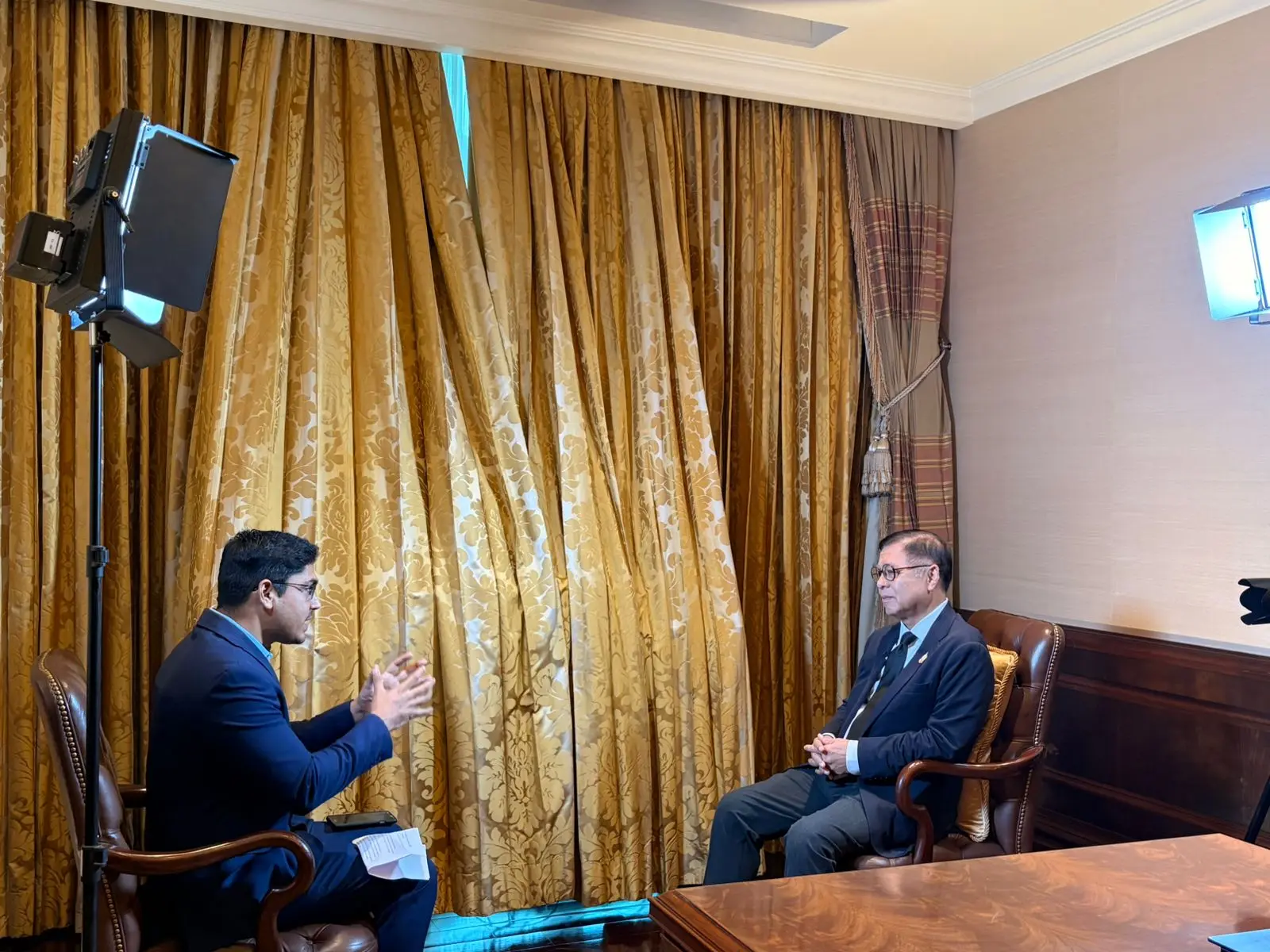
&imwidth=800&imheight=600&format=webp&quality=medium "India is an ‘important economic powerhouse’, says Thai FM amid deepening defence ties and cross-border cyber-scam crackdown")
Thailand’s Foreign Minister Sihasak Phuangketkeow has described bilateral relations with India as “excellent” and “robust”, with both countries determined to expand cooperation in trade, defence and tackling transnational cyber-scams. Speaking to WION's Sidhant Sibal, the minister highlighted the growing menace of cross-border online scam syndicates operating along Thailand’s borders with Myanmar and Cambodia. He revealed that Bangkok recently repatriated around 1,000 Indian victims and announced an international conference on 17 December in Bangkok to galvanise global action. “This is a grave threat to all of us… We must demonstrate political will and mobilise international efforts,” he said, calling for greater intelligence-sharing to dismantle criminal networks.
On the economic front, FM Sihasak expressed confidence that the $30 billion bilateral trade target by 2030 is achievable, citing India’s rapid growth and opportunities in food security, health, wellness and green technology. He urged India to reconsider joining the Regional Comprehensive Economic Partnership (RCEP) and stressed the need for upgraded connectivity projects, including the stalled India-Myanmar-Thailand Trilateral Highway.
Defence ties are also deepening, with Thailand already procuring Indian armoured vehicles and munitions, and both navies conducting joint exercises to ensure maritime security in the wider Indo-Pacific region. The minister underlined shared Buddhist heritage and booming Indian tourism, with over two million visitors annually, as enduring pillars of the relationship. Full interview
Your Excellency, how would you characterise the current state of India-Thailand relations?
The relationship is excellent, and I think it's going forward with opportunities for closer cooperation in many areas. We have a strategic partnership. A strategic partnership means that it's not just the bilateral issues, bilateral relations, but we're working together to promote regional peace and stability and prosperity, also working together to address common global challenges like climate change, pandemics, human trafficking, and so many other issues. So it's a very robust relationship, and I see there's a lot of potential for cooperation and partnership going forward.
On the issue of cross-border online scam syndicates, Thailand has helped repatriate many Indian victims; what has been Thailand’s role and what remains the biggest concern regarding these cyber-scam centres?
Trending Stories
&imwidth=180&imheight=135&format=webp&quality=medium)
'Hell of a beautiful a**': Trump compliments Nicki Minaj as rapper joins him in Michigan rally
&imwidth=180&imheight=135&format=webp&quality=medium)
'Hire the robot, fire the human': Bill Gates's words hint at a bleak future
&imwidth=180&imheight=135&format=webp&quality=medium)
Telangana unveils AI avatar of IT minister D Sridhar Babu at Hyderabad DevFest 2026
&imwidth=180&imheight=135&format=webp&quality=medium)
Who is Eyal Zamir, Israeli army chief, who reportedly clashed with Netanyahu over Iran?
&imwidth=180&imheight=135&format=webp&quality=medium)
Fire breaks out at Delhi’s North Block, thick black smoke seen | VIDEO
&im=FitAndFill=(700,400)&imwidth=180&imheight=135&format=webp&quality=medium)
Armoured vehicles vs main battle tanks: What is the real difference?
&imwidth=180&imheight=135&format=webp&quality=medium)
IND vs NZ: Tilak Varma sets world record with most T20I catches in a year
&imwidth=180&imheight=135&format=webp&quality=medium)
Harry Kane favourite to win 2026 Ballon d’Or ahead of Lamine Yamal and Kylian Mbappé
&imwidth=180&imheight=135&format=webp&quality=medium)
FIR filed against opposition MPs for ‘trespassing’ amid Jamia Millia students’ protest
&imwidth=180&imheight=135&format=webp&quality=medium)
WATCH | Virat Kohli returns to training ahead of New Zealand ODI series
&imwidth=180&imheight=135&format=webp&quality=medium)
Can Putin cheat death? All about his daughter’s billion-dollar quest for immortality
&imwidth=180&imheight=135&format=webp&quality=medium)
Daler Mehndi controversy: Mika Singh’s team confirms Subodh Uniyal’s apology
&im=FitAndFill=(700,400)&imwidth=180&imheight=135&format=webp&quality=medium)
How do army night-vision systems see in almost complete darkness?
&imwidth=180&imheight=135&format=webp&quality=medium)
Netanyahu warns Israelis of ‘existential threat’ from Iran, posts AI image of nuclear strike
&imwidth=180&imheight=135&format=webp&quality=medium)
Brazil re-elects factory worker Lula for fourth term; Indian PM Modi congratulates 'dear friend'
&imwidth=180&imheight=135&format=webp&quality=medium)
Pakistan airline PIA unveils new crew uniforms, faces online criticism
&imwidth=180&imheight=135&format=webp&quality=medium)
‘That is a miss’: Ravi Ashwin questions Sooryavanshi’s demotion to No. 3 in 2nd T20I vs NZ
&im=FitAndFill=(700,400)&imwidth=180&imheight=135&format=webp&quality=medium)
Why does this fighter jet have a golden window that looks like alien technology?
&im=FitAndFill=(700,400)&imwidth=180&imheight=135&format=webp&quality=medium)
New OTT releases this week (October 26-November 1, 2026): Baththa, Akka, The One About Matthew Perry- 7 titles coming on Netflix, Prime Video and more
&imwidth=180&imheight=135&format=webp&quality=medium)
Elon Musk’s Grok releases first AI-generated Odyssey episode, months after promising ‘historically accurate’ full-length film
&imwidth=180&imheight=135&format=webp&quality=medium)
'Already tired of his 9-to-5': Baby born with a moustache becomes internet sensation, video goes viral | Watch
&imwidth=180&imheight=135&format=webp&quality=medium)
Serbia’s student-led movement defeats Vucic’s party after 14 years in power: Why it matters
&imwidth=180&imheight=135&format=webp&quality=medium)
'I promised Gautam & Kotak Sir that...': Tilak Varma opens up on match-winning mindset against NZ
&imwidth=180&imheight=135&format=webp&quality=medium)
Maldives opposition leader demands transparency on Muizzu Govt's Pakistan defence, security deals
&im=FitAndFill=(700,400)&imwidth=180&imheight=135&format=webp&quality=medium)
Why do some fighter jets have two engines while others use one?
&imwidth=180&imheight=135&format=webp&quality=medium)
Formula 1: Mercedes' Kimi Antonelli one race and ninth spot finish away from title after US Grand Prix win
&imwidth=180&imheight=135&format=webp&quality=medium)
Delhi's new entry rules for vehicles begin November 1. Here's all you need to know about the ban
&imwidth=180&imheight=135&format=webp&quality=medium)
'Clear overkill': Putin rejects claims Russia is behind mass protests in Europe
&imwidth=180&imheight=135&format=webp&quality=medium)
'I've done my work sincerely': AR Rahman on facing backlash over Ramayana soundtrack
&imwidth=180&imheight=135&format=webp&quality=medium)
Clayface tops North American box office, Elizabeth Holmes documentary follows close behind
&imwidth=180&imheight=135&format=webp&quality=medium)
Nagpur man fails to pay rent, allegedly prints fake Rs 500 notes worth Rs 37 lakh
&imwidth=180&imheight=135&format=webp&quality=medium)
Israel elections 2026: How the country is gearing up for a crucial vote
&imwidth=180&imheight=135&format=webp&quality=medium)
Donald Trump targets Bill Maher in lengthy post after White House dinner, says ‘Don’t call anymore’
&imwidth=180&imheight=135&format=webp&quality=medium)
'He is a red flag': Ex-India strength and conditioning coach on Rohit's fitness regime
Well, it's not just a problem for any particular country. It's become a problem with regional and international dimensions, and we see you know these scam operations operating along the Thai-Myanmar border, along the Thai Cambodian border, and this particular regard to Myanmar, it is due to the instability in the country. Unfortunately, we have people who have been lured into working for these operations, some of course, knowingly, have gone there in the hope of making money. But, these operations are a grave threat to all of us. People are being robbed of their life savings by this scam and scammers, so we really have to do something about it.
Thailand believes that it's time that we demonstrate the political will, and mobilise international efforts to deal with this problem. We are hosting a major international conference on the 17th of December in Bangkok. So we hope that at that meeting, we can discuss this at the highest level, and hopefully, we can work on what we can. We must ensure that these frameworks and processes are consolidated and work together. So this is what we're hoping for. But the point is that we have victims from many countries. Indians are among the victims. We have a large number of them. We just helped recently with the repatriation of about 1000 Indians back to where they came from in India.
What kind of conversations have both sides had on this particular issue? We know that the Indian ambassador has met you on this particular issue, and also perhaps you've invited India to the upcoming meeting which you're going to host.
Immediate concern is to provide assistance to help them return to wherever they came from. But also, we need information on who the perpetrators are. What kind of networks have they been able to utilise? So what is important is that we should have more information sharing, sharing of intelligence, so that we really can get to the bottom of all this.
And who do you think is the perpetrator in this particular case, any group which you are worried about?
Well, I don't want to assign any particular nationality, because these are criminals. And we have criminals in every country, and so criminals are working together to make these scams and scam operations possible.
How do Thailand, India plan to increase their trade at a time when we have seen changes when it comes to global trading arrangements?
Well, we first have to do more bilaterally. Bilateral means having more exchange visits between the private sector. We also have to work together to see where the impediments are, and then we have to work together in terms of promotional activities. I see enormous potential in trading relationships; in our economic ties, we just have to work harder at it. But having said that, not just working bilaterally right now, we should also work to promote regional free trade at a time when the multilateral trading system is being challenged. You know what these challenges are: challenges of unilateralism, protectionism, and unilateral tariffs. Thailand and India should not just be working bilaterally for more trade, more investment, but also we should be working at the regional level to ensure that trade remains free.
There are many ways that we can work together regionally. There's the India ASEAN Free Trade Agreement. Let's see what we can do to upgrade it. We also have the Regional Comprehensive Economic Partnership, RCEP. India took part in negotiations throughout, but at the end, decided to opt out. We don't question India's intention. Of course, it's a decision for India to make. We do hope that India will join RCEP, because it's something that will benefit the region and definitely benefit India. We understand the concern of India, but still, India is such an important economic powerhouse in the region, and so there is much that we can do bilaterally, a lot that we can do regionally, at a time when we're facing the common challenge of the decline of the multilateral trading system under the WTO.
Plans to have the trade to $30 billion by 2030, I believe. Are you hopeful that India and Thailand will be able to achieve that?
Given the growth of India, the economic growth rate of India, and the size of your economy, I think we can achieve that goal. Again, let's look at where the impediments are, and where the opportunities are for us to trade more. I see that the target that we have set is not beyond reach, but trade is only part of the economic relations. I'd like to see more investment. Investment also helps to create more trade between our two countries. Thailand has an economy that is in transition. We want to go towards more innovation, more digitalisation, and a greener economy.
There are many areas where we can work together, such as, first is Thailand wants to be a food hub, and this is where there's a tremendous demand for food products. So maybe we can work together in this area. Another area where Thailand and India can work together is in the health and wellness. Thailand has some of the best hospitals in the world. You are very strong in the pharmaceutical industry, why not look at opportunities for closer collaboration? Connectivity is also another area. There is much more that we can do in terms of connectivity, and connectivity will enhance trade.
Any update on the India-Myanmar-Thailand trilateral highway?
The segment in Thailand is completed. We have financed a certain segment within Myanmar. India's part has been done. India is helping also to finance part of this segment in Myanmar, but the project has been stalled because we know why, because of the situation. So that's why we're hoping that the situation will return to normalcy soon, and so that we can continue to work on the trilateral highway project, so that it can be completed. And another project is the coastal shipping project, connecting the various main ports along the course from Thailand to Myanmar to Bangladesh to India.
Moving forward to the defence relationship, what's your view on that?
The defence cooperation helps us to ensure that we are prepared in terms of defence, and we also look to India as a source of defence supplies, of defence equipment, weapons, and also these joint exercises, whether it's between our armed forces, our naval forces. I think it serves to enhance our preparedness in terms of defence and security. Another area is maritime security; we share a common interest in ensuring that the sea lanes of communication and transport and commerce, connecting the Pacific Ocean with the Indian Ocean, are kept free and open.
Any specific assets you are looking to import from India?
Well, we always think in terms of efficiency, effectiveness and cost. Up to now, I think the weapons that we have purchased from India, mainly military vehicles, armoured vehicles, and maybe some munitions.
Where do you see the future of the India-Thailand tourism relationship?
Well, tourism is a very important sector of the Thai economy. The Thai economy is driven by two important sectors, the trade exports in particular, and also tourism. India has been an important source of tourism for Thailand. We have over 2 million tourists from India coming to enjoy the various sites in Thailand each year, and we are very happy that the number is growing. And I'm always amazed by the size of the Indian weddings held in Thailand. You know, it's not just the bride and bridegroom. You have the whole family, not from one side, but both sides, coming to celebrate Thailand, and so we hope that there'll be more of this kind of tourism in addition to the regular tourism that we have from India.
How do you see India's Act East Policy working in terms of India's growing engagement with ASEAN countries, especially Thailand?
Well, it was "Look east". Now it's "Act East". And for us, it is "Act West" before we "Look West". So we have to act in terms of concrete actions on what to do. And again, it's not just bilaterally. First of all, we welcome the engagement of India, economically, strategically in the ASEAN region, and India is a very important dialogue partner. There is another framework that brings about the convergence of India's Look East policy and Thailand's Look West policy, which is BIMSTEC. And with regard to BIMSTEC, it has a lot of potential, but we still have a long way to go. So I think that Thailand and India should be working together more under our respective Act East and Thailand's act West policy.
How hopeful are you about BIMSTEC?
Well, to be very frank, I think we have to really try to quicken the pace, broaden the cooperation, and also make sure that real progress is achieved. I think BIMSTEC has not realised its potential yet. I think South Asia is getting its act together, and Southeast Asia, I think, we remain one of the highest growth areas in the world. And actually, BIMSTEC is not just about the member countries alone. It's about linking South and Southeast Asia. So we really have to do much more. There's been a lot that we've agreed to, such as we have a master plan on connectivity, we have to do more in terms of connectivity, rail, air, land, sea, and also promoting free trade.
One element that combines tourism and connectivity is digital connectivity, the connectivity between India's UBI and Thailand's Prompt Pay. Can we see a day when an Indian tourist, or perhaps a Thai tourist, comes to India and uses their QR code to pay?
Yes, I say that. I hope it will be done very quickly, because, you know, digital payment is going to really promote economic ties and help tourism, and Thailand is already doing that, with countries like Singapore.
Buddhism connect between the two countries. How important is it to both countries?
Yes, I think tourism is one of the pillars of our relationship, the fact that we share so much in common in terms of religion and many Thais come to India for religious pilgrimage. We appreciate that you have kindly offered the relics of the Lord Buddha to allow the people in Thailand be able to show their respect. That is very much appreciated. So Buddhism will be at the core of our relationship. It will remain an important pillar of ties.
The conflict we saw with Cambodia, if you can perhaps brief to the Indian viewers, about the reason for the conflict, and also what is the current status as well, especially after the mediation, which we saw by the US President Donald Trump
Well, it has to do with the border. Borders that have not been clearly demarcated. It has to do with the existence of mines along the border. It has to do with the spread of these illegal crimes, the scam operations. It has to do with encroachment into other territories. And, you know, relations with neighbouring countries, there's a lot of potential, but there always will be problems, and we have to resolve them peacefully, bilaterally. And I guess the issue for us is that sometimes the Cambodians prefer to take many of these bilateral issues internationally, and so we really believe that our two countries should sit down and try to work things out bilaterally. Some of the recent incidents have not helped. They planted a lot of mines along the border. They say that these are old mines, but clearly the evidence proves that they are new mines, and our soldiers have been severely injured by these land mines despite both sides agreeing to do the de-mining.
But is the ceasefire, which was mediated by the US president, holding or has it been violated?
Right now, it's holding. We don't have any clashes, but when you talk about a ceasefire, it includes the issue of landmines, and the landmines, you know, it's been breached by the Cambodians because they've planted new mines, and these new mines have injured Thai soldiers.
And when you meet with your counterpart, the Indian External Affairs Minister, tomorrow, all these issues will be discussed. Any particular focus area?
We will try to discuss all the issues that we consider to be important, bilaterally, regionally, and internationally. One issue we have to discuss, this issue of the situation in Myanmar, because both of our countries share a common border with Myanmar, and we're concerned about instability in Myanmar. We want to see peace, stability and unity return to the country. Both countries, as neighbouring countries, together with other neighbouring countries, China, Bangladesh and ASEAN, the ASEAN countries, we have to work more closely. We have to align our efforts to ensure that our efforts are going in the same direction towards peace and stability in Myanmar.
