

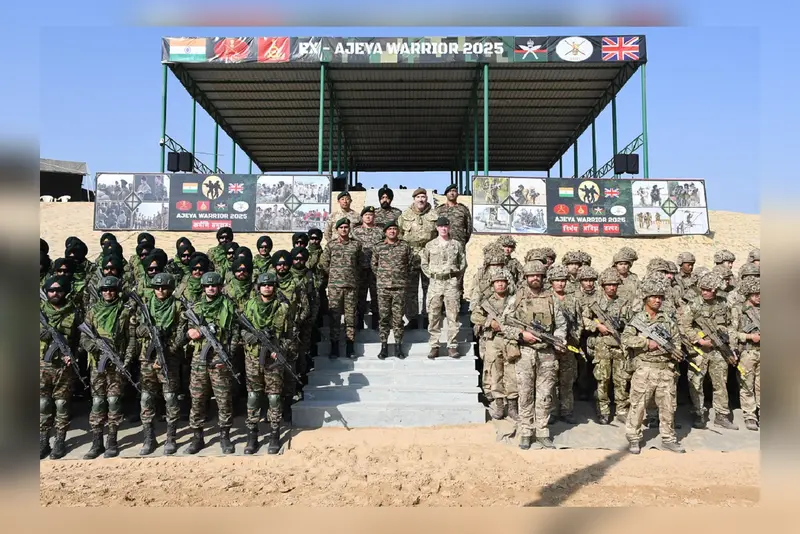
New Delhi: The United Kingdom and India have concluded the eighth edition of their flagship army exercise Ajeya Warrior, with senior officials on both sides presenting the event as evidence of a rapidly deepening defence partnership. Held at Mahajan Field Firing Ranges in Rajasthan from 17 to 30 November, the exercise brought together 120 soldiers from the Indian Army’s 21st Battalion The Sikh Regiment and an equal number from A (Amboor) Company, 2nd Battalion The Royal Gurkha Rifles. The two contingents operated under a fully integrated battle-group headquarters during the final validation phase, conducting complex counter-terrorism and peace-enforcement operations under a simulated Chapter VII UN mandate, that gives the United Nations Security Council (UNSC) the authority to take enforcement action.
The Indian Ministry of Defence stated, “‘AJEYA WARRIOR-25’ reinforced the strong defence cooperation between India and the United Kingdom and reaffirmed the shared commitment of both nations to global peace and security.” British High Commissioner Lindy Cameron directly tied the exercise to long-term strategic goals. “Defence and security forms a crucial pillar of UK-India Vision 2035,” she said.
“Exercise Ajeya Warrior is a demonstration of UK’s deepening defence ties with India as we deliver this shared vision over the next decade. Beyond military cooperation, it underscores our shared commitment to peace, stability and a rules-based international order.”
Commodore Chris Saunders MBE, UK Defence Adviser in New Delhi, emphasised operational convergence and regional implications. “Ex Ajeya Warrior follows closely on the back of our Navies training together during the recent visit by the UK’s Carrier Strike Group and demonstrates the ever-closer relationship and readiness of both our militaries to face shared security challenges in the Indo-Pacific region,” he said. “We now greatly look forward to welcoming the Indian Army to the UK for Ex Ajeya Warrior IX in 2027.”
Officials describe these exchanges, combined with increasingly complex joint exercises, as tangible steps toward genuine military interoperability between two countries. The exercise follows as India and the UK agreed on a 10-year Defence Industrial Roadmap designed to enable joint development and co-production of military equipment. It also comes months after the UK Carrier Strike Group conducted advanced bilateral manoeuvres with Indian naval forces. Indian officers already serve as instructors at the Royal Military Academy Sandhurst and Britannia Royal Naval College.
