How Trump wants to tie Syria into a new, stable Middle East

&imwidth=600&imheight=450&format=webp&quality=medium "How Trump wants to tie Syria into a new, stable Middle East")
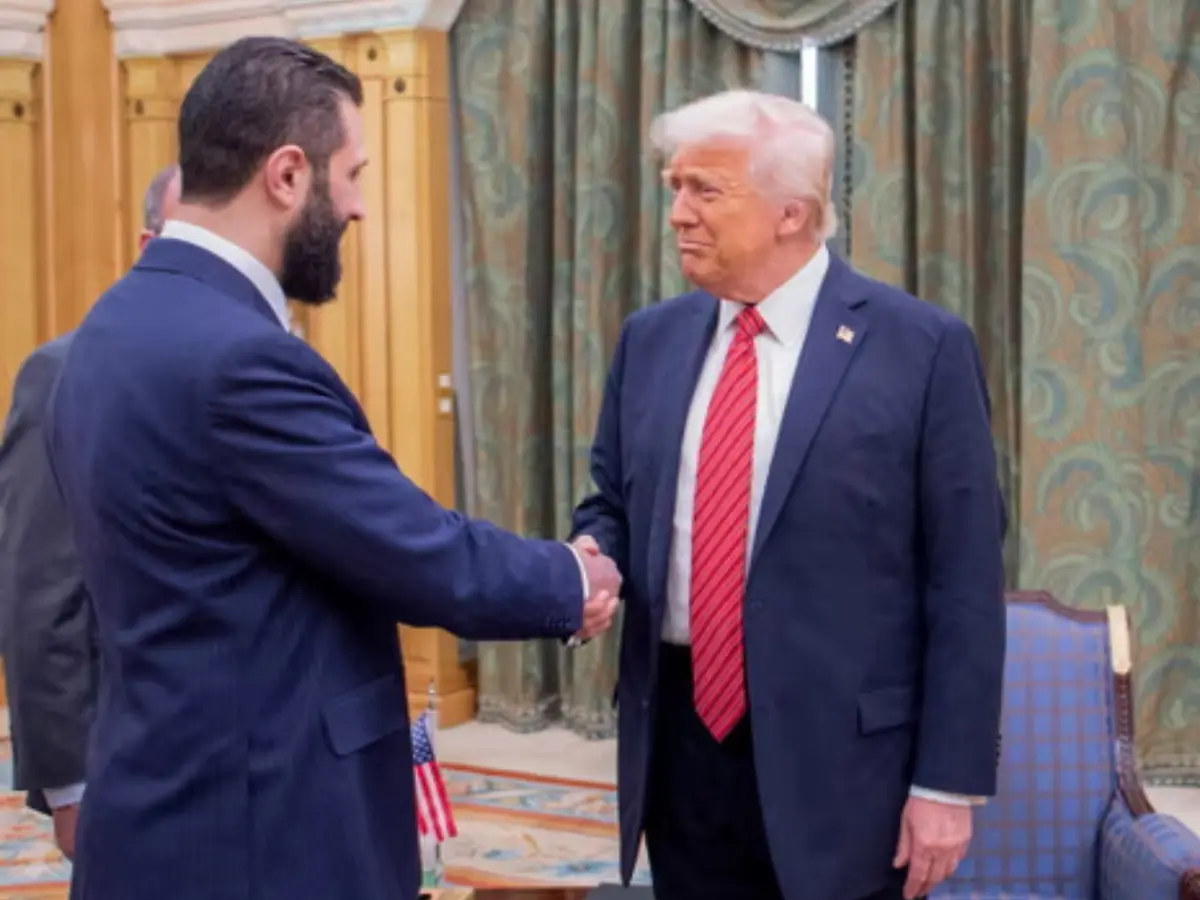
US President Donald Trump and Syrian Leader Ahmed al-Sharaa Photograph: (AFP)
Trump had praised Ahmed al-Sharaa as “a young attractive guy. Tough guy. Strong past. Very strong past. Fighter.” A man “with a real shot at pulling it together” in turning fractured, war-shattered Syria into a stable country.
On May 14, US President Donald Trump met Syria’s new leader, Ahmed al-Sharaa in Riyadh, the Saudi Capital. The meeting, over cups of tea, lasted 33 minutes, long enough for the American president to form a positive view of the Syrian.
He praised him as “a young attractive guy. Tough guy. Strong past. Very strong past. Fighter.” A man “with a real shot at pulling it together” in turning fractured, war-shattered Syria into a stable country. That would be a big step towards realizing Tump’s proclaimed vision of a new Middle East building on the Abraham Accord concluded in his first term.
Brokered by the US and signed in 2020, those accords normalized relations between Israel, the United Arab Emirates (UAE), Bahrain and Morocco. The White House has said it hope that Syria will establish relations with Israel and join the accords.
The Trump-al Sharaa meeting was the first between American and Syrian presidents in 25 years and came a day after a surprise announcement by Trump that all sanctions on Syria will be lifted “to give the country a chance at greatness.”
Trump’s unexpected announcement on the sanctions, at an economic conference in Riyadh, was followed by Executive Orders and a formal announcement by the Department of State along with a removal of al-Sharaa’s Hay’at Tahrir al-Shams (HTS) from the list of foreign terrorist organisations. Both took effect early in July.
AL-Sharaa led HTS fighters in a lightning offensive against the Syrian military that led to its collapse and the end of the regime of Bashar al-Assad, who fled into exile in Russia.
Trending Stories
)
)
)
)
)
)
)
)
)
)
)
)
)
)
)
)
)
)
)
)
)
)
)
)
)
)
)
)
)
)
)
)
)
)
&im=FitAndFill=(700,400))
)
)
)
)
That Trump would shake hands with the leader of the victorious anti-Assad forces less than five months after he seized powers astonished even the most veteran observers of Syria. After all, Washington dropped a $10 million reward for the capture of al-Sharaa only in December. It was imposed when al-Sharaa was a leader of al Qaeda before he broke from it and formed his own group. A White House fact sheet on June 30 provided a list of reasons for the dramatic change of positions on Syria, including “recent positive changes by the government of Syria after the fall of the brutal Assad regime (that) demonstrate promise for a stable and peaceful future.” It added that “this policy aligns with U.S. goals to promote peace and stability in the region.”
In the new climate of optimism, there was no mention of a series of massacres featuring the kind of stomach-turning acts of brutality that were a feature of the 14 months of civil war that began when Assad’s military opened fire on peaceful demonstrations against the government. For four days, an estimated 1,500 civilians belonging to the Alawite sect, an offshoot of Shia Islam, were massacred along Syria’s Mediterranean coast, the heartland of the Alawite minority, which held sway under Bashar al-Assad and his father Hafez. Alawites account for around 12 percent of the Syrian population and their dominant role was deeply resented by the Sunni majority.
According to the government, a wave of shootings and stabbings was in response to a day-old rebellion organized by former officers loyal to Bashar al-Assad against government security forces. The revenge by Sunni fighters featured acts of stomach-turning brutality. Some of them were depicted in graphic detail by the Reuters news agency, which conducted a months-long investigation into the slaughter. Example: “The young man’s heart was sliced from his chest and placed on his body. The men who killed him called his father from the victim’s phone and dared him to fetch the body.” Human Rights organisations, including Amnesty International, blamed militias affiliated with al-Sharaa’s government and said the coastal massacres of civilians should be investigated as war crimes. “Without justice, Syria risks falling back into a cycle of further atrocities and bloodshed,” the organization warned.
Al-Sharaa pledged to hold the perpetrators to account, established a fact-finding committee and formed an additional committee to maintain civil peace. The results of the investigation have not so far been published and human rights groups have expressed skepticism over the committee’s independence.
Trump’s words of praise for the new Syrian leader bring to mind an earlier premature judgment of a new president from a senior US official, then Secretary of State Hillary Clinton. During the early days of the Syrian uprising against Bashar al-Assad, Clinton was asked by a TV interviewer why the US government did not use force in the case of Syria as it had in Libya. Her response: “There is a different leader in Syria now. Many of the members of Congress of both parties who have gone to Syria in recent months have said they believe he’s a reformer.”
Bashar became president in July, 2000, succeeding his father Hafez, who died a month before, ending 29 years of iron-fisted rule enforced by administrations dominated by members of the Alawite minority. Father and son accounted for 53 years of Alawite minority rule over the Sunni majority. More than half a century of resentment.
Is al-Sharaa the man “with a real shot of pulling it together”, as Trump thinks? Time will tell.
