

&imwidth=800&imheight=600&format=webp&quality=medium "How ancient Indian Ocean trade shaped civilizations: Louvre Abu Dhabi launches 'spices and wonders'")
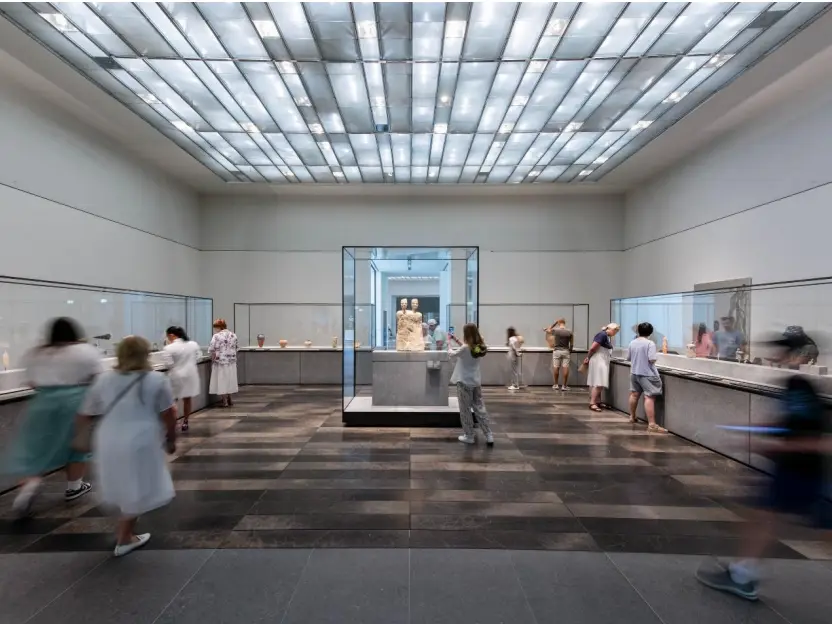
Louvre Abu Dhabi opened a new exhibition on Wednesday (Oct 14), exploring how maritime trade connected civilisations across the Indian Ocean. Spices and Wonders: Sailing the Indian Ocean runs until February 14, 2027. Organised with the Guimet National Museum of Asian Arts in Paris, the show brings together about 240 artworks and historical objects from 24 lenders. Lenders include the Asian Civilisations Museum in Singapore, the National Museum of the Philippines and the Al Sabah Collection in Kuwait. The exhibits cover maritime exchange from antiquity to the 17th century and include archaeological finds, jewellery, religious artefacts and objects recovered from shipwrecks.
The exhibition places the Arabian Gulf at the centre of the story. "The story is told from here, and that is something we consider very important at Louvre Abu Dhabi," said Guilhem Andre, the museum's director of scientific, curatorial and collections management. He added that this had not been done on such a scale before.
Visitors enter a darkened opening gallery with lights imitating a star-filled sky, reflecting how ancient navigators relied on the stars and coastal landmarks. Pierre Baptiste, director of collections and curatorial staff at the Guimet, said the aim was to give visitors a sense of what people experienced at the time.
Later galleries display navigational instruments, including the kamal, used in Arab and Indian maritime traditions, and the astrolabe. Twenty-four maps created for the exhibition trace routes linking ports across the ocean. Six large ship models represent Arabian, South-East Asian, Chinese, Portuguese and Spanish traditions. Andre said they were built in South Africa over a year, based on extensive historical research. They are shown alongside shipwreck finds that offer evidence of the cargo the vessels carried. Baptiste noted that advances in underwater archaeology since the 1990s have allowed researchers to recover significant material from sunken ships, including objects from China, India, Spain and Mexico.
Trade goods featured include spices, which commanded high prices, along with jewellery, furniture and textiles. The Gulf's pearl industry is a key regional example, with pearls reaching markets in India and beyond, while carnelian was traded across the ocean from ancient times. Andre said discoveries of new sources of gold, spinels, rubies and emeralds influenced jewellery production. Diplomatic gifts show how valuable objects helped build relationships between rulers.
Trending Stories
&im=FitAndFill=(700,400)&imwidth=180&imheight=135&format=webp&quality=medium)
Navratri 2026: 9 days, 9 forms of Goddess Durga and 9 colours- Check the complete list
&imwidth=180&imheight=135&format=webp&quality=medium)
US considering use of ‘mother of all bombs’ in its war with Iran: Report
&imwidth=180&imheight=135&format=webp&quality=medium)
Is America trying to ‘destabilise’ India or change its regime? How influence operations became a recurring theme in political rhetoric
&imwidth=180&imheight=135&format=webp&quality=medium)
Russian woman and Bihar boy's love story goes viral after she reaches India to marry him
&imwidth=180&imheight=135&format=webp&quality=medium)
Arijit Singh 9-city India stadium tour to start from January: Check venue and ticket prices
&imwidth=180&imheight=135&format=webp&quality=medium)
F1 set to return to Africa for first time since 1993
&imwidth=180&imheight=135&format=webp&quality=medium)
'Don't ever mess with nature!': Trump’s tiger attack post triggers social media backlash as victim's family issues heartbreaking tribute
&imwidth=180&imheight=135&format=webp&quality=medium)
Ankita Bhandari’s parents detained after overnight India Gate protest; released later: Why are they protesting
&imwidth=180&imheight=135&format=webp&quality=medium)
US judge blocks Trump administration sanctions on human rights groups supporting Gaza war crimes investigation
&imwidth=180&imheight=135&format=webp&quality=medium)
Washington calls for 'de-escalation' as Ethiopia-Eritrea tensions fuel war fears
&im=FitAndFill=(700,400)&imwidth=180&imheight=135&format=webp&quality=medium)
Which jobs are safest from humanoid robots?
&imwidth=180&imheight=135&format=webp&quality=medium)
US midterms: Trump rallies behind Husted as Brown mounts challenge in crucial Ohio race
&imwidth=180&imheight=135&format=webp&quality=medium)
US police foil alleged mass shooting plot targeting Illinois Hindu temple during Navratri; 19-year-old’s manifesto called Indians ‘subhumans’
&imwidth=180&imheight=135&format=webp&quality=medium)
Group of men cheered and asked 'when’s it my turn?' as woman was assaulted inside bathroom at University of Chicago frat party
&imwidth=180&imheight=135&format=webp&quality=medium)
‘Rise up, young patriots!’: American singer Mary Millben says US donors funding CJP, backs Modi govt
&imwidth=180&imheight=135&format=webp&quality=medium)
Nobel Peace Prize winner Navi Pillay calls on US to 'get back to' being defender of human rights
&imwidth=180&imheight=135&format=webp&quality=medium)
Who is Abu Dhabi royal Mahrah Al Nahyan, found unconscious on London street with toddler after cocaine use
&imwidth=180&imheight=135&format=webp&quality=medium)
Iranian woman, 23, handed death sentence for ‘blasphemy’ in social media post; appeals for help
&imwidth=180&imheight=135&format=webp&quality=medium)
'Turn approver, resign, we'll forgive you': Rahul Gandhi claims receiving messages from CEC Gyanesh Kumar
&imwidth=180&imheight=135&format=webp&quality=medium)
'Leakers should be shot': Trump rages over leak of US military plans to attack Iran, slams media
&imwidth=180&imheight=135&format=webp&quality=medium)
Bangladesh man killed after mob storms hospital, drags him away over blasphemy allegations
&imwidth=180&imheight=135&format=webp&quality=medium)
‘My president, I mean my husband’: Trump's new press secretary Katie Zacharia's first briefing goes off the rails in 14 minutes
&imwidth=180&imheight=135&format=webp&quality=medium)
Mars is not for man: Human heart is too weak to survive the trip, study shows
&imwidth=180&imheight=135&format=webp&quality=medium)
Girl 'dead' for 8 hours wakes up at her own funeral, dad insists she wasn't breathing
&imwidth=180&imheight=135&format=webp&quality=medium)
India-Afghanistan relations: Growing India-Kabul ties to rattle Islamabad?
&im=FitAndFill=(700,400)&imwidth=180&imheight=135&format=webp&quality=medium)
New OTT releases this week (October 12-18, 2026): Sacrifice, Koffee with Karan S9, Roadies Rebirth- 6 titles coming on Netflix, JioHotstar and more
&imwidth=180&imheight=135&format=webp&quality=medium)
Actor Imran Khan asked to leave India by the Mumbai Police days after participating in CJP-led protest
&imwidth=180&imheight=135&format=webp&quality=medium)
Did the US withhold missile warnings? Ukraine questions Washington's 'bad weather' explanation after Russian strikes kill six, cut power to 600,000
&imwidth=180&imheight=135&format=webp&quality=medium)
Global energy crisis hits Indian economy
&imwidth=180&imheight=135&format=webp&quality=medium)
Hidden video recording device found on Australian Navy ship amid claims of secret filming
&imwidth=180&imheight=135&format=webp&quality=medium)
'White supremacist' terror plot against Illinois Hindu temple foiled by jammed gun: Who is Alexandros Paporakis?
&imwidth=180&imheight=135&format=webp&quality=medium)
Zelensky feels betrayed by Trump, urges Musk to restore Starlink in Ukraine; Musk responds
&imwidth=180&imheight=135&format=webp&quality=medium)
'Girls are uncomfortable': Salman Khan calls out paparazzi for bad angles, speaks on PR on Koffee With Karan
&imwidth=180&imheight=135&format=webp&quality=medium)
After flydubai co-pilot attack, Air France bans Pakistani, Muslim-majority crew on Israel flights
&imwidth=180&imheight=135&format=webp&quality=medium)
US midterms 2026: Trump under election watch? Democrats deploy 100 observers across nine states
Cultural exchange is another theme. A Buddha sculpture from present-day Pakistan, loaned by the Guimet, reflects the influence of ancient Greek and Roman artistic traditions. The final gallery examines four religious traditions that spread along the same routes as commerce. "Religion was not separate from trade," Andre said.
The narrative ends in the 17th century by design, Baptiste said, to show networks that existed before European powers became prominent. "Europe was only one part of this story," he said. The exhibition will travel to the Guimet in Paris, where it will run from May 12 to September 6, 2027.

