

&imwidth=800&imheight=600&format=webp&quality=medium "Greenwashing: Are we being fooled into buying eco-friendly products that aren’t? WION Decodes")
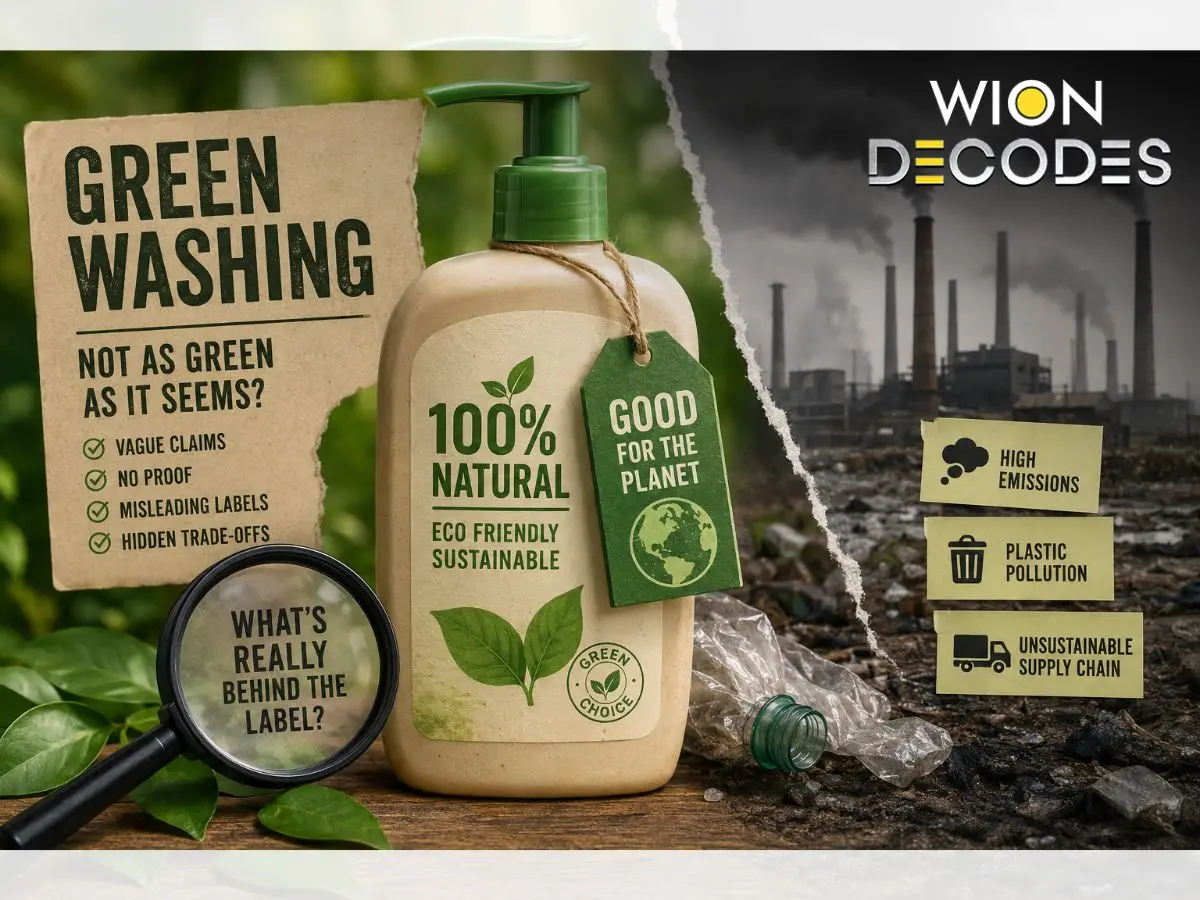
As climate change and environmental concerns start to take centre stage, several people are opting for sustainable, eco-friendly, or natural products. With a shift in consumer perspective, several brands have also introduced environmentally friendly products, flooding store shelves with green labels and promises. But are these items actually eco-friendly, or are we being fooled into believing a fake marketing gimmick by big brands, which are just “greenwashing” us?
What is greenwashing?
Many of the so-called sustainable and eco-friendly products in the market are not actually as green as they claim to be. Major companies, which are seizing every opportunity to make more money, are taking advantage of the fact that the consumer perspective has now shifted towards products that appear better for the environment and climate – “appear” being the keyword here.
Regardless of whether a certain product is a better alternative for our planet, firms have been engaging in a marketing strategy called greenwashing.
Greenwashing refers to the practice of misleading consumers into believing that a company, product, or service is more environmentally friendly than it actually is. The term was coined in the 1980s by environmentalist Jay Westerveld, who criticised hotels for encouraging guests to reuse towels in the name of environmental protection while making little effort to reduce their broader environmental footprint.
In simple terms, greenwashing occurs when marketing and branding create an illusion of sustainability that is not supported by meaningful environmental action.
Trending Stories
&im=FitAndFill=(700,400)&imwidth=180&imheight=135&format=webp&quality=medium)
What is the real meaning behind Pete Hegseth's tattoos?
&imwidth=180&imheight=135&format=webp&quality=medium)
Kim Jong Un death rumours: State media shares photos to prove dictator is alive amid reports of brain haemorrhage
&imwidth=180&imheight=135&format=webp&quality=medium)
Two Indians among 28 arrested in California over alleged voter registration fraud, DOJ says
&imwidth=180&imheight=135&format=webp&quality=medium)
‘Nuclear-use decision should be taken by humans’: India flags AI risks at UN
&imwidth=180&imheight=135&format=webp&quality=medium)
Flying car race: Alef Aeronautics welcomes Tesla Roadster '11 years' later, but are the two models the same?
&imwidth=180&imheight=135&format=webp&quality=medium)
Dussehra 2025: Why is Ravana not burnt but worshipped in these places of India?
&imwidth=180&imheight=135&format=webp&quality=medium)
Shastri backs Shami comeback; lauds Bhuvi and warns Bumrah on format workload ahead of World Cup
&imwidth=180&imheight=135&format=webp&quality=medium)
Netanyahu rival Benny Gantz quits Israel election race, vows to push for unity government
&imwidth=180&imheight=135&format=webp&quality=medium)
US Midterm 2026: What do opinion polls and prediction markets say less than two weeks before voting
&imwidth=180&imheight=135&format=webp&quality=medium)
Mariah Carey wins $20 million legal battle over brother’s defamation lawsuit against her bestselling memoir
&imwidth=180&imheight=135&format=webp&quality=medium)
WATCH | Albania protesters set Supreme Court on fire as anti-Rama riots escalate
&imwidth=180&imheight=135&format=webp&quality=medium)
Indian Air Force turns to homegrown firefighting robot developed under iDEX programme
&imwidth=180&imheight=135&format=webp&quality=medium)
Pete Hegseth meets Benjamin Netanyahu during unannounced visit to Israel ahead of election
&im=FitAndFill=(700,400)&imwidth=180&imheight=135&format=webp&quality=medium)
Ghaziabad is world's fastest-growing city; Surat, Patna, Rajkot also feature on list
&imwidth=180&imheight=135&format=webp&quality=medium)
'It's a joy to see the makers bring it on such a grand scale': SS Rajamouli on Ramayana
&imwidth=180&imheight=135&format=webp&quality=medium)
Dark fantasy, violence, adult themes: BBFC data reveals animation's shift towards older audiences
&imwidth=180&imheight=135&format=webp&quality=medium)
Far-left parties, global networks among 54 groups linked to France protests, only 16 are youth outfits: Report
&imwidth=180&imheight=135&format=webp&quality=medium)
WATCH | Japan launches historic mission to collect samples from Mars' moon Phobos
&imwidth=180&imheight=135&format=webp&quality=medium)
India begins National Red List Assessment of 1,211 bird species to boost conservation
&imwidth=180&imheight=135&format=webp&quality=medium)
PCB omits Atherton, Hussain from tri-series commentary panel over Imran Khan interview row
&imwidth=180&imheight=135&format=webp&quality=medium)
Trump calls on New Mexico to become 'New America', claims 'home values and incomes would rise'
&im=FitAndFill=(700,400)&imwidth=180&imheight=135&format=webp&quality=medium)
Priyanka Chopra to Shilpa Shetty: 6 Bollywood actresses and their fitness secrets
&imwidth=180&imheight=135&format=webp&quality=medium)
Pujara says 'Samson and Vaibhav cannot be in Playing XI' for India on NZ tour
&imwidth=180&imheight=135&format=webp&quality=medium)
US midterms 2026: From Pooja Sethi to Vivek Ramaswamy, here are Indian-origin candidates to watch out for
&im=FitAndFill=(700,400)&imwidth=180&imheight=135&format=webp&quality=medium)
New OTT releases this week (October 19-25, 2026): Gajab Raat to Chaar Yaar-8 titles to watch during Dussehra week on Netflix, Prime Video and more
&imwidth=180&imheight=135&format=webp&quality=medium)
Baby orangutan rescued in India returns to Indonesia
&imwidth=180&imheight=135&format=webp&quality=medium)
India moves to buy 10,000 more AI chips for a national compute pool open to startups
&imwidth=180&imheight=135&format=webp&quality=medium)
Prince Harry, Meghan Markle never accepted Queen Elizabeth’s terms for royal exit: Report
&imwidth=180&imheight=135&format=webp&quality=medium)
'Whatever I can do to end this war': Trump floats China Summit with Putin and Xi, questions Zelensky's role in peace talks
&imwidth=180&imheight=135&format=webp&quality=medium)
'They are not even telling us' - Mysterious metallic object discovered in Minnesota field
&imwidth=180&imheight=135&format=webp&quality=medium)
'We feel like Mr India': Gujarat’s undercover SHE team guard garba nights at Navratri
&imwidth=180&imheight=135&format=webp&quality=medium)
Cattle-feed bran in biscuits, detergent in milk: FSSAI acts against 3 companies
&imwidth=180&imheight=135&format=webp&quality=medium)
Feds obtain DNA evidence that could prove Ilhan Omar married her brother: Report
&imwidth=180&imheight=135&format=webp&quality=medium)
Ramayana advance booking: Ranbir Kapoor, Yash's film cross $500K ahead of Diwali release
&imwidth=180&imheight=135&format=webp&quality=medium)
AUS vs SA: Boland grabs opportunity with both ends to help Australia dominate
How companies make products appear ‘green’
Today, greenwashing is widespread across industries. Companies often use vague terms such as “eco-friendly,” “natural,” “green,” or “sustainable” without providing evidence to support these claims. Others rely on green packaging, images of forests and leaves, or self-created environmental labels that create an impression of environmental responsibility.
Some firms highlight a single environmentally friendly feature while ignoring larger sustainability issues associated with their operations, a tactic critics describe as “hidden trade-offs.”
Industries under scrutiny
Several sectors have come under increasing scrutiny for alleged greenwashing practices.
The fashion industry is frequently accused of promoting “conscious” or “sustainable” collections while continuing production models that generate significant waste and pollution. Airlines often advertise carbon-neutral flights through offset programmes, despite aviation remaining one of the most carbon-intensive forms of transport.
Similarly, major energy companies have faced criticism for promoting renewable energy initiatives in advertisements while continuing to derive much of their business from fossil fuel production.
Also read | WION Decodes | Why does coffee calm some people instead of waking them up? Here’s what science says
Regulatory measures
Amid rising greenwashing, governments and regulators have stepped up to take action. The European Union has introduced stricter rules requiring businesses to substantiate environmental claims with credible evidence.
In India, the Advertising Standards Council of India (ASCI) has issued guidelines requiring environmental claims to be clear, specific, verifiable and backed by scientific proof. Regulators worldwide are increasingly demanding transparency to prevent consumers from being misled.
How can you spot greenwashing?
For consumers, identifying greenwashing can be difficult. Experts recommend looking beyond marketing slogans and examining whether a company provides measurable data, independent certifications and transparent sustainability reports.
Warning signs may include vague environmental claims, a lack of evidence, and heavy reliance on buzzwords without clear explanations of environmental benefits.
WATCH | G7 Summit 2026: World Leaders Gather For The High Stakes Summit In Evian-Les-Bains

