
&imwidth=800&imheight=600&format=webp&quality=medium "Fortress Évian: Inside the massive security operation for G7 summit")
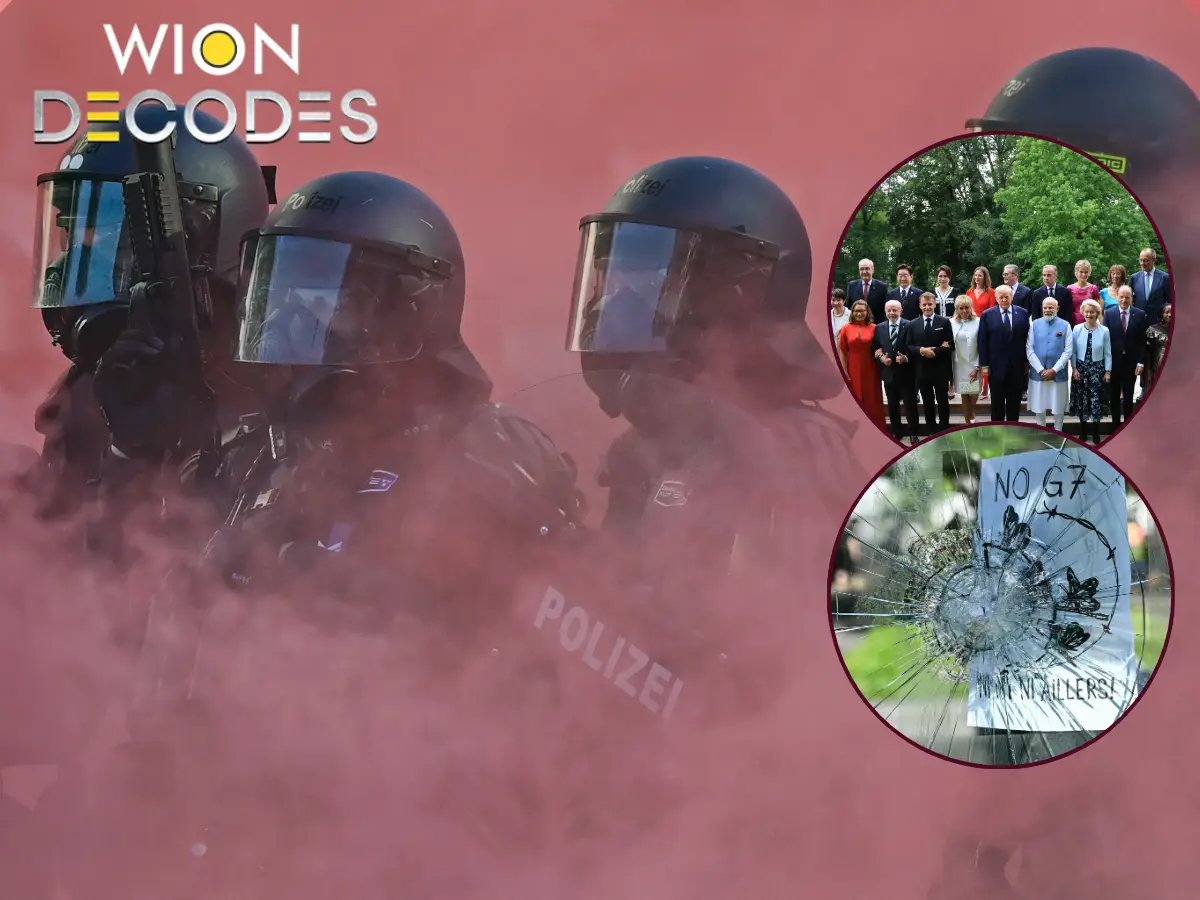
Long before world leaders begin discussing wars, trade and diplomacy at the G7 summit in Évian-les-Bains, thousands of security personnel from two countries had already launched one of the largest security operations seen in the region in years.
Nestled between Lake Geneva and the French Alps, the picturesque resort town of Évian presented a unique challenge for planners. Leaders will arrive through Switzerland, some delegations will stay on Swiss territory, while the summit itself takes place in France. Securing the event has therefore required an unprecedented level of cross-border coordination. How was this feat achieved? All you need to know about how Evian was turned into a fortress.
How Évian became a fortress

Behind the diplomatic photo opportunities and summit communiqués was a vast security operation stretching across two countries, thousands of personnel and an entire region transformed into a temporary fortress.
Why 21,000 security personnel were deployed
French authorities deployed nearly 16,000 personnel, including police officers, gendarmes, soldiers, firefighters and border guards. French personnel handled the immediate protection layer around the summit, with reinforced security zones covering Evian, nearby Thonon-les-Bains and the main transport routes.
Trending Stories
)
Pentagon revives mandatory testosterone testing for male troops aged 30 and above
)
FACT CHECK: Why did PM Modi ask Xi ‘is it okay’ at BRICS Summit? New video reveals...
)
India seeks to build a full semiconductor supply chain
&im=FitAndFill=(700,400))
From Abhishek Sharma to Sahil Chauhan, 5 batters with fastest T20I hundreds
)
Pyongyang dismisses US, western pressure over nuclear programme
)
US And Denmark reach Greenland deal, Trump announces expanded military presence
)
Google’s Gemini AI hacks real systems by guessing passwords during security test
)
US hiding troop deaths in Iran war? Toll higher than Pentagon count, claims report
)
China may have gained access to US's classified F-35 jets; parts meant for repairs diverted to Hong Kong, sparking Pentagon inquiry
)
NASA research plane reaches 61,000 feet over Panama
)
Godfather of AI Geoffrey Hinton gives US lawmakers a one-year warning on AI
)
Trump signs Russia sanctions law: India faces fresh 100% tariff threat over Russian oil
)
Brigitte Bardot’s private collection set for Paris auction; key items and prices revealed
)
Why Ranveer Singh’s Dhurandhar missed India’s Oscar entry; FFI jury member reveals what happened
)
Zendaya and Tom Holland step out for a low-key date in Los Angeles
)
‘Will go to any extent’: Pakistan vows to defend Saudi Arabia amid Houthi attacks
)
The Verdict | When precision fails: US commits war crime in Minab school strike, UN finds
)
Trump signs Russia sanctions bill into law, targets Moscow’s energy sector
66 years of the Indus Waters Treaty: How India and Pakistan settled a bitter river dispute
&im=FitAndFill=(700,400))
New Friday OTT releases (September 18, 2026): Lust Stories 3, You+Me, Best of the Best- 8 new titles coming on Netflix, Prime Video and more
)
Pak: A series of counter terrorism operations in Khyber Pakhtunkhwa
)
Fast bowler Brydon Carse faces no charges over Derby nightclub incident
)
Flying cars in UAE: Ras Al Khaimah signs deal with Chinese company to test new transport
)
Africa is splitting, and a lot sooner than estimated, giving way to a new ocean
)
Trump bans CNN, MS NOW and Politico from White House over ‘FAKE NEWS’
)
Trump 2.0: Dark days ahead for America’s ‘imperial presidency’
)
Trump's Greenland dream comes true? POTUS announces 'Infinite Life' deal with Denmark, claims permanent US control
)
Tirupati Laddu ghee adulterated with chemicals, says ED, supplier arrested
)
Who is Khalilur Rahman? All you need to know about 81st UN General Assembly President
)
IIT Bombay student dies by suicide, was caught seeking AI help during exams
&im=FitAndFill=(700,400))
Meet top 5 bowlers in latest ICC T20I rankings
)
Indian Cinema bets big on mythology, brings ancient stories to modern audiences
)
Ukraine plans record $109 bn defence spending, nearly two thirds of budget amid Russia war
)
Russia holds first parliamentary elections since the beginning of the Ukraine war
&im=FitAndFill=(700,400))
Meet top 5 Indian batters with fastest T20I centuries
)
During the summit, security teams patrolled by land, air and water, using motorcycles, patrol boats, drones, mounted police units and sniffer dogs.
The operation reflects more than just the scale of the summit. Officials say they are preparing for a range of threats, from terrorism and cyberattacks to sabotage attempts and public unrest. According to government prefect Emmanuelle Dubee, the deployment was to address "the risk linked to the extremely tense international context", the "terror threat, which remains high in France", the "risk of sabotage and cyber-attacks", and "public order disturbances".
Perhaps the most visible element of the security architecture is the air defence network that was built above the summit. Around 300 French Air Force personnel were tasked with creating what officials describe as a protective "bubble" around the venue.
A rare France-Switzerland security partnership
Additionally, French and Swiss forces jointly deployed radar systems, military aircraft, surface-to-air defence assets and counter-drone technology designed to detect and neutralise aerial threats.
Across the border, Switzerland authorised the deployment of up to 5,000 military personnel, with roughly 4,000 active throughout the summit period. Swiss troops operated on land, in the air and across Lake Geneva, coordinating closely with French counterparts.
Why officials still remember the 2003 G8 riots
The security preparations are also shaped by history, reported AFP. When Évian hosted the G8 summit in 2003, demonstrations spilled into nearby Swiss cities including Geneva and Lausanne, where riots, looting and clashes with police caused widespread damage. Two decades later, memories of those events continue to influence planning.
This year, authorities also faced an early test with large anti-G7 demonstration scheduled in Geneva on the eve of the summit. While organisers insisted the protest will remain peaceful, early on businesses began boarding up shopfronts and security agencies closely monitored the possibility of radical groups attempting to infiltrate the march.
Life under lockdown for local residents
For residents on both sides of the border, the summit brought road closures, enhanced border checks, restricted airspace and heavy police presence.

