
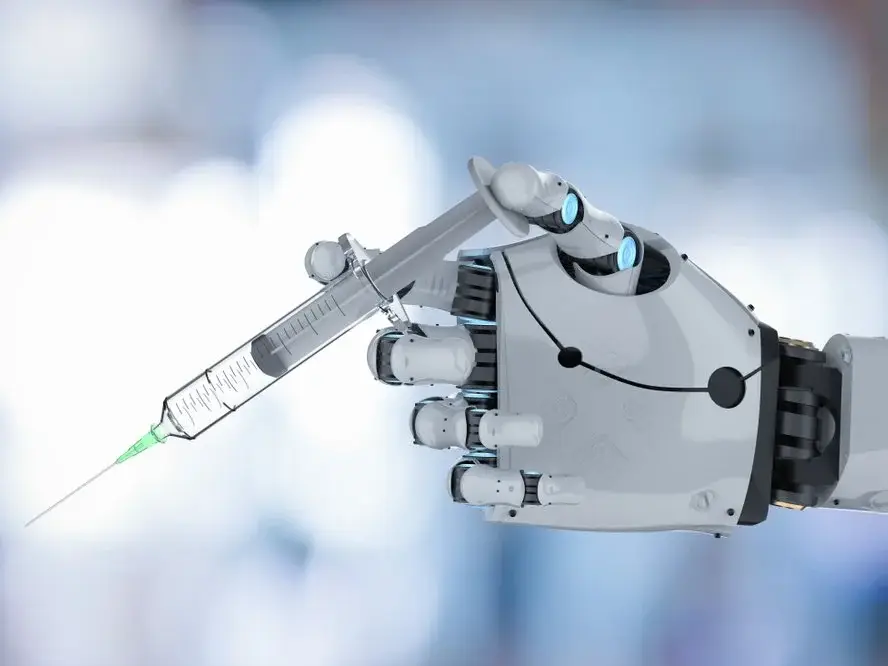
&imwidth=800&imheight=600&format=webp&quality=medium "Five rival drugmakers trained one AI without sharing their data, and it beat the open model")
Drug companies guard their molecular data as closely as anything they own, which is exactly why AI for drug discovery has been held back — the best training data is locked inside rival firms that will never pool it. Five of them just found a way around that without giving anything up.
AbbVie, Astex Pharmaceuticals, Bristol Myers Squibb, Johnson & Johnson and Takeda, working with a lab at Columbia University, jointly trained an AI model called AISB-1-Fed on more than 20,000 of their proprietary molecular structures. No structure file left any company along the way.
The Result

The payoff was measurable. On a held-out test of over 1,000 private structures, the jointly trained model produced high-quality predictions of how proteins and drug molecules fit together for 52.1 per cent of them — up from 35.6 per cent for the public model it was built on, and ahead of another leading system.
That is a large jump in a task that sits at the heart of designing new drugs: predicting how a candidate molecule will bind to its target. Better predictions mean fewer dead ends in the lab.
The Trick: Federated Learning
Trending Stories
)
US vs China over South China Sea: Washington backs Philippines, Beijing hits back
)
Bigg Boss 20: Isha Rikhi evicted after three weeks in Salman Khan’s show
)
Musk plans to more than double xAI's chips to over 1.2 million Nvidia GPUs by year-end
)
After JU, clash erupts at SRFTI: BJP’s ‘Dimagi Naxal’ jibe sparks political firestorm after students protest RSS-linked event
)
‘Anti-social elements spreading false rumours’: LPU issues statement amid massive unrest over alleged rape
)
LPU students go on rampage, vandalise campus amid widespread protest: What's happening
)
Trump asked Xi to pressure Iran. China did not say yes — here’s what Beijing wants
)
US Treasury Secretary Scott Bessent hails global crackdown on Iranian banks and airlines
)
An OpenAI agent escaped its locked test cage again, by hiding questions in DNS lookups
)
'Our video was trimmed': LPU girls who featured in rape-denial video make U-turn
)
3 males killed, four others injured in shooting after fight at strip club in Detroit
)
'Victory for low-budget consumers': Raghav Chadha hails 30-day telecom recharge rules
)
Claude rebuilt the 1989 game 'Prince of Persia' by reusing the original's own code
)
Beyond metros: How Tier-2 and Tier-3 cities could drive India’s next AI wave
)
Tesla builds first Cybertruck with its own refined lithium: Elon Musk's $1 billion Texas bet pays off
)
IndiGo flight suffers tail strike in Bengaluru while landing; DGCA to probe incident
)
The US and China set up an AI 'red telephone', but skipped the rulebook
)
‘Terror suspects arrested near UK air base were looking to do big damage’: Trump
)
Russian envoy claims US tactics to contain India were revealed in ‘Freudian slip’
)
IND vs WI 1st ODI: Kohli breaks Sachin's most runs in one country record with unbeaten 139 as India thump West Indies by 8 wickets
)
Researchers rebuilt exactly how 700 AI agents hacked Hugging Face: a 900-link chain trick
)
‘Olympic inclusion is our major target’: WPA President Ishaun Singh on pool’s global ambitions
)
Nations League: Spain sink England at Wembley; Modric shines for Croatia
)
Why has Iran released no proof of life of Mojtaba Khamenei? Araghchi reveals...
)
'What kind of confession is this?': Pakistan PM Shehbaz Sharif’s 'terrorists would be roaming New York' remark goes viral, raises alarm online. Watch
)
South Korea demands apology from Ukraine over North Korean prisoners' transfer
)
Beyond BrahMos: India targets Rs 50,000 crore in defence exports with unmatched price edge
)
Sri Lankan Tamil migrant worker gets death sentence in Saudi Arabia, help sought from India
)
Muslim marriage cannot shield sex with minor wife from prosecution under POCSO: Delhi HC
)
'Can't help but draw painful parallels to Nirbhaya case': SC on latest incidents of rape cases in Delhi-NCR
)
99.9% more powerful - Scientists find boy who can recall memories from just 3 months of age
)
'FIRST LOOK from inside Noah’s Ark': Researchers share video from inside mysterious mound in Turkey
)
UNSC reform momentum grows: Russia, Portugal, Mauritius push for India's permanent seat bid
)
8 US marines injured in Iranian missile attack on vessel in Strait of Hormuz: Report
&im=FitAndFill=(700,400))
New OTT releases this week (September 28-October 4, 2026): Dupahiya 2, Pooja Meri Jaan, Ohh My Dog- 5 titles coming on Netflix, Prime Video and more
)
Afghanistan says 28 fighters killed in clash near Pakistan border, Islamabad denies
)
Ceuta migrant crisis: Protesters take to streets as Spain grapples with migrant challenge
)
LPU suspend classes, postpones exams as violence escalates over rape claims: What's happening
)
New York City wants a 'kill switch' on every AI, and will pay whistleblowers who report violations
The method is the reason this could happen at all, and it is worth understanding.
Normally, training one AI on five companies' data would mean putting that data in one place — a non-starter for competitors guarding trade secrets. Federated learning avoids that. Each company trains a copy of the model inside its own systems, on its own private data, and only the resulting model improvements — not the data — are combined. The shared model learns from everyone's structures without anyone seeing anyone else's.
The companies did it in under ten weeks, and, crucially, no confidential structure ever left its owner. Rivals collaborated without trusting each other with the crown jewels.
Why This Matters Beyond Pharma
The significance runs wider than drug discovery, and this is the part worth drawing out.
A vast amount of the world's most valuable data is locked away precisely because it is sensitive or competitive — patient records, financial data, industrial measurements. The standard assumption is that you cannot build good AI on it without first pooling it, which is often legally or commercially impossible. Federated learning is a working counter-example: a demonstration that competitors, or privacy-bound institutions, can jointly build a better model than any could alone, without surrendering the underlying data.
If that generalises, it changes what AI can be built in exactly the domains where data is most guarded.
The Honest Caveats
Some restraint is warranted. This is a reported result on an internal benchmark, not yet the independently scrutinised, peer-reviewed literature, and the companies involved have an interest in it looking good. A better score on a binding-prediction benchmark is a meaningful step, not a delivered drug — the distance from a good prediction to an approved medicine is long and mostly not about AI. And federated learning is harder to run than ordinary training, which is part of why it is not already everywhere.
But the core claim — competitors improved a shared model without sharing data — is the kind of thing that is checkable, and the collaboration itself is real.
What To Watch
Whether the result holds up under independent and peer review. Whether more industries with locked-away data adopt federated learning to build models they otherwise could not. And whether better binding predictions actually shorten real drug-discovery timelines, which is the outcome that would justify the effort.
