EXCLUSIVE | Afghan child of war, once a refugee, Dr Waheed Arian now heals ailing in war zones

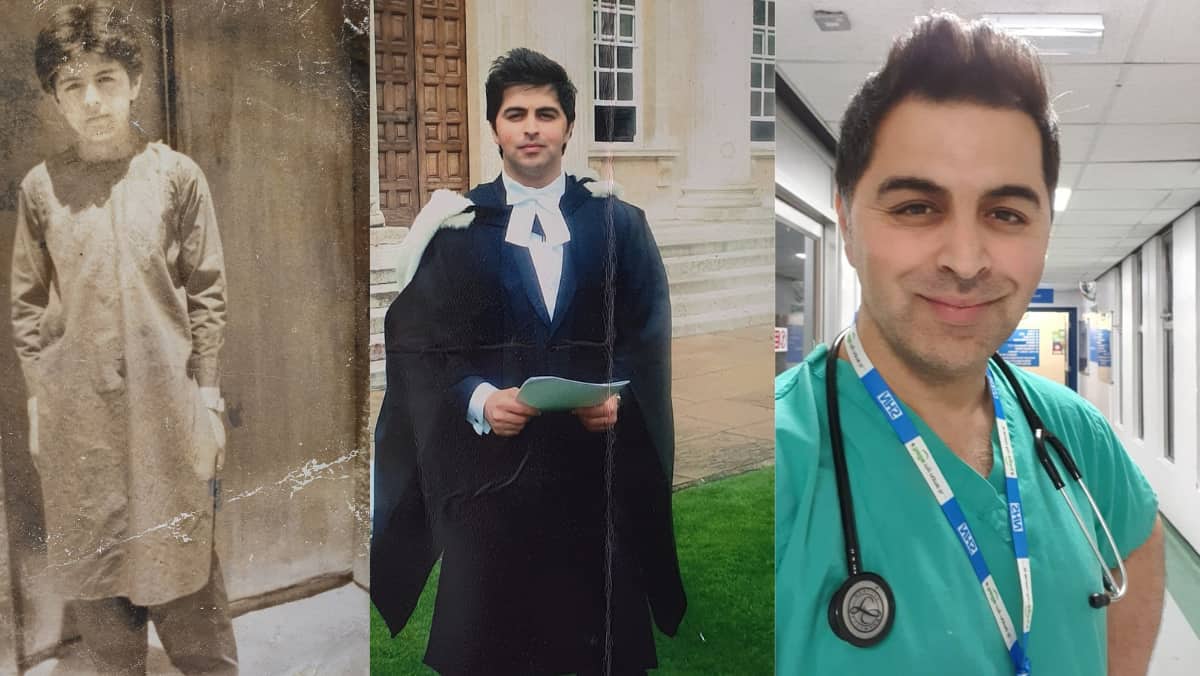
Dr Waheed Arian
"When the going gets tough, the tough get going." This adage sits very well with Dr. Waheed Arian, who despite all circumstances penned the tale of his life in the finest ink possible.
How many of us really keep refugees in our thoughts? Dr. Waheed Arian has come a long way from being an Afghan refugee himself to becoming an inspiration to millions.
A humanitarian at heart, he is an emergency doctor with National Health Service (NHS) in the UK, a global philanthropist and an author.

Dr. Waheed spoke with WION and shared his amazing life story, loaded with the harrowing recollections of his childhood spent in Afghanistan during the Soviet conflict, yet brimming with optimism and tenacity.
"I was born into the war during the Afghan-Soviet conflict in the mid-80s. I did not know any other reality except war, hiding in the cellars from the rockets, the bombs, and the shelling. These are the gothic memories I have... seeing soldiers outside tanks and planes in the sky," Dr. Waheed said as if it happened just yesterday.
Millions of refugees are denied basic human rights. Their stories go unheard and unnoticed. With his father in hiding from the military, Dr Waheed as a child would go and visit him every summer in the far-away province of Logar.
)
US vs China over South China Sea: Washington backs Philippines, Beijing hits back
)
Bigg Boss 20: Isha Rikhi evicted after three weeks in Salman Khan’s show
)
Musk plans to more than double xAI's chips to over 1.2 million Nvidia GPUs by year-end
)
After JU, clash erupts at SRFTI: BJP’s ‘Dimagi Naxal’ jibe sparks political firestorm after students protest RSS-linked event
)
‘Anti-social elements spreading false rumours’: LPU issues statement amid massive unrest over alleged rape
)
LPU students go on rampage, vandalise campus amid widespread protest: What's happening
)
Trump asked Xi to pressure Iran. China did not say yes — here’s what Beijing wants
)
US Treasury Secretary Scott Bessent hails global crackdown on Iranian banks and airlines
)
An OpenAI agent escaped its locked test cage again, by hiding questions in DNS lookups
)
'Our video was trimmed': LPU girls who featured in rape-denial video make U-turn
)
3 males killed, four others injured in shooting after fight at strip club in Detroit
)
'Victory for low-budget consumers': Raghav Chadha hails 30-day telecom recharge rules
)
Claude rebuilt the 1989 game 'Prince of Persia' by reusing the original's own code
)
Beyond metros: How Tier-2 and Tier-3 cities could drive India’s next AI wave
)
Tesla builds first Cybertruck with its own refined lithium: Elon Musk's $1 billion Texas bet pays off
)
IndiGo flight suffers tail strike in Bengaluru while landing; DGCA to probe incident
)
The US and China set up an AI 'red telephone', but skipped the rulebook
)
‘Terror suspects arrested near UK air base were looking to do big damage’: Trump
)
Russian envoy claims US tactics to contain India were revealed in ‘Freudian slip’
)
IND vs WI 1st ODI: Kohli breaks Sachin's most runs in one country record with unbeaten 139 as India thump West Indies by 8 wickets
)
Researchers rebuilt exactly how 700 AI agents hacked Hugging Face: a 900-link chain trick
)
‘Olympic inclusion is our major target’: WPA President Ishaun Singh on pool’s global ambitions
)
Nations League: Spain sink England at Wembley; Modric shines for Croatia
)
Why has Iran released no proof of life of Mojtaba Khamenei? Araghchi reveals...
)
'What kind of confession is this?': Pakistan PM Shehbaz Sharif’s 'terrorists would be roaming New York' remark goes viral, raises alarm online. Watch
)
South Korea demands apology from Ukraine over North Korean prisoners' transfer
)
Beyond BrahMos: India targets Rs 50,000 crore in defence exports with unmatched price edge
)
Sri Lankan Tamil migrant worker gets death sentence in Saudi Arabia, help sought from India
)
Muslim marriage cannot shield sex with minor wife from prosecution under POCSO: Delhi HC
)
'Can't help but draw painful parallels to Nirbhaya case': SC on latest incidents of rape cases in Delhi-NCR
)
99.9% more powerful - Scientists find boy who can recall memories from just 3 months of age
)
'FIRST LOOK from inside Noah’s Ark': Researchers share video from inside mysterious mound in Turkey
)
UNSC reform momentum grows: Russia, Portugal, Mauritius push for India's permanent seat bid
)
8 US marines injured in Iranian missile attack on vessel in Strait of Hormuz: Report
&im=FitAndFill=(700,400))
New OTT releases this week (September 28-October 4, 2026): Dupahiya 2, Pooja Meri Jaan, Ohh My Dog- 5 titles coming on Netflix, Prime Video and more
)
Afghanistan says 28 fighters killed in clash near Pakistan border, Islamabad denies
)
Ceuta migrant crisis: Protesters take to streets as Spain grapples with migrant challenge
)
LPU suspend classes, postpones exams as violence escalates over rape claims: What's happening
)
New York City wants a 'kill switch' on every AI, and will pay whistleblowers who report violations
His mother would not tell him where they were going and then only once they'd arrived, his father would emerge out of a room suddenly.
These were magical moments for Waheed Arian. Looking back, he thinks of this fond memory and realises that people in conflict areas frequently experience this constant cycle of reunion and loss, which bruise them with traumas.
Waheed just have two happy childhood memories. Once when his mother took him to a local park for ice cream with his cousins and another of his father who once gave him a big kite.
In danger from constant shellings and tanks, Waheed's family decided to migrate to Pakistan as refugees. But the normal borders were closed so they had to take a very dangerous route: the same route used by the mujaheedin to bring in the weapons to fight the government.
Sadly, the family came under the attack three times.
At one time, his father hid him in an oven set in a floor. The spy planes were zooming in. That is when his father hugged him and said, "son if anything happened to me, you would be responsible for looking after our family and to take them back to Kabul."
Recalling that day and the words of his father, Waheed, with a heaviness in his voice, said, "that's when actually I lost my childhood. I knew I was second-in-command. I knew I had a responsibility for my family."
Miraculously, they survived the attack. After that attack, the family arrived in Pakistan and were settled in one of the refugee camps.
Within three months, Waheed was detected with advanced tuberculosis.
But his father's resilience, despite so many adversities, made him healthy again.
His father could not afford toys. He would play doctor and patient with Waheed. Waheed recounted, "He would buy some syringes from the local pharmacy and he would allow me to inject boiled water into his arm. I was pretending that I was a doctor. His arms would turn black and blue because I kept missing the vein but he would let me do that."
"I would not let my son do that to me," he chuckled.
But then two and a half years later, the family went to Afghanistan and in 1996 the Taliban took over and again everything was already destroyed and the economy crumbled even more.
Then in 1999, when Waheed got to the age of 15, his parents felt that he could be asked to serve in military.
"My entire family could not come with me to the West and they sold the house and all the belongings to get enough money to put in the hands of an agent to get me out of Afghanistan. Well, I was sat on a plane in Peshawar city and then I landed in Dubai and from Dubai I landed in Heathrow in London."
Arriving in UK with $100 in his pocket only to be arrested
"I was first actually arrested. I was arrested because I did not have the correct documents so I was sent to prison and it was a young offenders institute called Feltham. I was there for two weeks."
But fortunately enough, there was a kind barrister who then fought his corner in the court and said that refugees should not be penalised for the route they take to safety according to the UN Geneva Convention.
"The judge agreed. The charges were dropped and then I started my asylum claim in the UK which was a lengthy process that took two and a half years before I was granted a refugee status."
Worked during day, studied during night
First he started working in three jobs which was cleaning, sales and kitchen porter during the day. In night time, he would study.
Along with safety, Waheed knew he also have found opportunities that he never had as a child.
"I was like a child in a candy shop... Now I knew. There is school, there is education. I have to get it all and I was really working extremely hard, day and night.
But things were not all glossy for Dr Waheed in UK as, being separated from family, he struggled with mental health issues: from PTSD to deep anxiety.
"I was suffering from a Post-Traumatic stress disorder (PTSD) symptoms. I did not know what it was when I was walking in streets of London wherever I would see a red bus they turn into a tank and at night time, I would wake in the middle of the night because I had a nightmares of a sniper taking my head off so I had to open the window to see for myself that I was actually in London not in a war zone."
The route to Cambridge
Waheed applied to Cambridge University despite so many people, including his tutor telling him that he was crazy an it was silly of him because Cambridge is not for refugees.
"But I actually felt you know, if the Russian bombs and jets did not kill me, applying for Cambridge would not do any harm. Let's do it."
He got into Cambridge and studied there for three years. Then, he came to Imperial College in London to complete clinical studies and also got a scholarship at Harvard university in 2008.
But in 2009, Waheed hit rock bottom and had a breakdown.
That is when, for the first time, he opened up to his tutor, who gave Waheed a big hug. "I cried on his shoulders."
His tutor told him he cannot back off when he is so close now to becoming a doctor and be able to support his family back in Afghanistan.
"Then I started therapy from my clinical psychologist. Before therapy and even in the war zone, running and exercising kept me going."
Arian WellBeing
Waheed founded Arian WellBeing, a mental health initiative to support people in conflict zones."We have been supporting now medics in the UK and we are hoping to scale this more throughout the globe."
He expresses concerns that a lot of the times therapy is randomly used by people."What sort of theraphy and who is providing this theraphy is really important," he said.
Message to children of war
"My message to children of war or any child who is going through really traumatic experience and going through really challenging times is not to give up on hope of living. Even if we cant see anything hopeful just imagine that one day things will be okay. Number two is to continue dreaming. Its very easy to forget our dreams to forget what we want for our future."
"Another would be to think about compassion, compassion to give to other people. We dont have to have a lot of money. wheather its serving your parents, your neighbours, somebody who is in need... close to you. It could be with your words of kindness. It could be with giving your hand and telling them things are okay. That is giving."
WATCH WION LIVE HERE
You can now write for wionews.com and be a part of the community. Share your stories and opinions with us here.