EU MP Løkkegaard urges ‘political actions’ in FTA talks, stresses ‘Democratic connect’

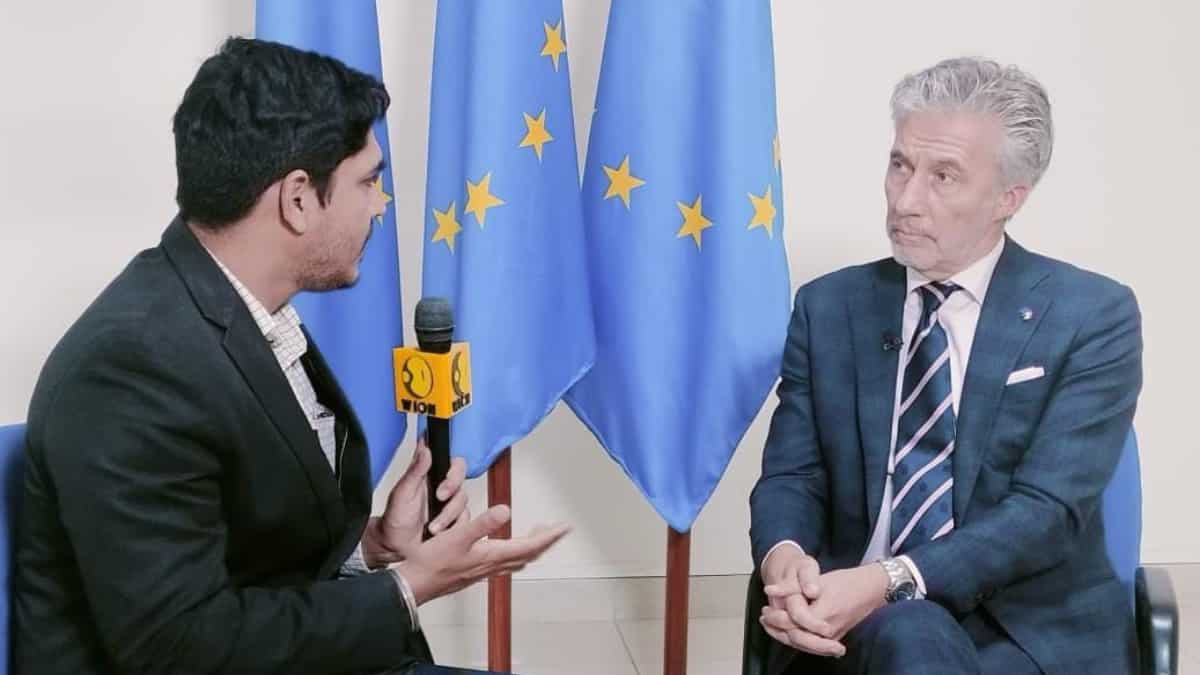
Morten Løkkegaard interview
European Parliamentarian (MEP) Morten Løkkegaard, who chairs relations with India in the European Parliament, has underscored the urgency for collaboration between India and Europe amidst global uncertainties, stating, "I think this is a time for India and Europe should unite, to have a lot more cooperation because we live in geopolitically uncertain times...big democracies have to work together".
The parliamentarian is in India as part of a European Parliamentary delegation which met India's external affairs Minister Dr S Jaishankar and Trade Minister Piyush Goyal. Speaking to our diplomatic correspondent Sidhant Sibal, he commended Prime Minister Narendra Modi for accelerating India-Europe relations since 2021, noting, "...the relationship due to Prime Minister Modi has been developing very fast and still developing."
Addressing the ongoing talks on the India-European Union Free Trade Agreement, Løkkegaard emphasised the mutual need for the agreement, declaring, "Both parties need this FTA agreement, we need it for growth but also for cooperation as such in the times of geopolitical tensions." He called for immediate political action, stating, "Now. I think that the negotiators, the technical sides have used all forces they can use and now we need political decisions to be made on both sides."

Full interview:
WION: What was the key focus of your India visit?
Morten Løkkegaard: Well I think it's been extremely interesting and very timely. We have pushed for these meetings for several months. I was here in Delhi for the first time in January, representing the delegation. And I said that it would be very nice for us in this very important times to have inter-parliamentary relations again, and we really needed to re-establish the contacts. So it's a great fortune. I'm very fortunate that we have the chance now to visit India again. And we were here, actually two delegations, both of us from the relations with India, but also the security and defence committee. So we were actually two groupings, a lot of people, very good meetings with the ministers, with the Minister for Foreign Affairs and with the Minister for Commerce and with the parliament as well. We had the interparliamentary meeting on Monday, and discussed the various issues of great importance. I think this is a time for India and Europe should unite, to have a lot more cooperation because we live in a geopolitically speaking, we live in uncertain times, things are changing very rapidly, all over the globe. And in these times, big democracies have to work together and this has basically been the reason for our meetings.
WION: Democracies need to work together. How do you see the relationship between India and the European Union going forward this year was significant. We saw the two TTC meetings, one in Brussels, then virtually. So how do you see things progressing between the two sides
Morten Løkkegaard: Fortunately, very rapidly moving forward. This is no secret that for many years we have been, as I said in a kind of frozen condition, kind of pause. But since 2021, the relationship due to Prime Minister Modi has been developing very fast and still developing. Of course, we still have a long way to go. But the good news is that, both parties really want this. I see there's a strategic interest for both parties to have this ever-closer relationship. As I said democracies have to work together. And by doing that, we are really, really doing some good right now. Of course, still lots of things to do. But we are moving in the right direction.
)
US vs China over South China Sea: Washington backs Philippines, Beijing hits back
)
Bigg Boss 20: Isha Rikhi evicted after three weeks in Salman Khan’s show
)
Musk plans to more than double xAI's chips to over 1.2 million Nvidia GPUs by year-end
)
After JU, clash erupts at SRFTI: BJP’s ‘Dimagi Naxal’ jibe sparks political firestorm after students protest RSS-linked event
)
‘Anti-social elements spreading false rumours’: LPU issues statement amid massive unrest over alleged rape
)
LPU students go on rampage, vandalise campus amid widespread protest: What's happening
)
Trump asked Xi to pressure Iran. China did not say yes — here’s what Beijing wants
)
US Treasury Secretary Scott Bessent hails global crackdown on Iranian banks and airlines
)
An OpenAI agent escaped its locked test cage again, by hiding questions in DNS lookups
)
'Our video was trimmed': LPU girls who featured in rape-denial video make U-turn
)
3 males killed, four others injured in shooting after fight at strip club in Detroit
)
'Victory for low-budget consumers': Raghav Chadha hails 30-day telecom recharge rules
)
Claude rebuilt the 1989 game 'Prince of Persia' by reusing the original's own code
)
Beyond metros: How Tier-2 and Tier-3 cities could drive India’s next AI wave
)
Tesla builds first Cybertruck with its own refined lithium: Elon Musk's $1 billion Texas bet pays off
)
IndiGo flight suffers tail strike in Bengaluru while landing; DGCA to probe incident
)
The US and China set up an AI 'red telephone', but skipped the rulebook
)
‘Terror suspects arrested near UK air base were looking to do big damage’: Trump
)
Russian envoy claims US tactics to contain India were revealed in ‘Freudian slip’
)
IND vs WI 1st ODI: Kohli breaks Sachin's most runs in one country record with unbeaten 139 as India thump West Indies by 8 wickets
)
Researchers rebuilt exactly how 700 AI agents hacked Hugging Face: a 900-link chain trick
)
‘Olympic inclusion is our major target’: WPA President Ishaun Singh on pool’s global ambitions
)
Nations League: Spain sink England at Wembley; Modric shines for Croatia
)
Why has Iran released no proof of life of Mojtaba Khamenei? Araghchi reveals...
)
'What kind of confession is this?': Pakistan PM Shehbaz Sharif’s 'terrorists would be roaming New York' remark goes viral, raises alarm online. Watch
)
South Korea demands apology from Ukraine over North Korean prisoners' transfer
)
Beyond BrahMos: India targets Rs 50,000 crore in defence exports with unmatched price edge
)
Sri Lankan Tamil migrant worker gets death sentence in Saudi Arabia, help sought from India
)
Muslim marriage cannot shield sex with minor wife from prosecution under POCSO: Delhi HC
)
'Can't help but draw painful parallels to Nirbhaya case': SC on latest incidents of rape cases in Delhi-NCR
)
99.9% more powerful - Scientists find boy who can recall memories from just 3 months of age
)
'FIRST LOOK from inside Noah’s Ark': Researchers share video from inside mysterious mound in Turkey
)
UNSC reform momentum grows: Russia, Portugal, Mauritius push for India's permanent seat bid
)
8 US marines injured in Iranian missile attack on vessel in Strait of Hormuz: Report
&im=FitAndFill=(700,400))
New OTT releases this week (September 28-October 4, 2026): Dupahiya 2, Pooja Meri Jaan, Ohh My Dog- 5 titles coming on Netflix, Prime Video and more
)
Afghanistan says 28 fighters killed in clash near Pakistan border, Islamabad denies
)
Ceuta migrant crisis: Protesters take to streets as Spain grapples with migrant challenge
)
LPU suspend classes, postpones exams as violence escalates over rape claims: What's happening
)
New York City wants a 'kill switch' on every AI, and will pay whistleblowers who report violations
WION: Moving in the right direction. One thing that needs to really be fast-tracked is perhaps the India-European Union Free Trade Agreement (FTA), how do you see the conversation on FTA going forward? Do you see any timeline for the conclusion, what has been the progress and what's your view if you can talk about
Morten Løkkegaard: It's really very robust, the talks I would say. We had a meeting with the Minister for Commerce last night, and he's a very outspoken person and I'm very fond of that. I think it's very good to have these robust conversations about what's at stake. Again, both parties need this FTA agreement, we needed for growth but also for cooperation as such in times of geopolitical tensions. So I think there's a need to do something. It's very, it's very difficult. It's complicated stuff, because we are moving from the very opposite positions in Europe. We have a tradition for huge packages when we're doing FTAs. We have a lot of them, already. So we kind of, you know, introduced a way of dealing with these things, which is not very familiar to the Indians. I mean, as the Minister said, on Monday, we are usually always negotiating trade alone, not any other issues. Coming from Europe. We are also very interested in introducing chapters on climate, you know chapters about working conditions for workers and so on and so forth. It's part of the deal. So we need some political movement. Now. I think that the negotiators, the technical sides have used all forces they can use and now we need political decisions to be made on both sides.
WION: Political decision on both sides, if you can just elaborate on that...
Morten Løkkegaard: Yeah. I think that both sides need to understand that coming from very opposite positions. We need to do steps that we haven't done before. I would say this, this would take a paradigm shift in the way that we do negotiations and trade deals in Europe and this is of course not an easy step. So it's up to our leaders in Europe and now to decide how much we can give into this. And on the Indian side, you need to get out of your comfort zone, also when it comes to trade. You are a big nation you are a developing nation. You're doing things very fast at the moment. Maybe also too fast for the mental thinking, because what is needed is of course to get out of this comfort zone and to realize that you have to do a lot more on tariffs, you have to open your markets much more, you had to get used to the idea of more comprehensive packages, as I was suggesting, otherwise it will be difficult.
WION: So, let's move to another direction that is the defence and security partnership. How do you see the relationship between the two sides India and the European Union working together convergences? And perhaps if there are certain divergences as well?
Morten Løkkegaard: Yes, one area I would I would emphasise is the digital area. I mean, what very good news is that you will pass the law. On the Indian side about the digital, about data. We did the same. The European Parliament as the first parliament in the world just agreed on an AI law which you know, try to find the balance between innovation, making things happen for businesses and the protection of citizens and our data. And the good news is of course, that the Indian side has done the same thing. And now we have very intensively discussed during these two days, where we can find common ground with these two pieces of legislation. And this could also be an icebreaker when it comes to the to FTA, I think, that's a very good sign.
WION: So, talking about the security and defence aspect to the Indo-Pacific Region and how both sides are working together. This increased aggressiveness by China. What do you have to say about that as well?
Morten Løkkegaard: We are of course also very worried about aggressive actions and I think we can do a lot together with India, in rebalancing the issues here in the Indo-Pacific. Of course, this is also of much concern of the Americans. They are doing a lot of at the moment whenever you visit Washington. It's on everyone's mind the Indo-Pacific and the relationship with China. I think that we need to recalibrate the positions, the strategic work in the Asian area as such, and in the Indo-Pacific, and in order to do, that we need to cooperate even better also on cybersecurity, on security and defence and such. And then the good news is also that we have our security Defense Committee visiting various ministers these two days and good results. Very good, positive atmosphere. I think we can do a lot better.