EU launches Red Sea mission; Houthis claim to have targeted ‘two American ships’ in Gulf of Aden

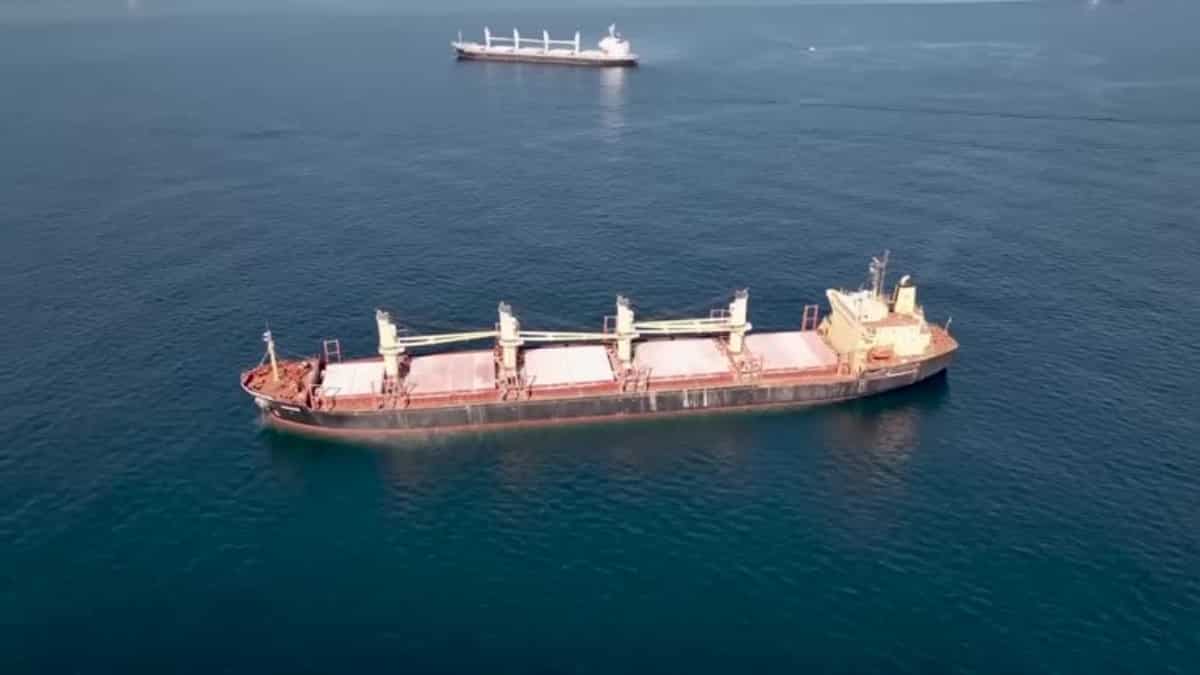
Belize-flagged British-registered Rubymar cargo ship
The European Union, on Monday (Feb 19) formally launched a naval mission to protect the Red Sea shipping from the Iran-backed Yemen-based Houthi rebels. Meanwhile, the militant group claimed to have targeted “two American ships” in the Gulf of Aden, a day after a missile attack severely damaged a Belize-flagged ship.
EU launches Red Sea mission
On Monday (Feb 19), European Commission President Ursula von der Leyen announced the decision to deploy Naval Force Operation Aspides in a post on X. “Europe will ensure freedom of navigation in the Red Sea, working alongside our international partners,” said von der Leyen.

She added, “Beyond crisis response, it’s a step towards a stronger European presence at sea to protect our European interests.” The EU aims to have the mission named Aspides, Greek for “shield”, up and running in a “few weeks” with at least four vessels, an official said on Friday (Feb 16).
WATCH |Red Sea Attacks: Houthi rebels attack two US vessels
)
The Early Spring is proof not everyone can talk about their real feelings, and it is perfectly OK
)
UN votes to ‘correct the map’ as India backs fairer world view
)
Nigerian Navy discovers 99,000 litres of suspected stolen, illegally refined products as it intensifies anti-crude oil theft operations
)
Who is Aditi Paudel? 17-year-old becomes Japan's first literacy ambassador
)
Bengaluru: Officials find 40 kg expired chilli at chairman's club
)
Jaishankar rejects trade link to ending Ukraine war
)
Israeli strikes on Lebanon kill three, injure 23 despite truce
)
Alpine glacier was covered with sheep wool sheets to prevent melting. It worked
)
South Korea mulls deploying military assets to Strait of Hormuz
)
World's fifth-largest economy, British army can't afford to train
)
Breaking | Vance takes the podium: First White House briefing since Leavitt's exit
)
Taiwan raises 'concerns' over China's missile test
)
BRICS 2026: $1 trillion sovereign capital set to converge in Delhi for first iBRICS Summit
)
What is Iran's Pickaxe Mountain that Trump has again threatened to bomb?
)
UN votes to correct world map that visually shrank Africa for 450 years
)
Former NewJeans member Danielle launches YouTube channel, hints at new solo journey
)
Bangladesh batter Towhid Hridoy creates history with 350 not out in South Africa
)
Brendan Fraser’s transformation fuels The Mummy 4 excitement as fans welcome back Rick O’Connell
&im=FitAndFill=(700,400))
Krishna Janmashtami 2026: From Dhaniya Panjiri to Makhana Kheer- 5 best sweet dishes perfect for celebrating Lord Krishna’s birth
)
Donald Trump plans to travel to Ireland on Qatari-donated jet amid security concerns
)
Nazi-looted art to return to Jewish heirs
)
Eight killed in Kerala’s Thrissur after car rams into lorry parked on highway
&im=FitAndFill=(700,400))
Why Russian fighter jets use bulky, low-pressure tyres compared to US jets
)
FBI-wanted fraud accused arrested in Jalandhar over $600,000 scam
&im=FitAndFill=(700,400))
Why US tanks weigh over 20 tons more than Russian tanks
&im=FitAndFill=(700,400))
New Friday OTT releases (September 4, 2026): GDN, Dhamaal 4, Jagamae Sangeetham- Watch 6 new movies and TV shows on Netflix, Prime Video and more
)
Killing the Himalayas slowly: Human urine is melting a glacier on Mount Everest
In line with the mission, European warships and airborne early warning systems will reportedly be sent to the Red Sea, Gulf of Aden and surrounding waters. So far, EU nations France, Germany, Italy and Belgium have said they plan to contribute ships.
The command centre for these vessels will be based in the Greek city of Larissa and they would be ordered to fire on the Houthis only if they attack first and will not be authorised to shoot pre-emptively, an EU official told German Press Agency dpa.
This comes as the United States is already spearheading its own naval coalition in the region and has conducted retaliatory strikes on Houthis in recent weeks, along with the United Kingdom.
Recent Houthi attacks
As of Monday evening, Houthis said that they had targeted three vessels in the last 24 hours, including the British-registered Rubymar, the US-owned Sea Champion and the Navis Fortuna which they also described as “American”.
Houthi naval forces used missiles to target “two American ships in the Gulf of Aden. The first was ‘Sea Champion’ and the other was ‘Navis Fortuna,’” said the militant group in a statement.
Also Read |Middle East crisis: Houthi missile attack damages Belize-flagged ship, crew forced to abandon vessel
UK-based maritime security firm Ambrey had earlier reported that a Greek-flagged, US-owned bulk carrier was attacked twice in two hours in the Gulf of Aden.
The bulk carrier reported a “missile attack” before another projectile hit the water just metres from the ship, said Ambrey. Meanwhile, the Royal Navy’s UK Maritime Trade Operations (UKMTO), said the ship’s master reported “evidence of shrapnel and damage to paintwork”.
The attack on “two American ships” claimed by Houthis also came a day after the militant group severely damaged a Belize-flagged Rubymar ship travelling through the Bab el-Mandeb Strait that connects the Red Sea and the Gulf of Aden, forcing the crew to abandon the vessel.
Houthi attacks affect Suez Canal revenue
Egyptian President Abdel Fattah al-Sisi, on Monday, said that revenues from the Suez Canal had “decreased by 40 to 50 per cent” since this year due to the attacks by Houthis.
“See what is happening at our borders...with Gaza, you see the Suez Canal, which used to bring Egypt nearly $10 billion per year, (these revenues) have decreased by 40 to 50 per cent and Egypt must continue to pay companies and partners,” said the Egyptian president.
Also Read |Brazilian President Lula recalls ambassador to Israel amid row over 'Holocaust' comment
The Suez Canal raised around $8.6 billion for Egypt in the 2022-23 fiscal year and is a vital source of foreign currency in addition to tourism.
The United Nations, in late January, said that the overall number of ships passing through the Suez Canal had fallen 42 per cent in the previous two months.
(With inputs from agencies)