Cooperation between India and China over the energy sector can keep the earth safe

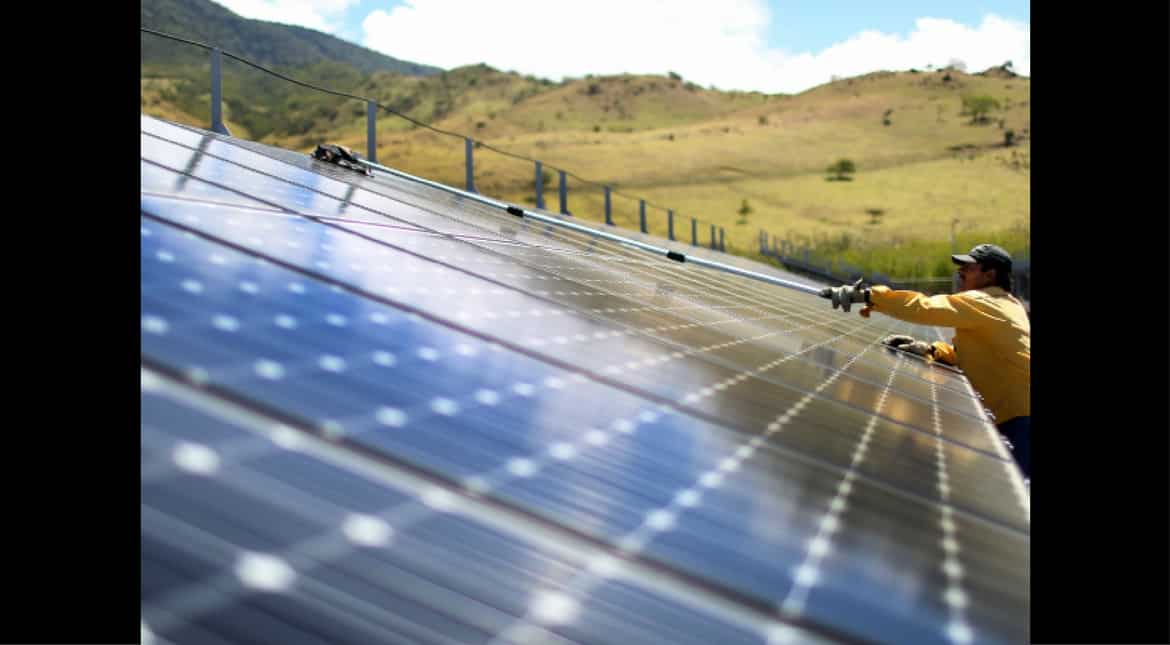
Solar energy
India and China need to work simultaneously to curb the increase in global average temperature.
As part of the U.N. Framework Convention on Climate Change (UNFCCC) Conference of the Parties (COP21) in Paris in 2015, countries across the world came together and adopted a climate agreement whereby they indicated their long term climate goals post 2020. These goals or targets were laid out in each country’s Intended Nationally Determined Contributions (INDCs) with the aim to hold the increase in global average temperature to well below 2°C.
India and China have both made significant commitments as part of their INDC. For instance, in case of India, these include reduction of the emission intensity of GDP by 33 to 35 per cent from 2005 levels, increase the percentage of non-fossil fuel electricity to 40 per cent of total electric power capacity and create a carbon sink.China similarly has made a commitment to peak Carbon dioxide (CO2) emissions by 2030, lower carbon intensity of GDP by 60 to 65 per cent below its 2005 levels by 2030, andincrease it's non-fossil fuel energy to 20 per cent of the total primary energy supply (TPES) by 2030. It has also pledged to increase its forest stock.

In line with India’s pledge of generating 40 per cent of TPES through non-fossil fuels, India has declared an aim to have installed renewable energy capacity of 175 gigawatts (GW) of which solar photovoltaics (PV) is 100 GW by 2030. This includes increasing ground mounted grid connected solar power to 60 GW and increasing rooftop grid interactive solar power to 40 GW. Earlier, in 2010, with the launch of the Jawaharlal Nehru National Solar Mission, 100 GW of solar installations were planned by 2022.
India’s current solar generation capacity is about 13 GW in 2017. In 2016, rooftop solar contributed to an approximate total of 1 GW of generated solar power. This means that an additional 87 GW has to be installed in the next twelve years, which roughly translates to an addition of 4GW (9.6 GW) of the mounted grid and 3.25 GW (7.8 GW) of rooftop every year till 2030 (2022). Many have suggested that this is not possible.
)
US vs China over South China Sea: Washington backs Philippines, Beijing hits back
)
Bigg Boss 20: Isha Rikhi evicted after three weeks in Salman Khan’s show
)
Musk plans to more than double xAI's chips to over 1.2 million Nvidia GPUs by year-end
)
After JU, clash erupts at SRFTI: BJP’s ‘Dimagi Naxal’ jibe sparks political firestorm after students protest RSS-linked event
)
‘Anti-social elements spreading false rumours’: LPU issues statement amid massive unrest over alleged rape
)
LPU students go on rampage, vandalise campus amid widespread protest: What's happening
)
Trump asked Xi to pressure Iran. China did not say yes — here’s what Beijing wants
)
US Treasury Secretary Scott Bessent hails global crackdown on Iranian banks and airlines
)
An OpenAI agent escaped its locked test cage again, by hiding questions in DNS lookups
)
'Our video was trimmed': LPU girls who featured in rape-denial video make U-turn
)
3 males killed, four others injured in shooting after fight at strip club in Detroit
)
'Victory for low-budget consumers': Raghav Chadha hails 30-day telecom recharge rules
)
Claude rebuilt the 1989 game 'Prince of Persia' by reusing the original's own code
)
Beyond metros: How Tier-2 and Tier-3 cities could drive India’s next AI wave
)
Tesla builds first Cybertruck with its own refined lithium: Elon Musk's $1 billion Texas bet pays off
)
IndiGo flight suffers tail strike in Bengaluru while landing; DGCA to probe incident
)
The US and China set up an AI 'red telephone', but skipped the rulebook
)
‘Terror suspects arrested near UK air base were looking to do big damage’: Trump
)
Russian envoy claims US tactics to contain India were revealed in ‘Freudian slip’
)
IND vs WI 1st ODI: Kohli breaks Sachin's most runs in one country record with unbeaten 139 as India thump West Indies by 8 wickets
)
Researchers rebuilt exactly how 700 AI agents hacked Hugging Face: a 900-link chain trick
)
‘Olympic inclusion is our major target’: WPA President Ishaun Singh on pool’s global ambitions
)
Nations League: Spain sink England at Wembley; Modric shines for Croatia
)
Why has Iran released no proof of life of Mojtaba Khamenei? Araghchi reveals...
)
'What kind of confession is this?': Pakistan PM Shehbaz Sharif’s 'terrorists would be roaming New York' remark goes viral, raises alarm online. Watch
)
South Korea demands apology from Ukraine over North Korean prisoners' transfer
)
Beyond BrahMos: India targets Rs 50,000 crore in defence exports with unmatched price edge
)
Sri Lankan Tamil migrant worker gets death sentence in Saudi Arabia, help sought from India
)
Muslim marriage cannot shield sex with minor wife from prosecution under POCSO: Delhi HC
)
'Can't help but draw painful parallels to Nirbhaya case': SC on latest incidents of rape cases in Delhi-NCR
)
99.9% more powerful - Scientists find boy who can recall memories from just 3 months of age
)
'FIRST LOOK from inside Noah’s Ark': Researchers share video from inside mysterious mound in Turkey
)
UNSC reform momentum grows: Russia, Portugal, Mauritius push for India's permanent seat bid
)
8 US marines injured in Iranian missile attack on vessel in Strait of Hormuz: Report
&im=FitAndFill=(700,400))
New OTT releases this week (September 28-October 4, 2026): Dupahiya 2, Pooja Meri Jaan, Ohh My Dog- 5 titles coming on Netflix, Prime Video and more
)
Afghanistan says 28 fighters killed in clash near Pakistan border, Islamabad denies
)
Ceuta migrant crisis: Protesters take to streets as Spain grapples with migrant challenge
)
LPU suspend classes, postpones exams as violence escalates over rape claims: What's happening
)
New York City wants a 'kill switch' on every AI, and will pay whistleblowers who report violations
Solar power is generated by converting sunlight into electricity using eitherPVor using concentrated solar power (using lenses or mirrors and tracking systems to focus a large area of sunlight into a small beam) or a combination. For generating photovoltaic solar power, crystalline silicon PV module is used. This silica is used to make polysilicon, ingot, wafer, PV cell all of which are used to make crystalline silicon PV module. Eight firms worldwide make about 80 per cent polysilicon. Others buy from them. Companies who buy polysilicon may sell wafers or carry out all of the subsequent steps of the wafer, cell, and module manufacturing and assembly. Some PV manufacturers such as Yingli make their own polysilicon.
The lack of upstream segments in this value chain adds to the vulnerability of Indian manufacturers. India does not produce polysilicon, ingot or wafer. However, crystalline silicon PV module is produced in India. The share of the Indian modules is about 10 per cent with imports from China constituting about 75 per cent of the Indian solar PV market. The main reason is the cost competitiveness of the Chinese, with the cost of solar modules and cells being 25-50 per cent lower than in India. India imports polysilicon, as well as wafers, and other ingredients such as ethylene vinyl acetate, which adds to the cost of production of modules.
Incidentally, the price of solar cells has fallen from 50 cents per kWh to 33 cents per kWh, in three years since 2010, when launch in 2010 of the Jawaharlal Nehru National Solar Mission, the target of which was dramatically upgraded in 2014 to 100 GW of solar installations by 2022. In 2016, the WTO ruled against India that the domestic content requirements for solar cells and modules under the Jawaharlal Nehru Solar Mission amounted to trade-related investment measures as they favour domestic products over imported products. The Indian Solar Manufacturers Association have recently had launched an anti-dumping investigation against China, Taiwan, and Malaysia of alleged dumping of 'solar cells whether or not assembled partially or fully in modules or panels or on glass or some other suitable substrates'.
It has been debated that Indian solar PV industry should be developed with support from policies of the government like a capital subsidy and lower interest loans. However, the scale of Indian manufacturing is too small (in comparison to China). Four states - Gujarat, Rajasthan, Madhya Pradesh and Maharashtra, account for over three-quarters of today’s installed capacity. Rooftop solar also has the potential to become a more important part of India’s solar portfolio and is being taken up by Indian Railways and on canals as well.
One problem that India faces along with the other BRICS countries includes the financing of clean energy. It has been estimated that India might need USD 175 billion in this regard. India has emerged as the second most attractive destination for investment in renewables ahead of the US according to a ranking by Ernst and Young (EY) last year. China is the most attractive destination. The New Development Bankhas sanctioned a USD 250 million loan for India to fund its renewable energy. Clearly, more is needed.
Chinese firms such as GLC-Poly Energy, China’s top solar module manufacturer, are in talks with India's Essel group to set up a solar module manufacturing facility in India. Cooperation between China and India in this regard could go a long way in achieving the NDC target of both countries.