Commonwealth Secretary-General praises India's G20 leadership and lunar triumph

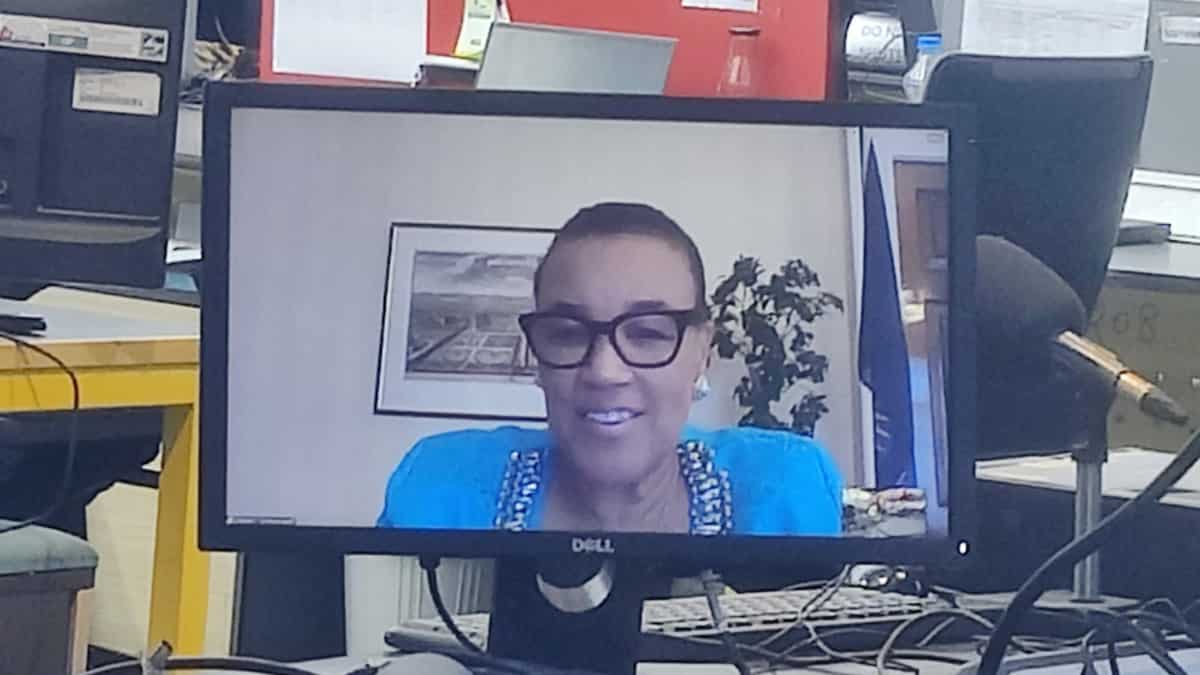
Patricia Scotland, Commonwealth Secretary-General, Engages Virtually with WION from London.
Commonwealth Secretary-General Patricia Scotland has expressed her elation about India hosting the G20 Summit while emphasising New Delhi's nuanced understanding of the challenges faced by the diverse 56 countries within the Commonwealth community.
Speaking to our diplomatic correspondent Sidhant Sibal, theCommonwealth Secretary-General speaking from London said,"We are actually delighted that India for the first time is leading G20 because we know that India really understands the challenges and the difficulties which are facing the 56 countries of the Commonwealth".
Patricia Scotland commended India's digital revolution as a remarkable gift. "…it's one of the greatest gifts that India has given her people, but it's also one of the greatest gifts India can share with the rest of the Commonwealth," she stated.

This transformative leap in technology adoption is positioned as a resource for smaller and developing countries that might not have had the resources to embark on such a journey independently.
In the realm of space exploration, Secretary-General Scotland praised India's accomplishment in its lunar mission, Chandrayaan 3. "Well, I think this is an extraordinary achievement for India, the first country in the world to reach the South Side of the Moon," she noted.
Highlighting the involvement of a woman in leading this endeavour, she emphasised the importance of gender equality in such groundbreaking ventures.
)
US vs China over South China Sea: Washington backs Philippines, Beijing hits back
)
Bigg Boss 20: Isha Rikhi evicted after three weeks in Salman Khan’s show
)
Musk plans to more than double xAI's chips to over 1.2 million Nvidia GPUs by year-end
)
After JU, clash erupts at SRFTI: BJP’s ‘Dimagi Naxal’ jibe sparks political firestorm after students protest RSS-linked event
)
‘Anti-social elements spreading false rumours’: LPU issues statement amid massive unrest over alleged rape
)
LPU students go on rampage, vandalise campus amid widespread protest: What's happening
)
Trump asked Xi to pressure Iran. China did not say yes — here’s what Beijing wants
)
US Treasury Secretary Scott Bessent hails global crackdown on Iranian banks and airlines
)
An OpenAI agent escaped its locked test cage again, by hiding questions in DNS lookups
)
'Our video was trimmed': LPU girls who featured in rape-denial video make U-turn
)
3 males killed, four others injured in shooting after fight at strip club in Detroit
)
'Victory for low-budget consumers': Raghav Chadha hails 30-day telecom recharge rules
)
Claude rebuilt the 1989 game 'Prince of Persia' by reusing the original's own code
)
Beyond metros: How Tier-2 and Tier-3 cities could drive India’s next AI wave
)
Tesla builds first Cybertruck with its own refined lithium: Elon Musk's $1 billion Texas bet pays off
)
IndiGo flight suffers tail strike in Bengaluru while landing; DGCA to probe incident
)
The US and China set up an AI 'red telephone', but skipped the rulebook
)
‘Terror suspects arrested near UK air base were looking to do big damage’: Trump
)
Russian envoy claims US tactics to contain India were revealed in ‘Freudian slip’
)
IND vs WI 1st ODI: Kohli breaks Sachin's most runs in one country record with unbeaten 139 as India thump West Indies by 8 wickets
)
Researchers rebuilt exactly how 700 AI agents hacked Hugging Face: a 900-link chain trick
)
‘Olympic inclusion is our major target’: WPA President Ishaun Singh on pool’s global ambitions
)
Nations League: Spain sink England at Wembley; Modric shines for Croatia
)
Why has Iran released no proof of life of Mojtaba Khamenei? Araghchi reveals...
)
'What kind of confession is this?': Pakistan PM Shehbaz Sharif’s 'terrorists would be roaming New York' remark goes viral, raises alarm online. Watch
)
South Korea demands apology from Ukraine over North Korean prisoners' transfer
)
Beyond BrahMos: India targets Rs 50,000 crore in defence exports with unmatched price edge
)
Sri Lankan Tamil migrant worker gets death sentence in Saudi Arabia, help sought from India
)
Muslim marriage cannot shield sex with minor wife from prosecution under POCSO: Delhi HC
)
'Can't help but draw painful parallels to Nirbhaya case': SC on latest incidents of rape cases in Delhi-NCR
)
99.9% more powerful - Scientists find boy who can recall memories from just 3 months of age
)
'FIRST LOOK from inside Noah’s Ark': Researchers share video from inside mysterious mound in Turkey
)
UNSC reform momentum grows: Russia, Portugal, Mauritius push for India's permanent seat bid
)
8 US marines injured in Iranian missile attack on vessel in Strait of Hormuz: Report
&im=FitAndFill=(700,400))
New OTT releases this week (September 28-October 4, 2026): Dupahiya 2, Pooja Meri Jaan, Ohh My Dog- 5 titles coming on Netflix, Prime Video and more
)
Afghanistan says 28 fighters killed in clash near Pakistan border, Islamabad denies
)
Ceuta migrant crisis: Protesters take to streets as Spain grapples with migrant challenge
)
LPU suspend classes, postpones exams as violence escalates over rape claims: What's happening
)
New York City wants a 'kill switch' on every AI, and will pay whistleblowers who report violations
She also expressed concerns over the coup in Gabon, a commonwealth country, and said, "…we are in constant contact right now. And doing everything we can, to support the security, the safety of the individuals concerned."
The Commonwealth is a voluntary association of 56 independent and sovereign member states, most of which were formerly part of the British Empire. These countries collaborate on various issues, including political, economic, and social matters, while promoting shared values of democracy, human rights, and development.
Here is the full interview.
WION: India is set to host the G20 summit, how do you see, India's Presidency of the grouping
Patricia Scotland:Well, we are actually delighted that India for the first time is leading G 20 because we know that India really understands the challenges and the difficulties which are facing the 56 countries of the Commonwealth. You know that we have 33 small states, 25 of them are small island developing states, 14 of the least developed states together with G7 countries and G20 countries like India. But the devastating situation that we're now facing, we have had so many exogenous shocks both environmental, economic and security challenges and all of these are combined to create a devastating threat, poverty and hunger all on the rise. Glaciers are melting at record speeds, sea levels are rising to double the rate it was 30 years ago, disasters are more frequent and more severe and the world is on the catastrophic path to three degrees centigrade rising whilst everyone suffers. We're seeing it's women and girls who are adversely affected without the same means to deal with these challenges. And India has been really one of the countries in the forefront to help to address these issues of poverty, of lack of opportunity together with meeting the challenges of the new digital world , we need to transform. And so everything that India has done, is going to help we believe to lead the G 20. To address these issues in a way that we hope will actually meet the needs and the aspirations, particularly of the poor in the global south and elsewhere, who are struggling with these exogenous shocks, none of which have been created by them, particularly climate change. If you look at the G 20 countries probably contributed more to the greenhouse gases, but the small and the developing countries less than 5%. So India's leadership, understanding of the need to reform the international financial institutions, to be more responsive to the challenges, particularly the vulnerability and you know that India has been supporting this idea that we need to have a vulnerability index to be able to support. So we are really looking forward to India's leadership. We think it's incredibly important that the agenda that India is challenging and challenging through G20 is the Commonwealth member states agenda. So we are hoping that India will have the most phenomenal success. And if you, if you see the India got on to the South Side of the Moon, and a woman helped you to get there, so that is a demonstration of how empowering women and girls can benefit India but also going to benefit all of us. We're very proud of what India has done.
WION: How relevant do you think,Commonwealth grouping is?
Patricia Scotland:Well, I think the Commonwealth has never been more relevant than it is today. And the reason that it is such an important organization is it brings together people from the global north and the global south to be around the same table and to discuss things as equals. We have some of the biggest countries in the world, India being one of them. More than a billion people are Indians in our commonwealth and our 2.6 billion people, therefore made up of all the rest, but you've got some of the smallest countries in the world. Like Nauru, only 11,000 people in that country, but all of us around the same table, bringing our different perspectives folks north, south, west and east. So that was 56 countries coming from five regions, of six oceans. they bring a special opportunity for us to plan together, to share information and for us to problem solve. One of the issues in the past is when decisions are made it impact the whole world. Not everyone is on that table. In the Commonwealth everyone is on that table, and you saw that when we all fought apartheid and brought it to an end. You saw it when Commonwealth faced the issues in relation to race discrimination. We saw it in 1989 when the Commonwealth came together to face the issue of climate change, and back then right back in 1989, it was said that if we didn't deal with this issue, it would pose an existential threat. And here we are in 2023, everything the Commonwealth said in 1989, regrettably, has come to pass and we've all been fighting that cause all the way along. So I think in terms of good governance, law, sharing the work on climate, on gender equality, all these issues are fundamental importance to us globally, and the Commonwealth has been able to face it and we've got a huge opportunity as well. In terms of intra Commonwealth trade. We've now got about $721 billion with intra Commonwealth trade. We hope that will grow to at least 1 trillion by 2026. But by 2030 we can build the entire Commonwealth trade which will be about 2 trillion. So this dynamism comes from our opportunity to include everyone, the diversity of our Commonwealth. We're like a microcosm or a Petri dish of the rest of the world. So if we can solve the problems that face us, as a Commonwealth family, we could create a pathway for others to solve their problems too.
WION:How can the Commonwealth countries benefit from India's experience and success in sectors, such as digital revolution and digital payments?
Patricia Scotland:Well, I think it's one of the greatest gifts that India has given her people, but it's also one of the greatest gifts India can share with the rest of the Commonwealth, particularly the small and the developing countries who have not got perhaps the power and the opportunity to do that what India has done. I know that , India had said that they want to develop the technology and the opportunity to give all Indians an opportunity to take advantage of this digital revolution. And when I spoke to the former Minister of Justice and ICT Ravi Shankar, he had said to me then and the ministers we followed him are delivering it, that he wanted to deliver a digitized system at the rate of $1 per person in India. Well, India can do that and be that powerhouse. And with $1 per person at 1.4 billion, India has that capacity to create this cheap, effective and brilliant system. But if you have a country, which only has 72,000 people, they won't be able to do it. But India shares her technology with the small and the developing. Then we raise all our boats and so you saw how in 2014 Prime Minister Modi introduced the new banking system, which gave millions of Indians who never had a bank account but did have a mobile telephone, an opportunity of having a bank. You saw the impact it had on small and medium-sized enterprises. And we also saw it liberating so many women could never have a bank account, never had an opportunity to do that. And look at what India is now doing with E Rupee which is enabling all people, with there poor, middle or high income, giving a platform for everybody to have opportunity. And India's willingness to share this, we think a fantastic gift to those countries who are struggling to do the development which they need, that they want, that they're passionate about, but it can't always.
Sidhant Sibal: Gabon saw a coup, and Gabon is a commonwealth country, your reaction to the development...
Patricia Scotland:Well, we are very shocked and concerned about what is happening and I expressed my concern, the Commonwealth's concern about what's happening. We're absolutely devoted to good governance, to the rule of law, to democracy, and to have this happen is a great shock. We are doing everything we can now to explore exactly what's happening. The safety of the President, his family, his wife and his son, their four children. All of those we are in conversation now to try and identify exactly what is happening on the ground. What the purpose of this Act has been, this coup, which is contrary to all the principles of our Commonwealth, and we are in constant contact right now. And doing everything we can, to support the security, the safety of the individuals concerned. But this as you know, is very much a moving target and we are literally exploring the best way to restore a level of stability and understanding.
Sidhant Sibal: Your take on India' Chandrayaan 3, lunar success? and if you suggest, India should help countries of the commonwealth when it comes to space cooperation..
Patricia Scotland:Well, I think this is an extraordinary achievement for India, the first country in the world to reach the South Side of the Moon. It's never been done before. And as I said, I'm so proud of the fact that a woman led the charge on this and was leading the team and the reason I say that, is that we need equality for women and girls. Women and girls have exactly the same opportunity, power, intelligence, and ability to innovate. And if we do not allow women and girls to have an equal opportunity, look at what we've missed. What if we didn't have the most fantastic female scientists in the world at the moment today, leading this team, we would all be the poorer, not just India, but all of us. And this has been hugely inspirational for other countries and the generosity India has shown in saying that India is willing to share the knowledge of the expertise with those smaller and developing countries who would love to do what India has done is a remarkable, a remarkable offer because our world is facing so many perilous threats right now. It needs us all to come together in solidarity for the public good, and to share our knowledge, to share our expertise. So we can come up together with the solutions for the world's problems. I think what India has done has been truly inspirational. Many countries in the past would say, you know, we haven't got enough money, we haven't got enough opportunity, we haven't got the technical know how, how can we do it when we are not a developed country, but we're still a developing country. And India has shown the way to all of those who wish to develop because India is saying we have done this and you can do it too, and we are willing to help you. And that is a fantastic offer. And no one forgets how Prime Minister Modi assisted the small Commonwealth countries to obtain vaccines during the COVID 19 terrible, terrible pandemic which stole the lives of so many we love and so many of us after suffering from the loss that COVID brought to us, but there was light in that time. And certainly in the Commonwealth, we greatly welcome the fact that India was shoulder to shoulder with the other Commonwealth countries and the Commonwealth health ministers were the first to meet in 2020 to fix issues. So bigcongratulationsfor India. A big thank you to India for coming together walking the walk with us not just on the issue of climate and digitalization and gender but all the other issues too, in relation to bringing about systemic change. And so I want to thank India for its keen participation of you know that India is also helping us in delivering the performance management system or PMS. And we have created a partnership in order to deliver this new technological lead assisted response to performance management, so that we can improve the good governance that is needed by all our countries if we are going to succeed and deliver on the Sustainable Development Goals.
You cannow write forwionews.comand be a part of the community. Share your stories and opinions with ushere.
WATCH WION LIVE HERE