

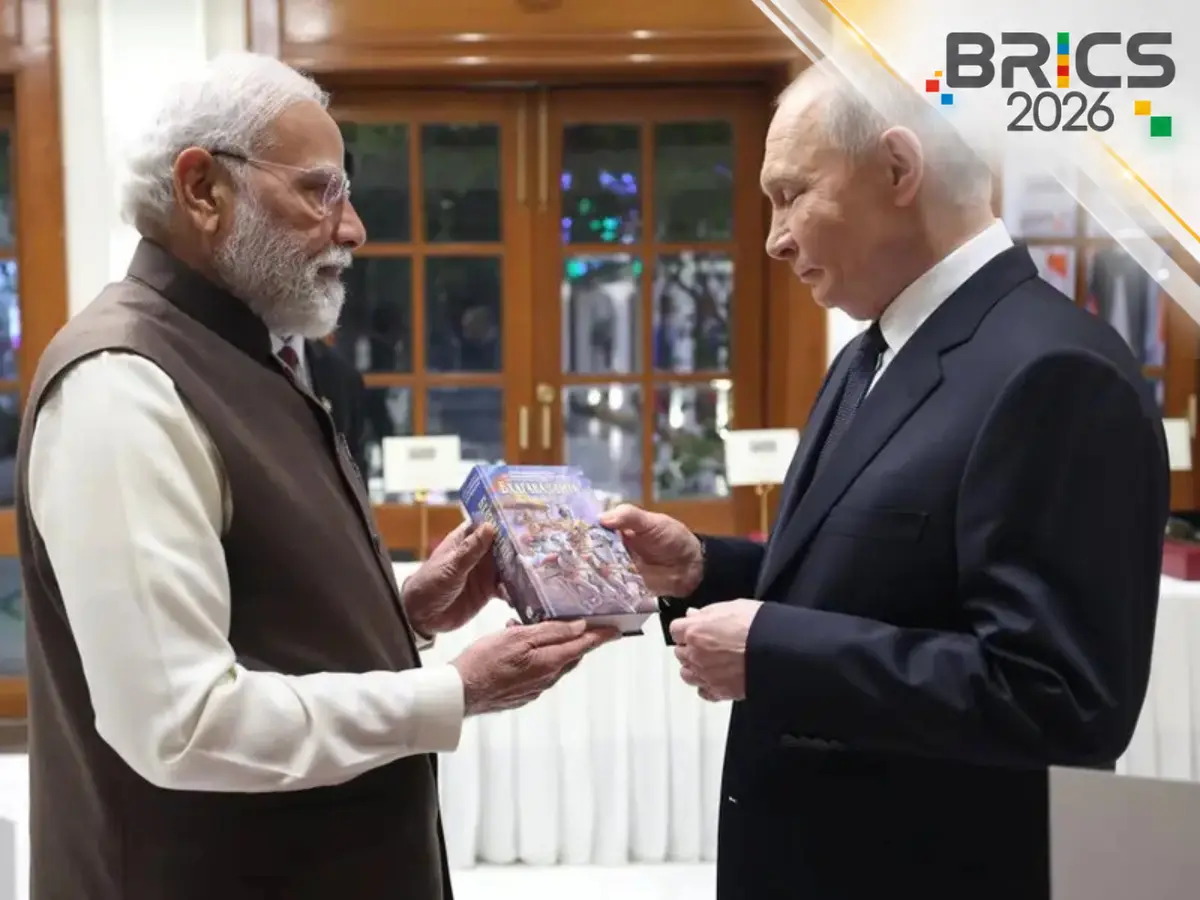
&imwidth=800&imheight=600&format=webp&quality=medium "BRICS Summit 2026: Putin’s second India visit in 10 months comes amid focus on Russian oil")
Russian President Vladimir Putin’s expected return to New Delhi for the BRICS Summit 2026 comes at a particularly sensitive moment for India’s relationship with Moscow, and for its increasingly complicated economic relationship with Washington. Putin was last in India in December 2025 for the annual India-Russia summit. His expected appearance at the September BRICS gathering would therefore put the Russian president in Delhi for a second time in less than a year, underlining the continuing importance of the India-Russia relationship even as New Delhi simultaneously manages its ties with the United States and other Western powers. Russia’s Ambassador to India Denis Alipov said on Friday that Putin is expected to attend the summit.
But beyond the optics of another Modi-Putin meeting, one issue will inevitably hang over the summit: Russian oil. India’s dependence on Russian crude has grown dramatically since the Ukraine war. In July 2026, Russian crude accounted for a record 50.83% of India’s total oil imports, or about 2.47 million barrels per day, according to trade data cited by news agency Reuters. That makes the oil question far more complicated than a simple diplomatic choice between Washington and Moscow.
The 50% tariff episode, and what changed
The Trump administration had imposed an additional 25% tariff on Indian imports in August 2025 specifically over India’s purchases of Russian oil. Combined with the existing reciprocal tariff, the total reached 50%. The White House said the additional duty was intended to pressure countries purchasing Russian oil. But that is not the current tariff structure. In February 2026, Washington removed the additional 25% Russia-oil tariff after saying India had committed to stop directly or indirectly importing Russian oil. The US also lowered its reciprocal tariff on Indian goods to 18%. Crucially, however, the February executive order contains a warning: if India resumes direct or indirect purchases of Russian oil, US officials can recommend bringing back the additional 25% tariff. And India's subsequent oil-import numbers make that provision highly relevant.
Why India cannot simply walk away from Russian crude
India is the world's third-largest oil consumer and relies heavily on imports to meet its energy requirements. Russian crude became particularly attractive after Western sanctions and price restrictions disrupted Moscow's traditional markets. For Indian refiners, Russian crude has not simply been a geopolitical purchase. Price, availability, refinery economics and supply security have all mattered. The scale of the trade illustrates the problem. India's imports from Russia have become heavily concentrated in energy: crude oil alone accounted for $35.76 billion of imports in FY2025-26 through November, according to IBEF data. Fertilisers were another major category at $2.11 billion. And crude is not the only Russian commodity India has reasons to keep buying.
Trending Stories
&imwidth=180&imheight=135&format=webp&quality=medium)
Viral video shows cross falling on Colombia priest, no official confirmation | WATCH
&imwidth=180&imheight=135&format=webp&quality=medium)
France reports first human case of livestock virus Shamonda, patient dies; what we know so far
&imwidth=180&imheight=135&format=webp&quality=medium)
Shikhar Mohan earns maiden India A call-up, replaces KL Rahul
&imwidth=180&imheight=135&format=webp&quality=medium)
AI slop or smart strategy? South African author Coral Hart defends Her 370 AI- assisted books in 20 months
&imwidth=180&imheight=135&format=webp&quality=medium)
Two BrahMos missiles on Tejas, triple the range and 100% indigenisation, says former BrahMos CEO
&imwidth=180&imheight=135&format=webp&quality=medium)
India-China face-off continues near Arunachal’s Taksing, reveals ITBP chief in first official confirmation of tensions
&imwidth=180&imheight=135&format=webp&quality=medium)
Ilhan Omar breaks silence over alleged marriage to her brother; Trump thinks it's 'really good answer'
&imwidth=180&imheight=135&format=webp&quality=medium)
WATCH: Trump demands Ilhan Omar removal from Congress for 'using fake name to be sworn in'. So what is her real name?
&imwidth=180&imheight=135&format=webp&quality=medium)
Netanyahu dials PM Modi, invites him and Capt Smit Machchhar to light torch on Israel’s Independence Day
&imwidth=180&imheight=135&format=webp&quality=medium)
Christa Pike's failed execution: Tennessee team struggled to insert IV lines, lawyer says
&imwidth=180&imheight=135&format=webp&quality=medium)
Did Neha Bora call for Bangladesh-like GenZ protest, 'anarchy' in India? WION Fact-checks viral claim
&imwidth=180&imheight=135&format=webp&quality=medium)
US midterms 2026: US Supreme Court allows New Hampshire to restrict student IDs for voting
&imwidth=180&imheight=135&format=webp&quality=medium)
A secret code, a midnight escape and 300 deaths: The Russian officer who turned on Putin
&imwidth=180&imheight=135&format=webp&quality=medium)
Trump ordered to answer questions under oath in BBC defamation lawsuit by December 11
&imwidth=180&imheight=135&format=webp&quality=medium)
Putin says Russia is ready to resume Ukraine-US peace talks but rejects 'short ceasefire' amid deadly attacks
&imwidth=180&imheight=135&format=webp&quality=medium)
Horrific video shows the moment 18-year-old fell to her death from Mexico amusement park ride
&imwidth=180&imheight=135&format=webp&quality=medium)
From Agni-V to Project Kusha: How are India’s indigenous missile systems and defence shield reshaping modern warfare
&imwidth=180&imheight=135&format=webp&quality=medium)
'It's a crime not to see this scene': Tehran puts Trump 'behind bars'
&imwidth=180&imheight=135&format=webp&quality=medium)
What is the ‘heat ray’ weapon? Pete Hegseth reportedly authorises DHS to test it at US-Mexico border
&imwidth=180&imheight=135&format=webp&quality=medium)
Meghan Markle’s father Thomas under investigation over alleged child abuse images: Report
&imwidth=180&imheight=135&format=webp&quality=medium)
SA vs AUS 2nd Test: Temba Bavuma reveals 'Tendulkar inspiration' behind career-best 179
&imwidth=180&imheight=135&format=webp&quality=medium)
China's dancing robot turns violent bodyguard, lifts cars and fights intruders - Watch
&imwidth=180&imheight=135&format=webp&quality=medium)
Watch: India rejects ‘imprecise and unsupported’ references in UN migrant rights report
&imwidth=180&imheight=135&format=webp&quality=medium)
US to get 850 F-35 stealth fighter jets under 10-year Pentagon-Lockheed deal
&imwidth=180&imheight=135&format=webp&quality=medium)
GRAVITAS | Putin fires nuclear-capable hypersonic missiles, Zelensky ready to surrender 25% territory
&im=FitAndFill=(700,400)&imwidth=180&imheight=135&format=webp&quality=medium)
New Friday OTT releases (October 23, 2026): Gajab Raat, Dorothy, Chaar Yaar- Watch these 6 new movies and TV shows on Netflix, Prime Video and more
&im=FitAndFill=(700,400)&imwidth=180&imheight=135&format=webp&quality=medium)
Serbia elections: Nearly 150,000 people take to streets in massive rally against Aleksandar Vucic | In pics
&imwidth=180&imheight=135&format=webp&quality=medium)
BCCI’s CoE cautious over Hardik Pandya’s fitness, sets expected comeback timeline
&imwidth=180&imheight=135&format=webp&quality=medium)
'This is despicable': Amy Acton hits back at Vivek Ramaswamy over Ohio campaign ad featuring her estranged mother
&imwidth=180&imheight=135&format=webp&quality=medium)
Finance influencer dies by suicide in Chennai; father accuses tech CEO, who denies charge
&imwidth=180&imheight=135&format=webp&quality=medium)
'Vivek should keep it up': Trump defends Ramaswamy's controversial campaign ad targeting Amy Acton
&imwidth=180&imheight=135&format=webp&quality=medium)
One man, 8 months of work, and a river dirty again: Why Bittu Tabahi may quit
&imwidth=180&imheight=135&format=webp&quality=medium)
US midterms 2026: Elon Musk’s political spending hits $445 million as Republicans battle to retain Senate control
&imwidth=180&imheight=135&format=webp&quality=medium)
450 villagers in UP rush to take anti-rabies shots after consuming 'charnamrit'
&imwidth=180&imheight=135&format=webp&quality=medium)
ENG vs SL: Harry Brook breaks Shubman Gill’s record for fastest ODI double century
&imwidth=180&imheight=135&format=webp&quality=medium)
ENG vs SL: Harry Brook’s 202 goes in vain as Sri Lanka pull off second-highest ODI chase
&imwidth=180&imheight=135&format=webp&quality=medium)
Saudi Arabia targeted yacht carrying 14 Indians in Red Sea, rescue underway, Houthis claim
What India buys from Russia
Crude oil: By far the biggest component. Russian supplies have become crucial to Indian refiners, and July's record share shows how difficult it is to immediately replace those volumes. Fertilisers: Russia remains an important source of fertilisers for India's agriculture sector. Any disruption has implications beyond foreign policy, potentially affecting input costs and food security.
Defence equipment: Russia has historically been India's biggest defence supplier, although India's dependence has declined as New Delhi has diversified its procurement. The relationship nevertheless includes decades of equipment, spares, maintenance and technology links. Diamonds, metals and other commodities: India also imports diamonds, iron and steel, vegetable oils and several other commodities from Russia, although their strategic significance is generally much smaller than oil, fertilisers and defence.
What India can reduce, and what it cannot easily replace
This is where the Russian oil debate becomes more nuanced. India can diversify its crude purchases. It already buys from suppliers in the Middle East, Africa and elsewhere. It can also adjust refinery configurations and procurement patterns depending on prices, sanctions and shipping costs. But replacing Russian oil overnight is another matter.
The challenge is not simply finding another barrel. India needs barrels that are economically viable, available in sufficient volumes and compatible with its refinery system. Removing one of its largest sources could raise procurement costs and put pressure on refiners and consumers. The same logic applies, in a different way, to fertilisers and defence sustainment. India can diversify suppliers over time. But diversification is not the same as immediate substitution.
Why Putin’s BRICS visit matters?
This makes Putin’s expected Delhi visit particularly significant. India's BRICS presidency comes at a time when the grouping is discussing energy security, economic cooperation, local-currency trade and reducing vulnerabilities created by global financial and supply-chain disruptions. Russia, meanwhile, has a strong interest in preserving access to major markets such as India.
For Moscow, India is not merely a diplomatic partner. It is a major energy customer and an increasingly important economic relationship. For New Delhi, Russia remains one pillar of a broader strategic-autonomy strategy: maintaining ties with Moscow while simultaneously engaging Washington, Europe, the Gulf, Japan and other partners.
That does not mean India is choosing Russia over the US. It means India is trying to avoid being forced to choose.
The bigger India-US question
The oil issue therefore puts the Modi government in a delicate position. Washington has already demonstrated that Russian energy purchases can become a trade issue. The February 2026 executive order removed the additional 25% tariff but explicitly kept the door open to bringing it back if Russian oil imports resume.
At the same time, India's latest import data suggest that Russian crude remains extremely difficult to displace. With Russian oil reaching more than half of India's imports in July, the economic relationship has moved far beyond the limited purchases that existed before the Ukraine war. That is why the Putin-Modi meeting on the sidelines of BRICS Summit 2026 will carry significance beyond the usual India-Russia agenda.
The discussion is likely to encompass energy security, fertilisers, defence, trade imbalances and payment mechanisms. But underneath all of it will be one fundamental question: How much Russian oil can India continue buying without reopening the tariff confrontation with Washington, and how much Russian oil can India realistically afford to stop buying? For Moscow, the answer is strategically important. For Washington, it is a test of economic pressure. And for New Delhi, it is ultimately a question of energy security, economic interests and strategic autonomy.

