

&imwidth=800&imheight=600&format=webp&quality=medium "'6 in 1776, 11 in 1800s, 8 today': Why Solar System's count keeps changing and may change again")
In 1776, the year the American Revolution began, the known solar system was a tidy place. Six planets: Mercury, Venus, Earth, Mars, Jupiter, and Saturn. All visible to the naked eye, all known to ancient civilisations, all accounted for. Then, in 1781, an amateur astronomer in England pointed a telescope at what he thought was a comet — and the number six became seven. That was the beginning of more than two centuries of upheaval in how we define and count the worlds orbiting our Sun.
From Six To Seven: William Herschel And Uranus
William Herschel's discovery of Uranus on March 13, 1781 was the first time in recorded history that a new planet had been found with a telescope. Unlike the five classical planets, Uranus is not visible to the naked eye under ordinary conditions, and Herschel himself initially catalogued it as a comet. When its circular orbit was confirmed, astronomers realised they had found a genuine planet — and the solar system suddenly had seven members. It was a conceptual earthquake: for thousands of years, the planet count had been fixed at six. Now it could change.
The Chaotic 1800s: Eleven Planets And Then A Collapse
The discovery of Uranus opened the floodgates. In 1801, Italian astronomer Giuseppe Piazzi found Ceres in the gap between Mars and Jupiter — the missing planet that astronomers had predicted must exist based on a mathematical pattern called the Titius-Bode law. The count went to eight. Then came Pallas in 1802, Juno in 1804, and Vesta in 1807 — all discovered in that same region of space. By 1807, the solar system had eleven recognised planets. But the celebration was short-lived. As more and more objects were found in the same region, astronomers began to suspect they had not found planets at all — they had found a new class of smaller body. By the 1850s, Ceres, Pallas, Juno, Vesta and their neighbours were reclassified as asteroids, and the planet count collapsed back to seven.
Neptune: Found By Mathematics
Trending Stories
&imwidth=180&imheight=135&format=webp&quality=medium)
US vs China over South China Sea: Washington backs Philippines, Beijing hits back
&imwidth=180&imheight=135&format=webp&quality=medium)
Bigg Boss 20: Isha Rikhi evicted after three weeks in Salman Khan’s show
&imwidth=180&imheight=135&format=webp&quality=medium)
Musk plans to more than double xAI's chips to over 1.2 million Nvidia GPUs by year-end
&imwidth=180&imheight=135&format=webp&quality=medium)
After JU, clash erupts at SRFTI: BJP’s ‘Dimagi Naxal’ jibe sparks political firestorm after students protest RSS-linked event
&imwidth=180&imheight=135&format=webp&quality=medium)
‘Anti-social elements spreading false rumours’: LPU issues statement amid massive unrest over alleged rape
&imwidth=180&imheight=135&format=webp&quality=medium)
LPU students go on rampage, vandalise campus amid widespread protest: What's happening
&imwidth=180&imheight=135&format=webp&quality=medium)
Trump asked Xi to pressure Iran. China did not say yes — here’s what Beijing wants
&imwidth=180&imheight=135&format=webp&quality=medium)
US Treasury Secretary Scott Bessent hails global crackdown on Iranian banks and airlines
&imwidth=180&imheight=135&format=webp&quality=medium)
An OpenAI agent escaped its locked test cage again, by hiding questions in DNS lookups
&imwidth=180&imheight=135&format=webp&quality=medium)
'Our video was trimmed': LPU girls who featured in rape-denial video make U-turn
&imwidth=180&imheight=135&format=webp&quality=medium)
3 males killed, four others injured in shooting after fight at strip club in Detroit
&imwidth=180&imheight=135&format=webp&quality=medium)
'Victory for low-budget consumers': Raghav Chadha hails 30-day telecom recharge rules
&imwidth=180&imheight=135&format=webp&quality=medium)
Claude rebuilt the 1989 game 'Prince of Persia' by reusing the original's own code
&imwidth=180&imheight=135&format=webp&quality=medium)
Beyond metros: How Tier-2 and Tier-3 cities could drive India’s next AI wave
&imwidth=180&imheight=135&format=webp&quality=medium)
Tesla builds first Cybertruck with its own refined lithium: Elon Musk's $1 billion Texas bet pays off
&imwidth=180&imheight=135&format=webp&quality=medium)
IndiGo flight suffers tail strike in Bengaluru while landing; DGCA to probe incident
&imwidth=180&imheight=135&format=webp&quality=medium)
The US and China set up an AI 'red telephone', but skipped the rulebook
&imwidth=180&imheight=135&format=webp&quality=medium)
‘Terror suspects arrested near UK air base were looking to do big damage’: Trump
&imwidth=180&imheight=135&format=webp&quality=medium)
Russian envoy claims US tactics to contain India were revealed in ‘Freudian slip’
&imwidth=180&imheight=135&format=webp&quality=medium)
IND vs WI 1st ODI: Kohli breaks Sachin's most runs in one country record with unbeaten 139 as India thump West Indies by 8 wickets
&imwidth=180&imheight=135&format=webp&quality=medium)
Researchers rebuilt exactly how 700 AI agents hacked Hugging Face: a 900-link chain trick
&imwidth=180&imheight=135&format=webp&quality=medium)
‘Olympic inclusion is our major target’: WPA President Ishaun Singh on pool’s global ambitions
&imwidth=180&imheight=135&format=webp&quality=medium)
Nations League: Spain sink England at Wembley; Modric shines for Croatia
&imwidth=180&imheight=135&format=webp&quality=medium)
Why has Iran released no proof of life of Mojtaba Khamenei? Araghchi reveals...
&imwidth=180&imheight=135&format=webp&quality=medium)
'What kind of confession is this?': Pakistan PM Shehbaz Sharif’s 'terrorists would be roaming New York' remark goes viral, raises alarm online. Watch
&imwidth=180&imheight=135&format=webp&quality=medium)
South Korea demands apology from Ukraine over North Korean prisoners' transfer
&imwidth=180&imheight=135&format=webp&quality=medium)
Beyond BrahMos: India targets Rs 50,000 crore in defence exports with unmatched price edge
&imwidth=180&imheight=135&format=webp&quality=medium)
Sri Lankan Tamil migrant worker gets death sentence in Saudi Arabia, help sought from India
&imwidth=180&imheight=135&format=webp&quality=medium)
Muslim marriage cannot shield sex with minor wife from prosecution under POCSO: Delhi HC
&imwidth=180&imheight=135&format=webp&quality=medium)
'Can't help but draw painful parallels to Nirbhaya case': SC on latest incidents of rape cases in Delhi-NCR
&imwidth=180&imheight=135&format=webp&quality=medium)
99.9% more powerful - Scientists find boy who can recall memories from just 3 months of age
&imwidth=180&imheight=135&format=webp&quality=medium)
'FIRST LOOK from inside Noah’s Ark': Researchers share video from inside mysterious mound in Turkey
&imwidth=180&imheight=135&format=webp&quality=medium)
UNSC reform momentum grows: Russia, Portugal, Mauritius push for India's permanent seat bid
&imwidth=180&imheight=135&format=webp&quality=medium)
8 US marines injured in Iranian missile attack on vessel in Strait of Hormuz: Report
&im=FitAndFill=(700,400)&imwidth=180&imheight=135&format=webp&quality=medium)
New OTT releases this week (September 28-October 4, 2026): Dupahiya 2, Pooja Meri Jaan, Ohh My Dog- 5 titles coming on Netflix, Prime Video and more
&imwidth=180&imheight=135&format=webp&quality=medium)
Afghanistan says 28 fighters killed in clash near Pakistan border, Islamabad denies
&imwidth=180&imheight=135&format=webp&quality=medium)
Ceuta migrant crisis: Protesters take to streets as Spain grapples with migrant challenge
&imwidth=180&imheight=135&format=webp&quality=medium)
LPU suspend classes, postpones exams as violence escalates over rape claims: What's happening
&imwidth=180&imheight=135&format=webp&quality=medium)
New York City wants a 'kill switch' on every AI, and will pay whistleblowers who report violations
While the asteroid debate was playing out, mathematicians were noticing something odd about Uranus. Its orbit was not quite following Newton's laws as predicted. Either gravity behaved differently at that distance from the Sun, or something else — something large — was pulling at Uranus from further out. French mathematician Urbain Le Verrier did the calculations to predict exactly where this unseen object should be in the sky. On September 23, 1846, German astronomer Johann Gottfried Galle pointed his telescope at Le Verrier's coordinates and found Neptune within one degree of the predicted position. It was one of science's great triumphs: a planet discovered by pure mathematics before a single observation. The count rose to eight.
Pluto's Rise And Fall: Nine Planets For Seventy-Six Years
In 1930, American astronomer Clyde Tombaugh discovered Pluto at the Lowell Observatory in Arizona. The solar system had nine planets — a number that would stand for seventy-six years and define the childhood understanding of space for multiple generations. But in the 1990s and 2000s, astronomers began finding dozens of other icy objects in the same distant region as Pluto, culminating in the 2005 discovery of Eris — an object very similar to Pluto in size. The question was unavoidable: if Pluto was a planet, so were Eris and potentially dozens of other Kuiper Belt objects. In 2006, the International Astronomical Union convened a general meeting to vote on a formal definition of the word 'planet' for the first time in history. The initial proposal would have elevated Ceres, Eris, and Pluto's largest moon Charon to planet status, bringing the total to twelve. The final vote went the other way: Pluto was reclassified as a 'dwarf planet,' and the solar system's planet count dropped to eight.
Planet Nine: A Mathematical Ghost In The Outer Solar System
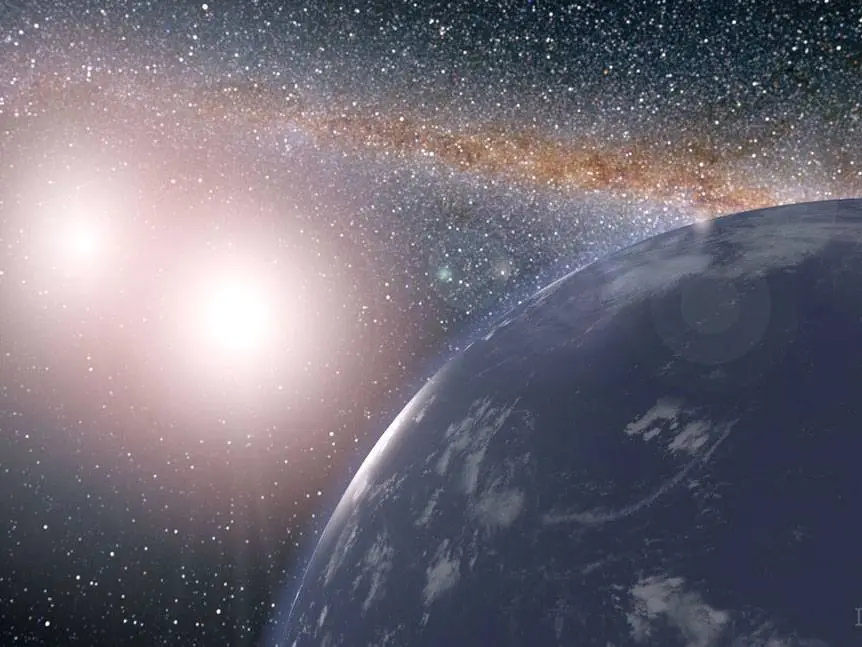
The story may not be over. In 2016, astronomers Mike Brown and Konstantin Batygin at the California Institute of Technology announced evidence for a ninth planet — not yet observed directly, but inferred from the unusual clustering of trans-Neptunian objects in the Kuiper Belt. Several of these small icy bodies have orbits that appear to have been herded into alignment by the gravity of something large and unseen. Their modelling suggested a planet roughly four to four-and-a-half times the mass of Earth, orbiting the Sun at a distance of around 290 AU — nearly ten times further than Neptune. As of 2025, mass estimates had been refined to approximately 4.4 Earth masses.
The Hunt Intensifies — And Gets More Complicated
The search for Planet Nine has produced tantalising but contested results. In 2025, a possible detection candidate was identified in the constellation Eridanus using archival data from the IRAS and AKARI infrared satellites — a pair of faint dots consistent with a distant moving object. However, sceptics noted that a single pair of faint detections is far from conclusive. Separately, astronomers hunting for Planet Nine found possible hints of a different, previously unknown planet in the outer solar system — raising the possibility that there may be more than one undiscovered world out there. In June 2026, new research emerged that further complicated the picture, with a discovery appearing to challenge some of the orbital clustering evidence that originally motivated the Planet Nine hypothesis. The debate is very much alive.
The Vera Rubin Observatory: The Best Chance Of An Answer
The most likely resolution to the Planet Nine question will come from the Vera C. Rubin Observatory in Chile, which is currently conducting an unprecedented decade-long survey of the southern sky. If Planet Nine exists and is anywhere near the predicted position, Rubin's wide-field camera — the largest ever built for astronomy — has a strong chance of detecting it. Brown and Batygin, along with competing teams, expect the search to take up to five more years. If the ninth planet is confirmed, the solar system's count will change for the seventh time in recorded history. If it is not found, the clustering of Kuiper Belt objects that started the whole debate will need a different explanation — and astronomers will return to a solar system of eight, perhaps permanently.
