Two airplane-sized asteroids are closely approaching Earth on June 9 – Do they pose a threat?

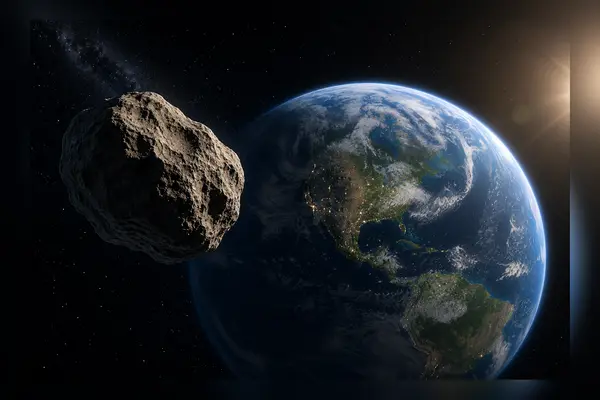
Representative image. Photograph: (AI-generated image)
Two airplane-sized asteroids, 2026 LD and 2026 KM3, will make close approaches to Earth on June 9, drawing the attention of astronomers worldwide. Do they pose a threat to our planet?
Astronomers are tracking two near-Earth asteroids that will make relatively close approaches to our planet on June 9. The two asteroids, 2026 LD and 2026 KM3, are roughly the size of an airplane. While the term “close approach” may sound alarming, scientists have assured that neither object poses any threat to Earth. Both objects will safely pass the Earth millions of kilometres away.
Asteroid 2026 LD to make closest pass
Estimated to be about 52 metres (170 feet) big, asteroid 2026 LD is expected to pass the Earth at a distance of approximately 1.14 million kilometres (710,000 miles). Although the encounter is considered close in astronomical terms, the asteroid will still remain more than three times farther away than the Moon and poses no risk of collision with our planet.
2026 KM3 to pass at a greater distance
The second asteroid, 2026 KM3, is relatively smaller than the first one, measuring around 34 metres (110 feet) in diameter. It will pass Earth at an even greater distance of roughly 2.35 million kilometres (1.46 million miles). After calculating its trajectory, scientists have said there is zero chance of an impact during this flyby.
Why scientists monitor near-Earth objects
Trending Stories
&imwidth=280&imheight=210&format=webp&quality=medium)
&imwidth=280&imheight=210&format=webp&quality=medium)
&imwidth=280&imheight=210&format=webp&quality=medium)
&imwidth=280&imheight=210&format=webp&quality=medium)
&imwidth=280&imheight=210&format=webp&quality=medium)
&imwidth=280&imheight=210&format=webp&quality=medium)
&imwidth=280&imheight=210&format=webp&quality=medium)
&imwidth=280&imheight=210&format=webp&quality=medium)
&imwidth=280&imheight=210&format=webp&quality=medium)
&imwidth=280&imheight=210&format=webp&quality=medium)
&imwidth=280&imheight=210&format=webp&quality=medium)
&imwidth=280&imheight=210&format=webp&quality=medium)
&imwidth=280&imheight=210&format=webp&quality=medium)
&imwidth=280&imheight=210&format=webp&quality=medium)
&imwidth=280&imheight=210&format=webp&quality=medium)
&imwidth=280&imheight=210&format=webp&quality=medium)
&imwidth=280&imheight=210&format=webp&quality=medium)
&imwidth=280&imheight=210&format=webp&quality=medium)
&imwidth=280&imheight=210&format=webp&quality=medium)
&imwidth=280&imheight=210&format=webp&quality=medium)
&imwidth=280&imheight=210&format=webp&quality=medium)
&imwidth=280&imheight=210&format=webp&quality=medium)
&imwidth=280&imheight=210&format=webp&quality=medium)
&imwidth=280&imheight=210&format=webp&quality=medium)
&imwidth=280&imheight=210&format=webp&quality=medium)
&imwidth=280&imheight=210&format=webp&quality=medium)
&imwidth=280&imheight=210&format=webp&quality=medium)
&imwidth=280&imheight=210&format=webp&quality=medium)
&imwidth=280&imheight=210&format=webp&quality=medium)
&im=FitAndFill=(700,400)&imwidth=280&imheight=210&format=webp&quality=medium)
&imwidth=280&imheight=210&format=webp&quality=medium)
&imwidth=280&imheight=210&format=webp&quality=medium)
&imwidth=280&imheight=210&format=webp&quality=medium)
&imwidth=280&imheight=210&format=webp&quality=medium)
Space agencies continuously track near-Earth objects to better understand their orbits and identify any potential future threats. Even when asteroids are not dangerous, each observation helps in improving prediction models and strengthens planetary defence strategies. Objects that are 30 to 60 metres in size are of particular interest because they could cause significant regional damage if they entered Earth’s atmosphere and struck the surface.
Does the June 9 asteroid pose any threat?
Both asteroids that are set to pass the Earth on June 9 are considered harmless as they are passing at a safe distance and have no risk of collision. These asteroids will offer astronomers an opportunity to study these ancient remnants of the solar system.

