Mathematics nightmare - This new geometrical shape has 8 sides, 26 edges, 24 corners and 3 holes

&imwidth=600&imheight=450&format=webp&quality=medium "Mathematics nightmare - This new geometrical shape has 8 sides, 26 edges, 24 corners and 3 holes")
This new geometric shape is the stuff of maths nightmares. Photograph: (Ruslan Mizhaev)
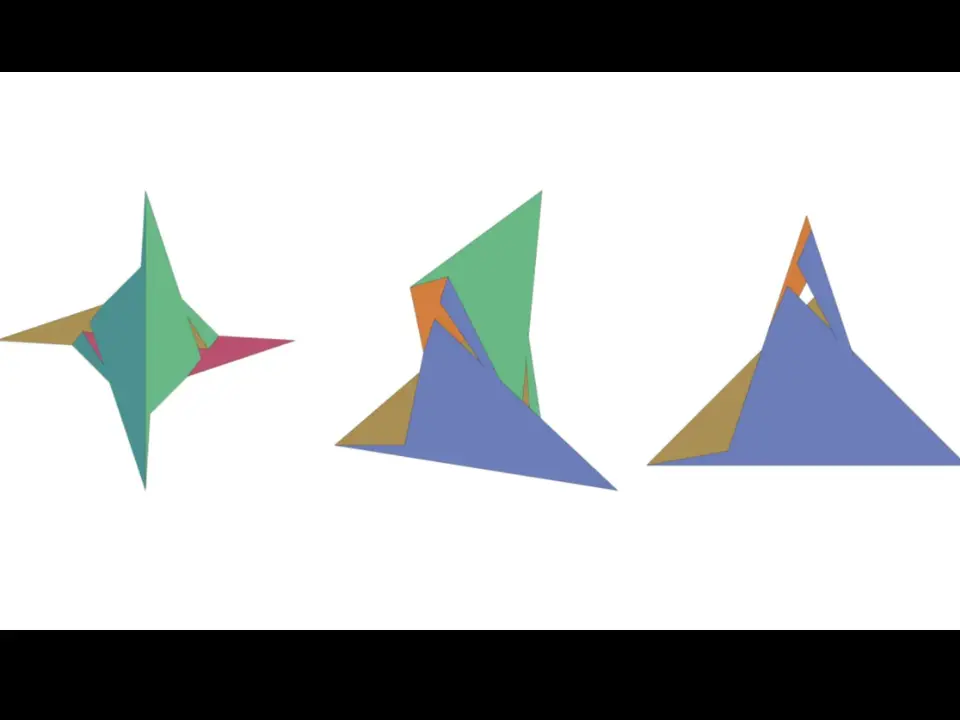
A mathematician has discovered a completely new shape which has 8 faces, 26 edges, 24 corners and three holes. Twenty face pairs share one single edge, while exactly three faces meet at every single vertex. Could this shape occur in nature?
A mathematician has created a new three-dimensional shape which is so complex that it will leave your head spinning. Ruslan Mizhaev has identified what is known as the genus-3 polyhedron. The new shape features eight faces, each arranged in such a way that every pair shares at least one edge. What you get is an odd shape with 26 edges and 24 vertices, with 20 face pairs sharing a single edge while eight others share two faces.
Mizhaev has explained the geometry of a genus-3 polyhedron in a preprint study detailed by New Scientist. It is yet to be peer-reviewed or published in a scientific journal. As you would have figured out, this shape is not your regular cube or pyramid. Polyhedral 3D shapes, that is, shapes with flat surfaces, have faces, edges and vertices, or corners. The straight edges and angled vertices are connected along flat surfaces.
Geometric Properties of genus-3 polyhedron
Faces: 8 faces
Edges: 26 edges
Vertices: 24 vertices
Trending Stories
)
)
)
)
)
)
)
)
)
)
)
)
)
)
)
)
)
)
)
)
)
)
)
)
)
)
)
)
)
)
)
)
)
)
&im=FitAndFill=(700,400))
)
)
)
)
Holes (Genus): 3 distinct holes passing through the figure
Edge-Sharing Property
20 face pairs share a single edge.
8 face pairs share two edges.
At every single vertex across the shape, exactly three faces meet.
Complex shapes mathematicians already know of
The most complex 3D shape that we come across in our lives is the dodecahedron, featuring 12 faces shaped as a five-pointed pentagram. But they can get even more complex. Toroidal polytopes are polyhedra that are also toruses, figures with holes in their centre. Mizhaev says they are used in studying relationships between "combinatorial topology, graph theory, and three-dimensional geometry."
The newly identified shape, a genus-3 polyhedron, has three separate holes. The independent researcher says mathematicians can use simple integer coordinates to create it. However, right now it is hard to say whether such a shape exists naturally anywhere. It is possible that it could be present somewhere on Earth if the calculations are found to be correct.

