Giant 'spider' right in the middle of Europa's Manannán crater proof of water? Scientists say...

&imwidth=600&imheight=450&format=webp&quality=medium "Giant 'spider' right in the middle of Europa's Manannán crater proof of water? Scientists say...")
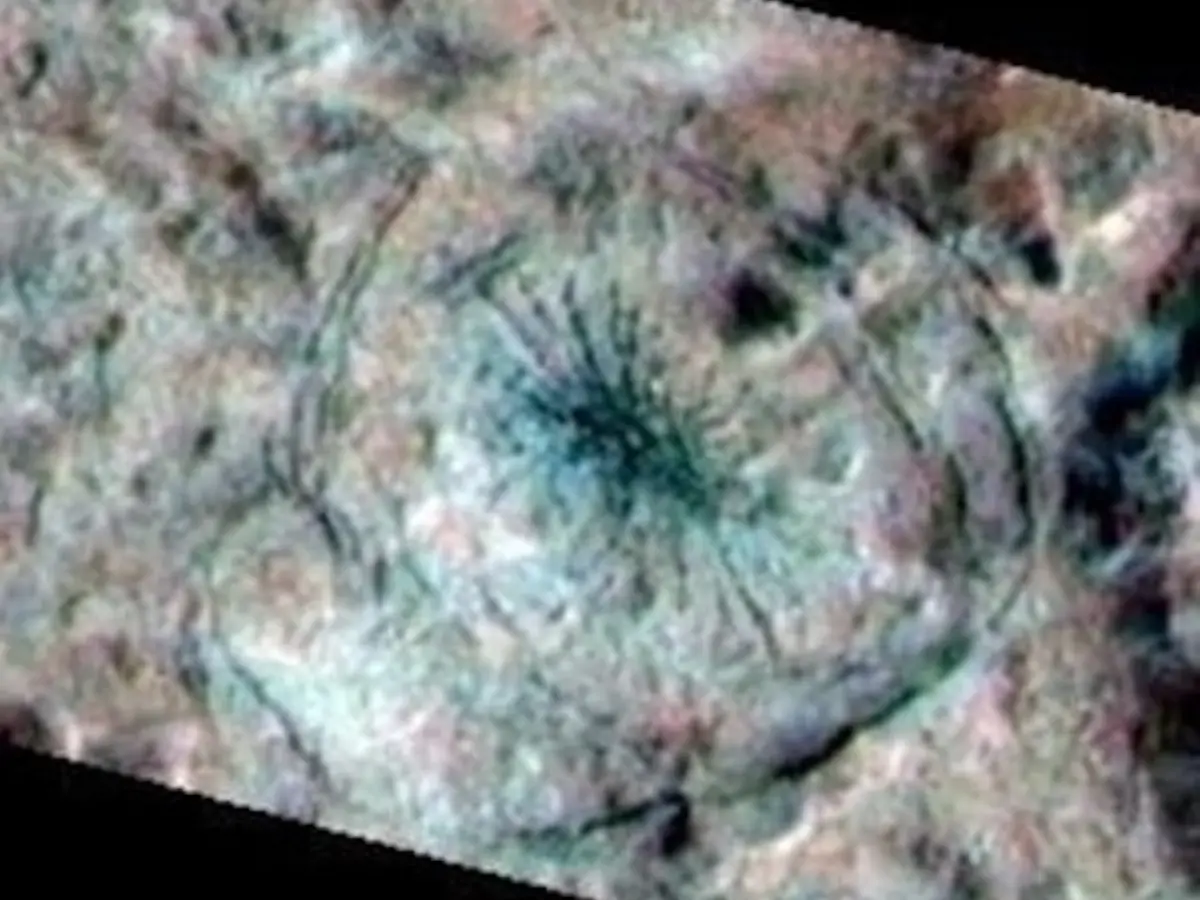
Scientists have a theory for the spider formation on Europa. Photograph: (NASA/JPL/ University of Arizona/ Planetary Science Institute)
One giant spider has been observed on Jupiter's moon Europa, sitting right in the middle of its largest crater. Scientists have a theory about Damhán Alla, the name given to this spider. Is it really a spider, or simply another phenomenon on the Jovian moon?
Scientists have discovered a spider on Jupiter's moon Europa, which seems to have been formed when salty water erupted to the surface following an impact that gouged a crater. The Manannán crater was recently studied by researchers from the Planetary Science Institute, the University of Central Florida, NASA’s Jet Propulsion Laboratory (JPL) and other institutions. It looks like the spiders seen on Mars and Earth, but the reason for their formation is different. The Martian spiders are formed when carbon dioxide gas escapes from underground, eroding the dust to form spider-like shapes. On Earth, such features are found on frozen lakes and ponds and are called lake stars, and are formed when snow falls on frozen lakes.
In the Manannán crater, this "spider" has been nicknamed Damhán Alla, the Irish term for the arachnid. It is one of the largest craters on Europa, stretching 21-23 kilometres in diameter, with the spider right at the centre. Previous studies of the crater have revealed ice and hydrated water minerals in concentrated form around it. Now, according to findings published in The Planetary Science Journal on December 2, 2025, briny water was released from the crater billions of years ago, causing this spider to take shape in the crater, EarthSky reported.
Manannán impact opened up a subsurface brine reservoir
Co-author of the study, Elodie Lesage of the Planetary Science Institute, said, "This spider-like feature might have formed through the eruption of melted brines following the Manannán impact." This discovery can reveal what the subsurface was like at the time of the impact. "This would mean that it can inform us on subsurface properties and brine composition at the time of the impact," he added.
Trending Stories
)
)
)
)
)
)
)
)
)
)
)
)
)
)
)
)
)
)
)
)
)
)
)
)
)
)
)
)
&im=FitAndFill=(700,400))
)
)
)
)
)
)
)
)
To check their theory, the researchers looked at the lake stars in Breckenridge, Colorado. They used Europa ice simulants cooled with liquid nitrogen to recreate the process in a cryogenic glovebox at NASA’s Jet Propulsion Laboratory (JPL). Lauren McKeown, a planetary geomorphologist at the University of Central Florida and lead author of the study, said, "We flowed water through these simulants under different temperatures and found that similar star-like patterns formed even under extremely cold temperatures."
McKeown explained that on Earth, "the weight of the snow creates holes in the ice, allowing water to flow through the snow, melting it and spreading in a way that is energetically favourable" to form these patterns. "On Europa, we believe a subsurface brine reservoir could have erupted [after an impact] and spread through porous surface ice, producing a similar pattern," she added.

