A pizza history | Archaeologists discover painting of pizza's 'ancestor' in ruins of Pompeii

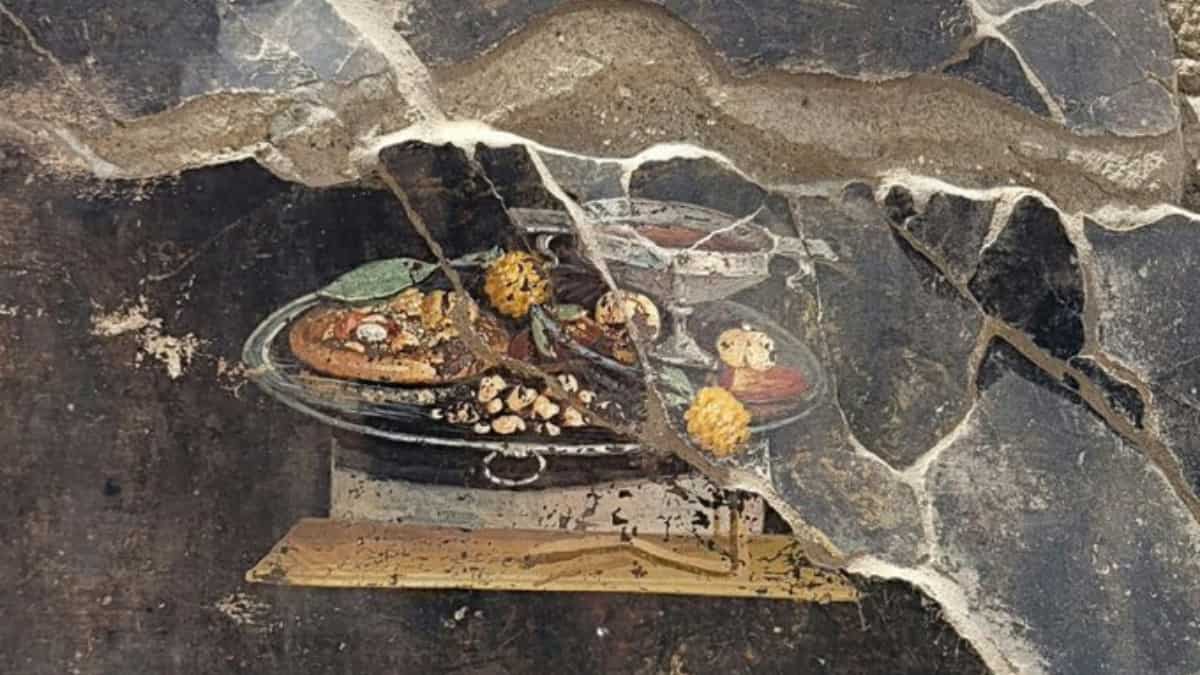
Fresco depiciting pizza's ancestor in Pompeii.
Archaeologists have discovered a 2,000-year-old fresco painting which depicts what may be called the Italian pizza's ancient ancestor in the ruined city of Pompeii, said Italy's Culture Ministry on Tuesday.
According to the archaeologists, the flatbread seen in the fresco near the wine goblet was being eaten by ancestors with fruits like pomegranate or dates and dressed with a particular kind of pesto sauce and spices, added the ministry. However, the pizza-looking food item appears without the cheese and tomatoes.
The image of the flatbread was painted with the use of the fresco technique, where the painting is done on wet lime plaster by the artist.

The Oxford Dictionary defines fresco as "a painting done rapidly in watercolour on wet plaster on a wall or ceiling so that the colours penetrate the plaster and become fixed as it dries."
ALSO READ |Archaeologists unearth 4,000-year-old ‘Stonehenge’ burial ground in the Netherlands
The painting was discovered on the wall of an ancient house in Pompeii, a city which was destroyed nearly 2,000 years ago by an eruption of Mount Vesuvius.
)
Pakistan deploys over 20,000 security personnel as PTI vows march for Imran Khan's release
)
Asian Games 2026: India face Afghanistan in quarterfinal on Sep 28; Pakistan clash with Hong Kong
)
‘I rejected it’: Trump confirms turning down Iran’s proposal to reopen Hormuz, claims Tehran is losing ‘badly’
)
'FIRST LOOK from inside Noah’s Ark': Researchers share video from inside mysterious mound in Turkey
)
‘Serial practitioner of terrorism’: Jaishankar calls out Pakistan’s ‘state-sponsored’ terror at UNGA
)
'A terrorist country is asking me that question?': Jaishankar hits back at Pakistani journalist at UN; flags attacks on commercial shipping
)
US court backs Pentagon's decision to exclude Anthropic over Claude AI restrictions
&im=FitAndFill=(700,400))
New Friday OTT releases (September 25, 2026): Don’t Be Shy, Hunkkaar: The Roar, Mango Pachcha- 6 movies and TV shows on Netflix, Prime Video and more
)
'He's very much in our plans': Ravindra Jadeja ‘in mix’ for 2027 ODI World Cup, says batting coach
)
Bollywood x K-pop crossover! LE SSERAFIM’s Kazuha charms fans with Shah Rukh Khan’s ‘Chammak Challo’ steps
)
Outrage erupts after 3-year-old is married to 60-year-old man in Pakistan, link to her sister's murder being probed
)
‘It is all possible’: Putin weighs next steps on Ukraine talks, rules out Europe conflict
)
‘Anti-social elements spreading false rumours’: LPU issues statement amid massive unrest over alleged rape
)
Gaza's war turned environmental damage into second crisis
)
'What kind of confession is this?': Pakistan PM Shehbaz Sharif’s 'terrorists would be roaming New York' remark goes viral, raises alarm online. Watch
)
Sri Lankan Tamil migrant worker gets death sentence in Saudi Arabia, help sought from India
)
‘Attack on Mecca a red line for Pakistan’: Shehbaz Sharif warns Houthis at UN
)
Prince Harry offers rare glimpse into Archie and Lilibet’s life after UK move
)
'Countries far from conflict are penalised': Jaishankar calls for Gulf peace, seafarer safety at UN
)
Russia will achieve Ukraine war aims; Europe doing everything to block peace talks: Lavrov at UN
)
US Supreme Court backs Trump administration's use of SAVE database to check voter citizenship
)
Nigeria Navy moves to boost oil security, tackle crude theft and infrastructure threats
)
Myanmar training camp case: US national, 6 Ukrainians allowed to meet their families abroad
)
WATCH | As Shehbaz Sharif claims Pakistan’s ‘victory’ during 2025 conflict, Indian diplomat R Srinivas laughs at UN
)
Trump-Xi summit wrap: Big pageantry, Iran talks, few major developments and more meetings planned
)
Donald Trump shares image of Xi's arrival in Washington, carries signs of AI
)
LPU students go on rampage, vandalise campus amid widespread protest: What's happening
)
US-Iran war: Trump rejects Iran's Hormuz proposal, reports suggest talks expected next week
)
‘Could kill billions...’: Bill Gates backs calls to slow AI development amid fears of catastrophe
)
Pentagon quietly adds 37 wounded troops to Iran war tally without explaining when or how
)
Bigg Boss 20: Salman Khan schools Rhiti Tiwari over Qazi Touqeer clash, compares her to Dolly Bindra
)
OpenAI AI Agents hacked 4 websites before Hugging Face, researchers reveal
"What was depicted on the wall of an ancient Pompeian house could be a distant ancestor of the modern dish," stated the experts at the archaeological park in a statement.
It is believed that the fresco refers to the 'hospitable gifts' which are offered to guests as per a Greek tradition which dates back to the 3rd to 1st centuries BC and has been described in detail by imperial Roman-era writers which include Philostratus and Virgil.
Pizza born as a 'poor man's dish'?
Pompeii's director Gabriel Zuchtriegel said the newly-discovered fresco displays the contrast between "a frugal and simple meal, which refers to a sphere between the bucolic and the sacred... and the luxury of silver trays and the refinement of artistic and literary representations."
"How can we fail to think, in this regard, of pizza, also born as a "poor" dish in southern Italy, which has now conquered the world and is also served in starred restaurants," he further stated.
WATCH |Gravitas: Egypt bans Dutch archaeologists over Beyonce's Egyptian outfit
An atrium of a house was revealed in the new excavations which included an annexe with a bakery. "In the working areas near the oven, the skeletons of three victims have been found in the past weeks," added the experts.
"Pompeii never ceases to amaze. It is a casket that always reveals new treasures" stated Culture Minister Gennaro Sangiuliano.
Almost 2,000 years ago, Mount Vesuvius volcano's eruption had destroyed the city of Pompeii. Since then, the city was lost to the time till it was rediscovered in the 16th century and since then, has seen a surge in archaeological activities.
You cannow write forwionews.comand be a part of the community. Share your stories and opinions with ushere.
WATCH WION LIVE HERE