WION Exclusive | It’s magical, but it hurts': Rio Olympics gold medalist Thomas Rohler on living the 90m life

&imwidth=600&imheight=450&format=webp&quality=medium "WION Exclusive | It’s magical, but it hurts': Rio Olympics gold medalist Thomas Rohler on living the 90m life")
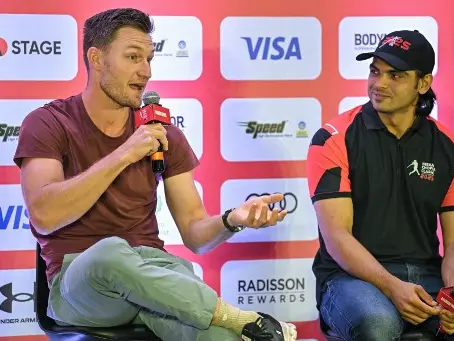
Thomas Rohler with Neeraj Chopra during a press conference Photograph: (AFP)
Neeraj Chopra Classic 2025, co-organised by two-time Olympic medallist Neeraj Chopra and JSW Sports, and sanctioned by the Athletics Federation of India, marks a major leap forward for Indian athletics
Thomas Rohler is no stranger to pain. The German javelin thrower, who won gold at the 2016 Rio Olympics, has spent years chasing, achieving, and recovering from the sport’s most elusive number — 90 metres. Now in Bengaluru to take part in the inaugural Neeraj Chopra Classic 2025, Rohler brings with him not just medals and technique, but a grounded, honest perspective about what it really takes to hit that mark — and why the world often misunderstands it.
Rohler reflected on the toll a 90m throw takes on the body and the mind. "Any 90m throw has a huge impact on the body," he said while talking to WION. “Once you throw 90m, the next thing you’re going to do is rest. Because the impact is high.” It’s not a dramatic exaggeration."
Rohler explains that the force exerted during the final block phase of the throw is equivalent to having the weight of a small car—roughly a ton—on the block foot. “People need to understand… this is not yoga,” he said with a mix of sarcasm and seriousness. “It’s really tough.”
It’s an apt description of a sport that often looks graceful but is, at its core, a controlled act of violence. The thrower must sprint with speed, position their leg with precision, and unleash energy through their body in a split second—all while avoiding injury. Rohler, like many in the sport, has battled injuries and setbacks throughout his career. But the physical toll is only one part of the equation.
What happens after a 90m throw, he suggests, is just as taxing. “Doing it again and again is a mental challenge,” he explained. “It’s about dealing with the pressure from the outside.” Once an athlete breaks the 90m barrier, expectations grow. The 33-year-old, with a smile, admits even he fell into that trap. “I also did it very often. We all mess up with the expectations.”
The German further went on to talk how perceptions have shifted in recent years. “We need to look back to 2012 London Olympics. You won the Olympic Games with a 84m throw” Rohler recalled. “Now people expect you to throw 90m. If you don’t do it, people ask, ‘Was it a bad day?’” His frustration isn’t with ambition, but with unrealistic expectations—especially from those who may not understand just how rare and magical a 90m throw is.
Trending Stories
)
)
)
)
)
&im=FitAndFill=(700,400))
)
)
)
&im=FitAndFill=(700,400))
)
)
)
)
)
)
)
)
)
)
)
)
)
)
)
)
)
)
)
)
)
)
)
)
)
)
)
And rare it is. In the long history of the sport, only a small handful of men have ever thrown beyond 90m. Rohler compares it to the very top tier of cricketers. “If you look at a cricket team, all these top players… if we talk about the top-top-top players, it’s the same like comparing to 90m of javelin,” he said. “It’s still magical.”
For the German, that magic is what the sport needs to hold on to. The number itself shouldn’t become routine or expected. “There’s only a few moments in life you get the chance to achieve it as an athlete,” he said. “But also to see it as a spectator.”
As the Neeraj Chopra Classic 2025 is set to take place in Bengaluru on July 5, Thomas Rohler's presence is a reminder that even in a sport driven by distance, wisdom still carries the farthest. And if he’s teaching anything this week, it’s that chasing greatness is never effortless, and never should be taken for granted.

