
&imwidth=800&imheight=600&format=webp&quality=medium "Lionel Messi's last World Cup ends in tears as Spain break Argentina hearts in 2026 final")
There is something cruel about sporting greatness. It convinces you that miracles are repeatable. For almost two decades, Lionel Messi had spent his career making football believe that the impossible was simply waiting for the right moment. The impossible became routine. Defenders disappeared with a feint, impossible passes found impossible angles, and finals that seemed lost suddenly became immortal.
So when Argentina reached another FIFA World Cup final, the world dared to believe once more. Not because logic suggested they would beat a relentless Spanish side. But because Lionel Messi was still wearing no. 10. On Sunday night, however, football delivered its oldest lesson. Not even Lionel Messi can defeat time.
Spain's 1-0 extra-time victory over Argentina was more than the crowning of a new world champion. It marked the end of what is expected to be the greatest World Cup career the sport has ever witnessed, a journey that started as an 18-year-old prodigy in Germany in 2006 and ended as a 39-year-old icon who had already achieved everything the game could offer. The scoreline will forever show Spain lifting the trophy. History, though, may remember something else. It was the night football bid farewell to Lionel Messi on its biggest stage.

The weight of one last dream
Messi never needed this World Cup. Unlike 2014, there was no burden of proving he could lead Argentina. Unlike 2022, there was no obsession with completing football. That chapter had already been written in Qatar. The World Cup trophy rested safely in his cabinet. His place among football's immortals had long been secured. The 2026 tournament was different. It wasn't about validation. It was about extending a love story. Every appearance felt like borrowed time.
Every goal felt like another reminder that age could slow his legs but not his mind. The tournament became a celebration of endurance. Eight goals, four assists and 12 direct goal contributions at the age of 39 were extraordinary numbers by any standard. They were among the best individual campaigns ever produced at a World Cup.
Trending Stories
)
The Early Spring is proof not everyone can talk about their real feelings, and it is perfectly OK
)
UN votes to ‘correct the map’ as India backs fairer world view
)
Nigerian Navy discovers 99,000 litres of suspected stolen, illegally refined products as it intensifies anti-crude oil theft operations
)
Who is Aditi Paudel? 17-year-old becomes Japan's first literacy ambassador
)
Bengaluru: Officials find 40 kg expired chilli at chairman's club
)
Jaishankar rejects trade link to ending Ukraine war
)
Israeli strikes on Lebanon kill three, injure 23 despite truce
)
Alpine glacier was covered with sheep wool sheets to prevent melting. It worked
)
South Korea mulls deploying military assets to Strait of Hormuz
)
World's fifth-largest economy, British army can't afford to train
)
Breaking | Vance takes the podium: First White House briefing since Leavitt's exit
)
Taiwan raises 'concerns' over China's missile test
)
BRICS 2026: $1 trillion sovereign capital set to converge in Delhi for first iBRICS Summit
)
What is Iran's Pickaxe Mountain that Trump has again threatened to bomb?
)
UN votes to correct world map that visually shrank Africa for 450 years
)
Former NewJeans member Danielle launches YouTube channel, hints at new solo journey
)
Bangladesh batter Towhid Hridoy creates history with 350 not out in South Africa
)
Brendan Fraser’s transformation fuels The Mummy 4 excitement as fans welcome back Rick O’Connell
&im=FitAndFill=(700,400))
Krishna Janmashtami 2026: From Dhaniya Panjiri to Makhana Kheer- 5 best sweet dishes perfect for celebrating Lord Krishna’s birth
)
Donald Trump plans to travel to Ireland on Qatari-donated jet amid security concerns
)
Nazi-looted art to return to Jewish heirs
)
Eight killed in Kerala’s Thrissur after car rams into lorry parked on highway
&im=FitAndFill=(700,400))
Why Russian fighter jets use bulky, low-pressure tyres compared to US jets
)
FBI-wanted fraud accused arrested in Jalandhar over $600,000 scam
&im=FitAndFill=(700,400))
Why US tanks weigh over 20 tons more than Russian tanks
&im=FitAndFill=(700,400))
New Friday OTT releases (September 4, 2026): GDN, Dhamaal 4, Jagamae Sangeetham- Watch 6 new movies and TV shows on Netflix, Prime Video and more
)
Killing the Himalayas slowly: Human urine is melting a glacier on Mount Everest
A final unlike the rest
Then came Spain. Perhaps the only team capable of making Messi look ordinary. Not because he played poorly. Because Spain simply refused to let him play. Luis de la Fuente's side understood something every opponent has struggled with for nearly twenty years. You don't stop Messi by chasing him. You stop him by denying him the spaces he wants before he ever reaches them. Whenever Messi drifted between midfield and defence, Rodri was already waiting.
When he attempted to combine with Julian Alvarez or Enzo, passing lanes disappeared. When he tried to receive possession facing goal, two or three Spanish shirts closed immediately. The result wasn't spectacular defending against Messi. It was suffocation. For perhaps the first time in years, the match unfolded without ever belonging to him. His touches became deeper. His influence became quieter. His moments became rarer. Spain dictated where Messi could play. For a footballer who built a career dictating every match himself, that was the greatest compliment his opponents could pay him.
Age didn't beat Messi
Spain Did. There will inevitably be voices claiming Messi ‘looked old’. That misses the point entirely. Throughout the tournament, Messi remained Argentina's conductor. He led the race for the Golden Boot until the final, created more chances than almost anyone, and continued to produce decisive moments despite approaching his 40th birthday. What changed in the final wasn't simply his legs. It was the opponent.
Spain may have produced one of the greatest defensive World Cup campaigns ever seen, conceding just one goal throughout the tournament while dominating possession and restricting elite attacks. Against that level of organisation, Messi no longer possessed the explosive burst that once transformed impossible situations into unforgettable highlights. The mind remained.
The body simply couldn't execute every idea. That is not failure. That is ageing. There is a difference.
The passing of the torch
Football loves symbolism. The final offered plenty. On one side stood Lionel Messi, the defining footballer of the last twenty years. On the other stood Spain's new generation, led by teenage sensation Lamine Yamal, representing the future of the sport.
The image felt almost poetic. Not because Yamal had surpassed Messi. Nobody replaces Lionel Messi. But because every generation eventually hands football to the next. Pele did. Maradona did. Zidane did. Now Messi has too. His final World Cup wasn't simply Argentina against Spain. It was yesterday meeting tomorrow. Tomorrow won.
The end of Messi's Argentina
Perhaps the greatest consequence of Sunday's defeat isn't personal. It's national. For nearly twenty years, Argentina never had to answer one question. “What happens after Messi?” Every coach, every tactical plan and every generation revolved around the same certainty. If the game became impossible… give the ball to no. 10. That safety net has disappeared. The next Argentina will not merely replace a goalscorer. It must replace its identity.
Messi's influence stretched beyond goals and assists. He slowed frantic moments. He demanded belief when panic spread. He attracted defenders, creating space for everyone else. He transformed ordinary teammates into fearless footballers simply because they trusted he would find them. That cannot be coached. It cannot be replicated. It can only be remembered.
What comes next?
Retirement from the World Cup does not necessarily mean retirement from football. Messi is expected to continue his club career with Inter Miami, where he remains the face of Major League Soccer. Internationally, however, the picture is clearer. A return for the 2030 World Cup would require Messi to compete at 43 years old. Football has never seen such longevity at the highest level. Even for a player who repeatedly challenged conventional limits, this appears to be the natural conclusion of his World Cup journey. His next chapter may involve club football, mentorship or perhaps a gradual farewell to the professional game. Whatever comes next, it will not redefine him. Nothing can.
Legacy was never decided in New Jersey
Sport often judges careers by one result. That would be unfair here. Sunday's defeat cannot erase what Messi accomplished across five previous World Cups. He remains the only player to dominate multiple generations, win virtually every major honour available, complete football by lifting the World Cup in 2022, and then return four years later to produce another elite tournament at an age when most players have long retired from international football.
If anything, the 2026 World Cup strengthened his legacy. Not because he lifted another trophy. Because he reminded the world that greatness is not measured only in victories. It is measured in relevance. At 39, the biggest football tournament on Earth still revolved around Lionel Messi. That, perhaps, is his greatest achievement.
The final image
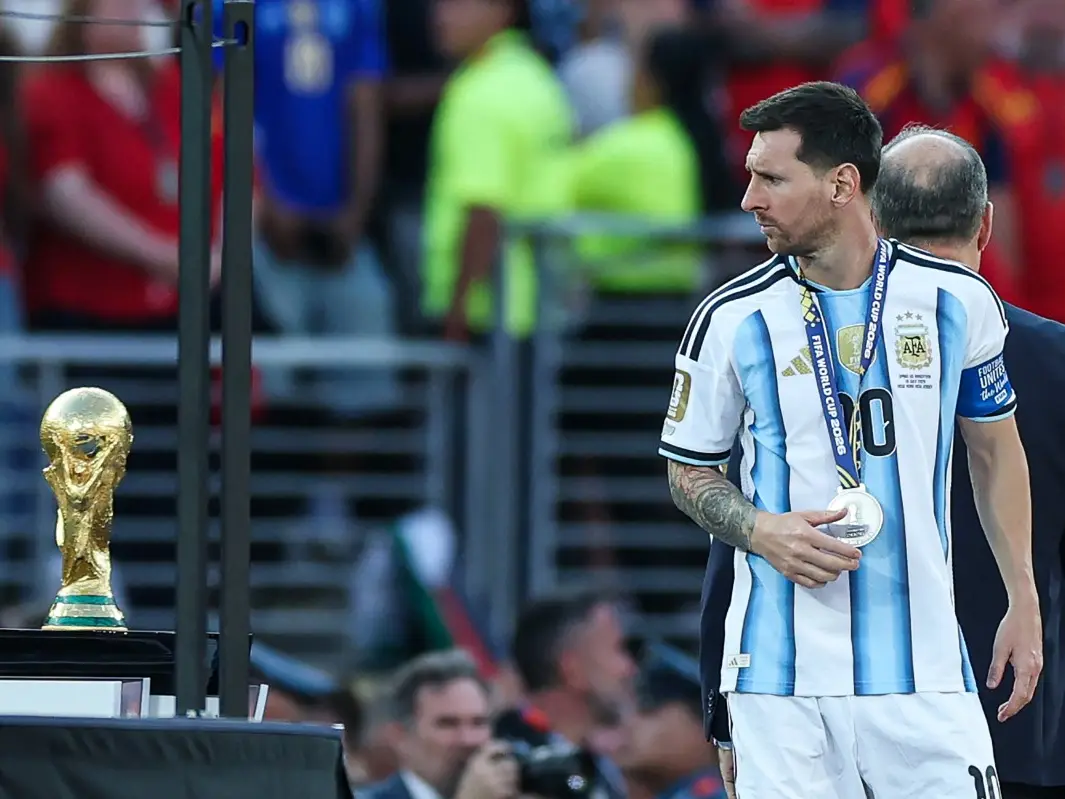
Football rarely grants perfect endings. Pele's final World Cup ended injured. Maradona's ended in controversy. Cristiano Ronaldo left the stage in disappointment. Now Lionel Messi joins them. Not with another golden trophy. Not with another iconic celebration. But with tears.
As Spain celebrated beneath the New Jersey sky, Messi stood watching in silence. It was a heartbreaking image. It was also a profoundly human one. The greatest player of his generation couldn't script one last miracle. Because even the greatest eventually lose to time. But legends are never remembered for how they leave. They are remembered for how they changed the game before they did.

