Watch: Pakistan man waits to fly his $600 homemade airplane

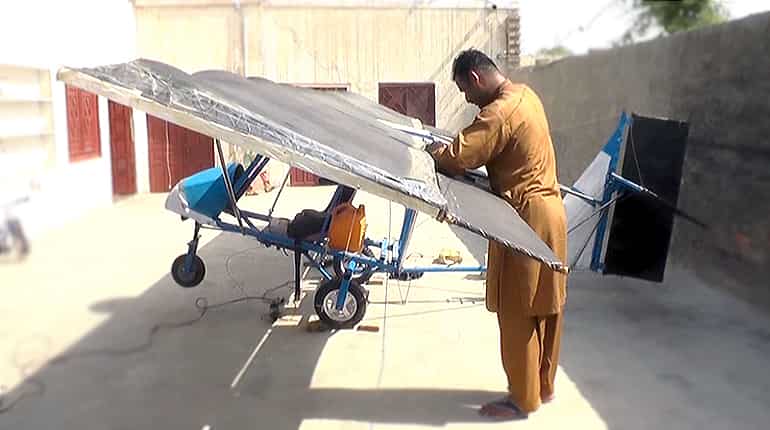
Pakistani popcorn seller awaits permission to fly his $600 homemade airplane
A popcorn seller in Pakistan is waiting for the country’s Civil Aviation Authority to allow him to fly his homemade airplane after police had stopped him from performing an unauthorized take-off.
On Thursday, the police had returned the plane they had confiscated from Muhammad Fayaz on March 31, after stopping him from taking off using a metal link road as a makeshift runway near his village.
The 30-year-old had dreamed of becoming an Air Force pilot and flying an airplane since he was in school. However, he had to drop out of school before he could finish his senior year due to poverty.

“Whenever I looked up to watch planes overhead, I longed to fly one myself. And then I thought I should use the creativity that God has bestowed on me to build my own plane and fly it,” Fayaz told EFE.
Fayaz, who lives in the Pakpattan district in central Punjab province, spent around Rs 90,000 by dipping into his savings, taking a bank loan and by selling a piece of his land, to build the plane.
To fulfil his childhood dream, he took on a job as a night watchman, alongside selling popcorn during the day, but the dream to fly a plane did not abandon him.
)
The Verdict | When precision fails: US commits war crime in Minab school strike, UN finds
)
Arvind Kejriwal, family members, Delhi CM Rekha Gupta get SIR notices
)
Russia extends ban on Western food imports for two more years in extended sanctions countermeasure
)
Trump wants to rename ‘Artificial Intelligence’, gives 3 options: Which one would you pick?
)
Russia-Europe tensions: Polish PM warns Russian attacks could test NATO's unity
&im=FitAndFill=(700,400))
How many F-35s does Britain, Japan and Israel have?
)
Mark Carney mimics Trump in hilarious moment over C$70 billion clean-energy investment; room erupts in laughter
)
Trump bans CNN, MS NOW and Politico from White House over ‘FAKE NEWS’
)
Ed Sheeran addresses Macklemore's removal, Gaza conflict during Philadelphia concert: 'I cannot hide how I feel'
&im=FitAndFill=(700,400))
‘Not the US or China’: These are the countries leading the world in arable land
)
How did an Australian river with 500 crocodiles pass the Olympic test? Here's how
)
Africa is splitting, and a lot sooner than estimated, giving way to a new ocean
)
US-Iran war: Tehran draws red lines — seven demands before any peace talks
)
Trump announces ‘AI Force’ as debate grows over AI risks and regulation
)
Harry Brook targets long reign at top of T20I rankings after Sri Lanka sweep
)
Iran sets 7 conditions to end war with US: What are Tehran’s demands?
)
‘End of my career...’: NSA Doval recalls tense Sikkim mission when China captured Indian intelligence team
)
Reacher star Alan Ritchson opens up about alleged blackmail, suicide attempt during difficult period
)
Brigitte Bardot’s private collection set for Paris auction; key items and prices revealed
)
Flying cars in UAE: Ras Al Khaimah signs deal with Chinese company to test new transport
)
9 women found dead near Johannesburg: South Africans rally, demand 'enough' to femicide
)
Trump defends AI amid growing alarm, announces new 'AI force' and promises an 'AI czar'
)
Russia's deadly Ukraine strikes kill 2 in Sumy, hit Dnipro mall
)
US-Iran war: Tehran sets seven conditions to re-engage in talks with US
)
Trump 2.0: Dark days ahead for America’s ‘imperial presidency’
)
Raphinha hat-trick powers Barcelona to 3-1 win over Sevilla in La Liga
&im=FitAndFill=(700,400))
Meet top 5 Indian batters with fastest T20I centuries
66 years of the Indus Waters Treaty: How India and Pakistan settled a bitter river dispute
)
China may have gained access to US's classified F-35 jets; parts meant for repairs diverted to Hong Kong, sparking Pentagon inquiry
)
‘Will go to any extent’: Pakistan vows to defend Saudi Arabia amid Houthi attacks
)
Russia holds first parliamentary elections since the beginning of the Ukraine war
)
Cochin shipyard starts building Indian Navy's next-gen missile vessels
)
Pentagon revives mandatory testosterone testing for male troops aged 30 and above
)
Nigeria: Protesters take to the streets, police fire shots
)
Gaza under attack: Health chief's son killed in IDF strikes
)
Saudi vs Houthis: Houthis claim missiles & drones used in attack on key Saudi sites
)
Fayaz began to build his plane a year and a half ago at home without any technical help from anyone.
He learned the basic rules of air pressure and flying techniques with the help of experiments that he carried out on his own, including one when he was in the fifth standard (fifth grade in elementary) and was riding on the passenger seat of his father’s motorcycle on his way to school.
He experienced air pressure by holding a writing slate in his hand and moving it in different directions.
“When I put it straight it didn’t make any difference but when I put it a bit downward my hands went up creating an airlift, and when I moved it upward my hands were going down, so I understood air does keep its pressure and what role an engine plays to push forward the plane,” said Fayaz.
Fayaz also watched National Geographic channel's Air Crash Investigation show meticulously to learn about why planes crashed and to understand the different parts of an aircraft and their functions.
He had also closely examined a grounded Pakistan International Airline plane that was displayed for public viewing at the Chauburji square in the eastern city of Lahore.
Fayaz had initially planned to take off on his maiden flight with his single-seater plane – which sports a national flag – on Mar. 23 to mark Pakistan Day.
However, his application to the police and other security agencies seeking permission for the flight was never acknowledged.
Fayaz says he conducted an unauthorized test flight around a year ago with a smaller engine and made some rounds of his village.
“It went up high about five feet and travelled around 2 kilometres (1.24 miles), and then I made different changes on the plane because I wanted to go higher, with accelerated speed,” he said.
The country’s Civil Aviation Authority said in a statement they appreciated the passion and skills of the “mini airplane” maker and would provide him with the required guidance to achieve more expertise in the field.
Under the New Aviation Policy 2019, developed in line with the vision of Prime Minister Imran Khan, every effort will be taken to promote the sector and support innovation, it added.
“We are considering whether he should be allowed to fly his plane or not. A technical team will inspect the plane’s airworthiness, safety parameters and if it meets all the requirements, then he will be allowed to fly,” Mujtaba Baig, a spokesperson for the CAA, told EFE.
“He has tried to make a simpler version of already-existing technology. It doesn’t look like a patent product with a new formula. If the technical team passes it, he will have to register with the CAA before he can fly,” Baig said.
If it were approved as a patented product, Fayaz would even be able to sell it to a company and earn money, he added.