Taliban take Kandahar and Herat; US and UK to evacuate Afghanistan embassies

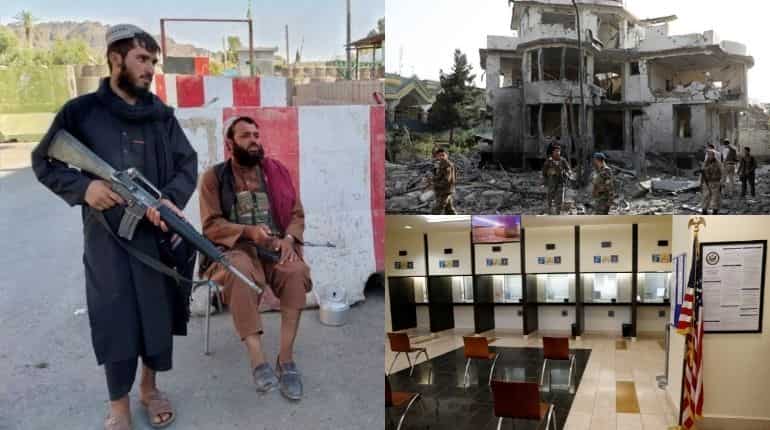
Taliban, Afghan armed forces and the consular section at the US Embassy in Kabul
TheTalibanclaimed control over two of Afghanistan's biggest cities on Thursday, according to media reports, as the United States and Britain said they would send thousands of troops to help evacuate their embassy staff.
The capture of Kandahar and Herat,the country's second and third largest cities, would represent theTaliban's two biggest military victories since they began a broad offensive in May.
The fall of major cities was a sign that Afghans welcome theTaliban, a spokesperson for the group said, according to Al Jazeera TV.

The USState Department said Secretary of State Antony Blinken and Defense Secretary Lloyd Austin spoke to Afghan President Ashraf Ghani on Thursday and told him the United States "remains invested in the security and stability of Afghanistan". They also said the United States was committed to supporting a political solution to the conflict.
In response to theTaliban's swift and violent advances, the Pentagon said it would send about 3,000 extra troops within 48 hours to help evacuate embassy staff.
)
Why asking questions could be more important than memorising answers
)
Did India risk its US trade deal despite softer stance at BRICS?
&im=FitAndFill=(700,400))
How 2nm technology improves iPhone performance
&im=FitAndFill=(700,400))
Shahid Kapoor to Rajkummar Rao: Actors who rule both theatres and OTT
)
BRICS Summit 2026: Trump wants to weaken BRICS, but maybe doing the opposite
&im=FitAndFill=(700,400))
Meet top 5 batters fastest to 3000 runs in T20Is
)
Did BRICS Summit 2026 prove that an 11-member bloc with India and China in it can still agree on key issues?
)
Top 5 places to visit in Goa beyond its famous beaches
)
Delhi’s balancing act: BRICS serves as a stage for West Asia diplomacy
&im=FitAndFill=(700,400))
Why European Meteor missiles use ramjet engines compared to standard US solid rockets
)
'He is popular...': Malaysian PM Anwar Ibrahim's praise for PM Modi during bilateral meeting | WATCH
)
Iran, India agree to deepen humanitarian and political ties, President Pezeshkian says
)
‘Want to reset ties with India, have engagement based on mutual interests,’ says Bangladesh minister
)
BRICS Summit 2026: PM Modi, Xi reach key consensus on ties, China to assume BRICS chairmanship in 2027
)
UK breakup on the cards? Scotland, Wales and Northern Ireland push for independence
)
Russia-Ukraine-US talks in October? Kremlin says not ruling out possibility of trilateral
)
Trump says Canada eager to reach a deal, it could come ‘fairly soon’ if Ottawa treats US farmers better
)
The Verdict | Africa is too big to remain a guest at the BRICS table
)
‘Partners, not rivals’: Xi outlines four point plan for stronger India-China ties
&im=FitAndFill=(700,400))
Why Chinese PL-15 air-to-air missiles use dual-pulse motors compared to European interceptors
)
'It’s going to be a war': Ben Shelton on facing Zverev in US Open title clash
)
NATO under Russian threat? Drone strikes just 2 km from Poland, narrow escape for former UK PM, CIA chief
)
Trump defends Lincoln Memorial pool amid NYT report blaming renovation flaws, not vandalism
)
BRICS Summit: New Delhi declaration adopted with full consensus, big diplomatic win for India
)
800 million years old - Scientists discover 'fingerprints' of supercontinent Gondwana in ancient rocks
)
Russian drone hits Warsaw-bound train near Polish border, Zelensky accuses Moscow of ‘deliberate’ targeting
)
War is making Russia stronger? How Ukraine is shaping Moscow’s next generation of weapons
)
BRICS Summit 2026: Russia-India-China grouping never formalised
)
9-year-old Chennai prodigy clears Cambridge IGCSE grade 10 exams
)
Indian importers urge Bangladesh to lift export ban on 'Hilsa' fish ahead of Durga Puja
)
Humans may lose control of AI: Anthropic CEO calls for slowdown, Altman, Musk back him
)
US diplomat accused of possessing child abuse images secretly flown out of UK by US Marines
)
BRICS Summit 2026: Modi-Xi moment highlights India-China thaw at BRICS
)
Why does your skin need protection from UV rays?
)
PM Modi and China's Xi offered to help resolve Russia-Ukraine war: Kremlin
)
Akram, Afridi, Mushtaq tear into PCB after Pakistan’s Test series collapse in UK
"We expect to draw down to a core diplomatic presence in Afghanistan in the coming weeks," said State Department spokesperson Ned Price, adding the embassy was not closed. A person familiar with the matter said there were no guarantees the embassy would remain open.
The State Department said it would also increase the tempo of Special Immigration Visa flights for Afghans who helped the USeffort in the country.
Britain said it would deploy around 600 troops to help its nationals and local translators get out.
As the United Nations warned that aTalibanoffensive reaching the capital would have a "catastrophic impact on civilians," the United States and Germany urged all their citizens to leave Afghanistan immediately.
In Qatar, international envoys to Afghan negotiations called for an accelerated peace process as a "matter of great urgency," and for an immediate halt to attacks on cities.
The fall of both Kandahar and Herat was reported by media including the Associated Press. Combined, the cities represent the two biggest prizes yet for theTalibanin their offensive over the past week.
"As you can see, we are inside the Herat police headquarters right now," aTalibanfighter said in a video shared by a group spokesperson, Qari Yousuf Ahmadi.
Earlier on Thursday, theTalibancaptured Ghazni, situated on the Kandahar-to-Kabul road some 150 km (90 miles) southwest of the capital.
On Wednesday, a USdefense official cited USintelligence as saying theTalibancould isolate Kabul in 30 days and possibly take it over within 90.
With phone lines down across much of the country, Reuters was unable to immediately contact government officials to confirm which of the cities under attack remained in government hands.
SAIGON COMPARISONS
The speed and violence of theTalibanoffensive have sparked recriminations among many Afghans over President Joe Biden's decision to withdraw UStroops, 20 years after they ousted in theTalibanin the wake of the September11 USattacks.
Biden said on Tuesday he does not regret his decision, noting Washington has spent more than $1 trillion in America's longest war and lost thousands of troops. He added the United States continues to provide significant air support, food, equipment and salaries to Afghan forces.
USSenate Republican leader Mitch McConnell said the exit strategy was sending the United States "hurtling toward an even worse sequel to the humiliating fall of Saigon in 1975."
"President Biden is finding that the quickest way to end a war is to lose it," McConnell said, urging him instead to commit to providing more support to Afghan forces.
"Without it, al Qaeda and theTalibanmay celebrate the 20th anniversary of the Sept. 11 attacks by burning down our Embassy in Kabul."
Former State Department spokesperson Morgan Ortagus said it was "a huge foreign policy failure with generational ramifications just shy of seven months into this administration. Everything points to a complete collapse."
VIOLENCE VS DIPLOMACY
In a deal struck with former USPresident Donald Trump's administration last year, the insurgents agreed not to attack US-led foreign forces as they withdrew. TheTalibanalso made a commitment to discuss peace.
Given the speed of theTaliban's advance, prospects for diplomatic pressure to affect the situation on the ground seemed limited, although theTalibanspokesman told Al Jazeera: "We will not close the door to the political track."
Al Jazeera reported a government source saying it had offered theTalibana share in power if the violence stopped. It was not clear to what extent the reported offer differed from terms already discussed in Qatar.
Talibanspokesperson Zabihullah Mujahid said he was unaware of any such offer but ruled out sharing power.
"We won't accept any offer like this because we don't want to be partner with the Kabul administration. We neither stay nor work for a single day with it," he said.
The international envoys in Doha, who met with Afghan government negotiators andTalibanrepresentatives, reaffirmed that foreign capitals would not recognise any government in Afghanistan "imposed through the use of military force."