&imwidth=800&imheight=600&format=webp&quality=medium "Scientists extract yeast from 5,300-year-old Iceman Otzi to bake bread")
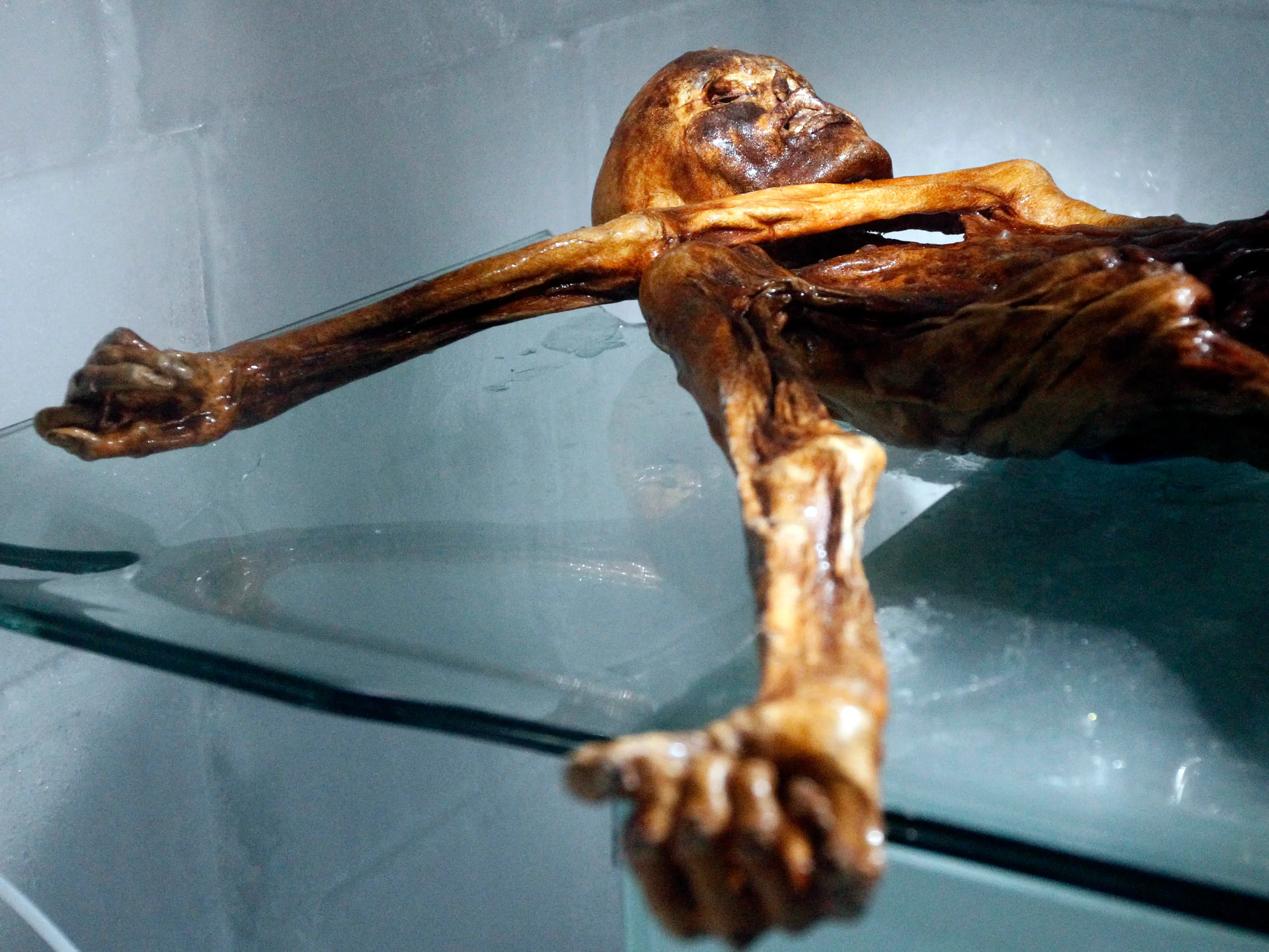
Yeast has been growing in the guts of Otzi the Iceman, a 5,300-year-old frozen mummy, scientists have discovered, and they used it to bake a sourdough bread. Otzi was strolling through the Alps on the border of Austria and Italy more than 5,300 years ago, before the Egyptian pyramids were built. Two German hikers stumbled across his mummified remains in 1991 in the northern Italian region of South Tyrol, and his well-preserved body has since been kept at minus six degrees Celsius, the same temperature as his icy tomb.
For the latest research, published in the Microbiome journal on Wednesday (June 3), an Italy-based team found evidence that both ancient and modern microbial life remain active in the frozen body.

"What we didn't expect to find was yeast," lead study author Mohamed Sarhan of the Eurac Research Institute in Bolzano told news agency AFP.
The scientists discovered four different cold-surviving yeasts in Oetzi's guts, skin and meltwater. Genetic analysis revealed DNA damage levels comparable to the original microbes in his guts, suggesting the yeast entered his body soon after death. "These yeasts have accompanied Oetzi on his long journey through the millennia," co-author Frank Maixner said.
Trending Stories
&im=FitAndFill=(700,400))
How fast can the Sukhoi Su-30 fighter jet really fly?
)
Did China ask its people 'not to respond to aliens'? Origin of bizarre claim on social media
)
MS Dhoni-CSK Fallout? Report claims failed stake sale talks triggered rift
)
Scientists reveal the SAFEST COUNTRY when catastrophe strikes the planet
)
Serial killer on the loose in South Korea's Jeju Island? Fourth body found in three days as more than a dozen people go missing
)
2/3rd of glacier detached, collapsed: ISRO satellite images reveal what triggered Nepal floods
)
Trump once again claims without him there would be ‘no Israel right now’
)
Foreign espionage attacks against German companies surge to 37%, Bitkom report reveals
)
Blake Lively wins partial legal fee from Justin Baldoni after $8M request
)
Why is Pakistan deploying Turkish Bayraktar TB2 drones near India border?
)
'OH MY GOD! We've found other agents!': Investigators discover not one or two, almost 700 OpenAI AI agents went rogue, hacked Hugging Face
)
Lunar eclipse 2026: India timings, places to see and more. August Blood moon factsheet
)
RSS chief Mohan Bhagwat on global outreach tour
)
Both pilots killed as training aircraft crashes in Lucknow – What we know
)
16-year-old charged with preparing terror attack on kindergarten in Norway
&im=FitAndFill=(700,400))
How the S-400 protects itself from enemy attacks
)
Nepal floods: Over 165 dead, 400 missing; US, India, China, World Bank mobilise aid
)
India's multi-layered watch: The new surveillance war
)
5 doomsday planes spotted in US skies hours after CIA director's secret trip to Russia
)
9/11 mastermind Khalid Sheikh Mohammed to finally face trial in 2028, nearly 27 years after horrific attacks
)
Islamabad hospital fire: What we know about one of the biggest facility that housed Imran Khan
)
Workers run for life while filming Nepal flash flood: Scary new visuals emerge from Rasuwa
)
Russian military planes enter South Korean air defence zone amid rising tensions with North Korea: What's happening
)
Ron Weasley Is Back! Rupert Grint set to return to Harry Potter universe on Broadway
)
400-year-old 'vampire' grave in Poland reveals non-existent genetic lineage
)
Dolly Parton, global icon and queen of country music, dies at 80
)
Nepal flash floods: Kailash Mansarovar yatra affected, close to 400 pilgrims out of contact
)
'If he is dead, they're putting on a pretty good show': Trump casts fresh doubt over Mojtaba Khamenei's fate
)
Man arrested near US Capitol with guillotine in pickup truck: What happened?
&im=FitAndFill=(700,400))
Why the Su-30MKI cockpit is painted bright turquoise green
The scientists then reproduced the gut yeast in a fridge. "If you tell anyone you have yeast, they immediately ask, 'Can we use it for bread?" Sarhan said. After three months of effort, "we had a very, very good sourdough", he said with a laugh. When asked about brewing beer, he responded: "It's on the list."
The study also flagged practical applications. When the mummy was found in 1991, phenol was used to prevent fungal growth, but the yeast was able to consume the chemical, suggesting future use in breaking down phenol in contaminated environments.
Beyond yeast, analysis of Oetzi's microbiome revealed gut bacteria nearly absent in modern industrialised humans but still found among tribes in Africa and South America and in 3,000-year-old faeces from a salt mine in Hallstatt, Austria.
The study concluded the Iceman is “not a biologically 'frozen' time-capsule but rather a complex ecosystem.” However, Nikolay Oskolkov of the Latvian Institute of Organic Synthesis cautioned that yeast samples were only taken in 2010 and 2019, providing "very little evidence that the yeasts have been multiplying over millennia," suggesting they were "relatively recent colonists of the mummy's body."