In a rare capture, NASA’s James Webb telescope clicks star on cusp of death

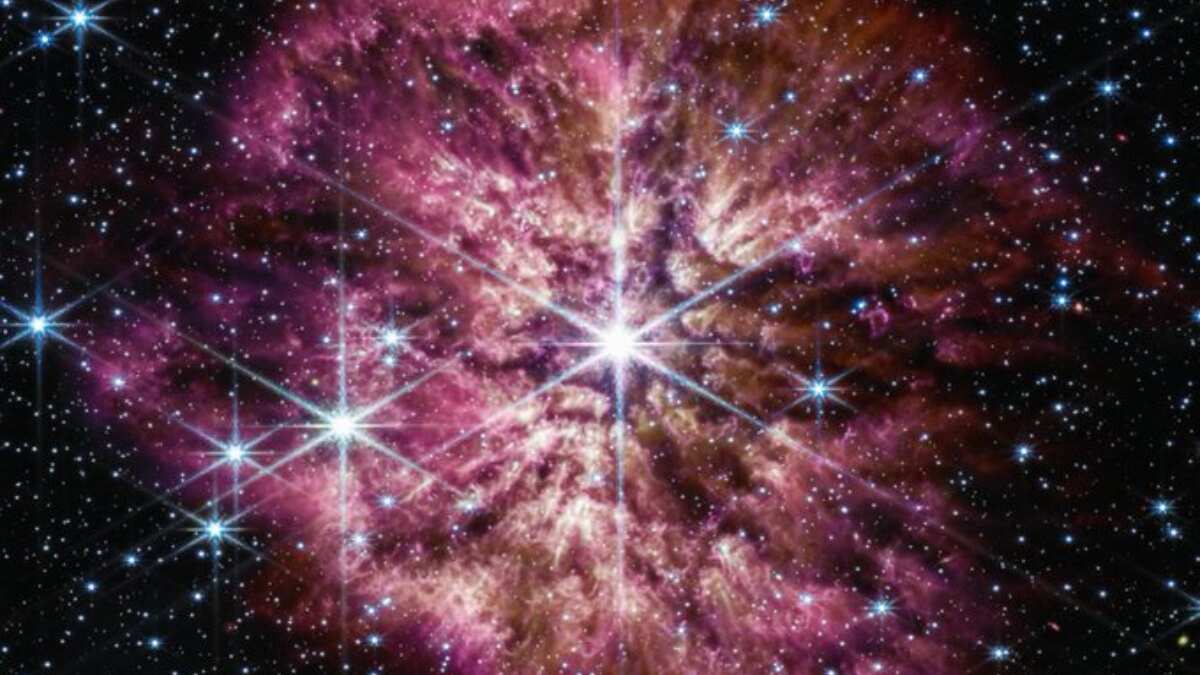
Rare Wolf-Rayet star in its fleeting phase.
A star's rare and fleeting phase on the cusp of death was captured by NASA's James Webb Space Telescope.
NASA on Tuesday released images of WR 124, a rare Wolf-Rayet star present in the constellation Sagittarius, at a distance of 15,000 light-years from Earth.
"Massive stars race through their life cycles, and only some of them go through a brief Wolf-Rayet phase before going supernova, making Webb's detailed observations of this rare phase valuable to astronomers," wrote NASA officials.

The telescope's infrared eyes captured the gas and dust flung into space by the hot star.
ALSO READ | A Martian Aurora? NASA's Curiosity captures heavenly sun rays on Mars
)
Extreme warming in Indian Ocean added 695 billion tons of ice to Antarctica ice sheet
&im=FitAndFill=(700,400))
Ananya Panday to Sharvari: 5 actresses serving major princess vibes
)
‘Will go to any extent’: Pakistan vows to defend Saudi Arabia amid Houthi attacks
66 years of the Indus Waters Treaty: How India and Pakistan settled a bitter river dispute
)
Trump bans CNN, MS NOW and Politico from White House over ‘FAKE NEWS’
)
Flying cars in UAE: Ras Al Khaimah signs deal with Chinese company to test new transport
)
IIT Bombay student dies by suicide, was caught seeking AI help during exams
)
Brigitte Bardot’s private collection set for Paris auction; key items and prices revealed
)
Claude led 26% of Anthropic's AI R&D work
)
Reacher star Alan Ritchson opens up about alleged blackmail, suicide attempt during difficult period
)
It's a girl! Deepika Padukone and Ranveer Singh welcome their second child
)
Pak: A series of counter terrorism operations in Khyber Pakhtunkhwa
)
How did an Australian river with 500 crocodiles pass the Olympic test? Here's how
&im=FitAndFill=(700,400))
How many F-35s does Britain, Japan and Israel have?
&im=FitAndFill=(700,400))
Meet top 5 Indian batters with fastest T20I centuries
)
Mark Carney mimics Trump in hilarious moment over C$70 billion clean-energy investment; room erupts in laughter
)
Putin: European leaders using war rhetoric to save falling ratings
)
Ajit Agarkar’s future as chief selector to be decided at right time, says BCCI secretary
)
China may have gained access to US's classified F-35 jets; parts meant for repairs diverted to Hong Kong, sparking Pentagon inquiry
)
Tirupati Laddu ghee adulterated with chemicals, says ED, supplier arrested
)
Trump signs Russia sanctions bill into law, targets Moscow’s energy sector
)
Africa is splitting, and a lot sooner than estimated, giving way to a new ocean
)
Pentagon revives mandatory testosterone testing for male troops aged 30 and above
)
Cochin shipyard starts building Indian Navy's next-gen missile vessels
)
Russia holds first parliamentary elections since the beginning of the Ukraine war
)
FACT CHECK: Why did PM Modi ask Xi ‘is it okay’ at BRICS Summit? New video reveals...
)
The Verdict | When precision fails: US commits war crime in Minab school strike, UN finds
)
Why Ranveer Singh’s Dhurandhar missed India’s Oscar entry; FFI jury member reveals what happened
Russia attacks Ukraine with 174 drones, kills 8; 2 vessels hit in Black Sea
)
Trump 2.0: Dark days ahead for America’s ‘imperial presidency’
)
New brain discovery could aid neurological disease studies
)
Oxford United's new clothing line featured 'United 93' phase
)
Trump extends H-1B visa's $100,000 fee until September 2027: What it means for Indians?
)
Iran rebuilding nuclear facilities? New satellite images show Tehran may be rapidly restoring bombed Parchin base
)
Arvind Kejriwal, family members, Delhi CM Rekha Gupta get SIR notices
)
)
"Wolf-Rayet stars are in the process of casting off their outer layers, resulting in their characteristic halos of gas and dust," agency officials stated.
"Dust is integral to the workings of the universe: It shelters forming stars, gathers together to help form planets, and serves as a platform for molecules to form and clump together — including the building blocks of life on Earth," stated NASA.
"Despite the many essential roles that dust plays, there is still more dust in the universe than astronomers' current dust-formation theories can explain,” it added.
A shot of the same transitioning star was captured by the Hubble Space Telescope a few decades ago, but in that image, it appeared like a fireball.
WATCH | NASA launches uncrewed Roscosmos Soyuz spacecraft
According to scientists, such transformation takes place only with some stars and is generally the last stage before they explode, going supernova.
“We’ve never seen it like that before. It’s really exciting,” stated Macarena Garcia Marin, a European Space Agency scientist.
This star's constellation Sagittarius, which is officially called WR 124, is 30 times bigger than our sun and has shed enough material already to account for 10 suns, as per NASA.
(With inputs from agencies)
You cannow write for wionews.comand be a part of the community. Share your stories and opinions with ushere.
WATCH WION LIVE HERE