'Great conjunction': Saturn, Jupiter and the Moon to form triangle in the sky

'Great conjunction': Saturn, Jupiter and the Moon to form triangle in the sky
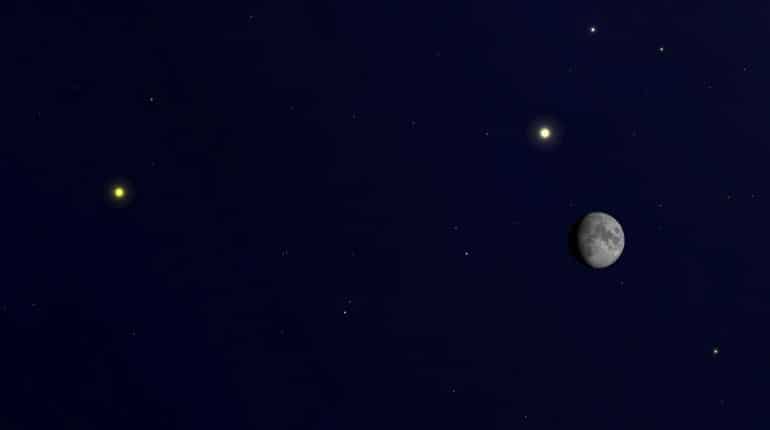
Skywatchers are in for a treat asSaturn, Jupiter and the Moon are going toform a triangle in the sky on December 21 in a phenomenonknown as the'great conjunction'.
This week Jupiter and Saturn are low in the southwest during the nippy December sunset. At the point when this month started, they were isolated by 2.1 degrees.
Yet, in the days that followed, they have been gradually moving toward one another; drawing nearer by about 0.1 degrees every day on their way toward the hotly anticipated "extraordinary combination" next Monday night (Dec. 21). They are crawling nearer to one another will be additionally charged by the entry on Wednesday and Thursday nights (Dec. 16-17) of a frontal area waxing bow moon.

The two planets are moving toward the east regarding the stars, with the slowest, Saturn, at first in the number one spot, and Jupiter, the quicker planet, in the back. In this way, December started with a thickset askew line of Saturn and Jupiter (from upper left to bring down right) along the ecliptic — that fanciful line on the sky that denotes the yearly way of the sun, just as where the moon and planets likewise meander.
)
US Treasury rallies global financial institutions for Op Economic Outcast to isolate Iran
)
Trump praises India’s Opium crackdown, hails anti-drug efforts
)
Saudi Vs Houthis: Yemeni military rebels clash with Houthis
)
Veteran actor Anant Nag honoured with Indian cinema’s highest award
)
Pakistan boycotts chess match against Israel at Olympiad
)
Lionel Messi for 2026 Ballon d’Or over Mbappe and Yamal, says Diego Simeone
)
Protests erupt over migrant housing plan in Piddington
)
Formula One reveals the 2027 race calendar; Monaco to host sprint race for the first time
)
Bigg Boss 20: Mahhi Vij reveals she lost Yuva role to Kareena Kapoor; 'didn’t work out in my favour'
)
No Pandya as Auqib Nabi earns maiden ODI call-up; Mayank returns for WI T20Is| check full squads
)
Former India player Diana Edulji wants Smriti Mandhana to replace Harman as skipper at the earliest
)
US House votes 417-3 to pass Ratepayer Protection Act targeting AI data center electricity costs
)
Pakistan: Imran Khan's sons Kasim & Sulaiman claim their father is 'tortured' in jail
&im=FitAndFill=(700,400))
New OTT releases this week (September 14-20, 2026): Lust Stories 3, Waiting Hai, Irumudi- 5 new titles coming on Netflix, Prime Video and more
)
Taiwan seeks deeper India ties as direct flights restart soon and chip projects advance
)
Trump gets new power to hit India, China with up to 100% tariffs as US Senate clears Russia sanctions bill
)
Former OpenAI researcher warns of growing risks from Artificial Intelligence
)
Want to get married within a year? Why 18 lakh people rush to Jaipur for ‘sacred henna’
)
Fed raises rates for first time in 3 years, Kevin Warsh defies Trump as inflation mounts
)
Chiefs tight end Travis Kelce named one of the victims in $35 million ponzi scheme
)
The Early Spring season 2 is happening, but fans have one request - 'don't change the actors'
)
All Indian goods to get duty-free access to New Zealand
)
Sydney Sweeney defends provocative ad choice, the internet is still not impressed
)
Shahzad Bhatti Network declared terrorist organisation under UAPA: Govt order
)
Europe wants a common playbook for security threats, seeks security beyond NATO
)
Trump calls Canada-EU associate membership plan ‘laughable’ and threatens 'very serious tariffs'
)
‘Imagine 50 AI fighters cornering one manned jet’: India’s mobbing doctrine eyes a new era of air warm
)
AUS vs SA: Steve Smith still gets 'little flashbacks' from sandpaper gate
)
India breaks silence on US Russia sanctions bill, 100% tariff threat: ‘Committed to energy security’ for 1.4 billion
)
Abhishek Sharma rises to No. 2 in T20Is; ENG’s Robinson 3rd after record Pakistan Tests
)
Daayra movie review: Kareena Kapoor, Prithviraj Sukumaran shine in Meghna Gulzar’s cop-versus-cop crime thriller
)
Katrina Kaif’s postpartum weight is not the problem; your gaze is
)
Hong Kong unveils 11 new measures to boost birth rates, offers higher cash bonuses and housing perks
)
US trade tariff: 100% tariff targets Russian buyers amid trade tensions
)
Pak batter Rizwan's petition against being questioned by cyber crime agency rejected by court
)
Saudi vs Houthis: Riyadh claims to have shot Houthi drone targeting Mecca
)
Prime Minister Narendra Modi's birthday: Italian PM Meloni sends birthday wishes
&im=FitAndFill=(700,400))
Suriya and Jyothika say ‘I do’ again after 20 years! See their dreamy wedding pics
)
Pakistan naval vessel returns to harbour with 'severe damage' after collision with Indian warship in Arabian Sea
As time passes the movement of fervor has been animating as the hole among Saturn and Jupiter has been quickly contracting.
What's more, presently we have shown up at the "final lap" of their hotly anticipated meeting.
What has become referred to prominently as the "Christmas Star" is a particularly lively planetary combination effectively obvious at night sky throughout the following fourteen days as the splendid planets Jupiter and Saturn meet up, coming full circle the evening of December21.
In 1610, Italian space expert Galileo Galilei guided his telescope toward the night sky, finding the four moons of Jupiter – Io, Europa, Ganymede, and Callisto. In that very year, Galileo additionally found an unusual oval encompassing Saturn, which later perceptions resolved to be its rings. These revelations changed how individuals comprehended the most distant spans of our close planetary system.
After thirteen years, in 1623, the nearby planetary group's two goliath planets, Jupiter and Saturn, traversed the sky. Jupiter got up to speed to and passed Saturn, on a galactic occasion known as an "Incredible Conjunction."
"You can envision the nearby planetary group to be a course, with every one of the planets as a sprinter in their own path and the Earth toward the focal point of the arena," said Henry Throop, space expert in the Planetary Science Division at NASA Headquarters in Washington. "From our vantage point, we'll have the option to be to see Jupiter within the path, moving toward Saturn throughout the month lastly overwhelming it on December 21."
The planets routinely seem to pass each other in the close planetary system, with the places of Jupiter and Saturn being adjusted in the sky about once at regular intervals.
What makes the current year's exhibition so uncommon, at that point? It's been almost a long time since the planets passed this near one another in the sky, and almost a long time since the arrangement of Saturn and Jupiter happened around evening time, as it will for 2020, permitting almost everybody around the globe to observe this "incredible combination."
The nearest arrangement will show up only a tenth of a degree separated and keep going for a couple of days. On December 21, they will show up so close that a pinkie finger at a manageable distance will effortlessly cover the two planets in the sky. The planets will be anything but difficult to see with the independent eye by looking toward the southwest soon after dusk.
From our vantage point on Earth the colossal gas monsters will show up near one another, however, they will stay a huge number of miles separated in space. And keeping in mind that the combination is going on around the same time as the colder time of year solstice, the circumstance is just an incident, in light of the circles of the planets and the tilt of the Earth.