A 'new' star will soon appear in the night sky, only to vanish for 80 years

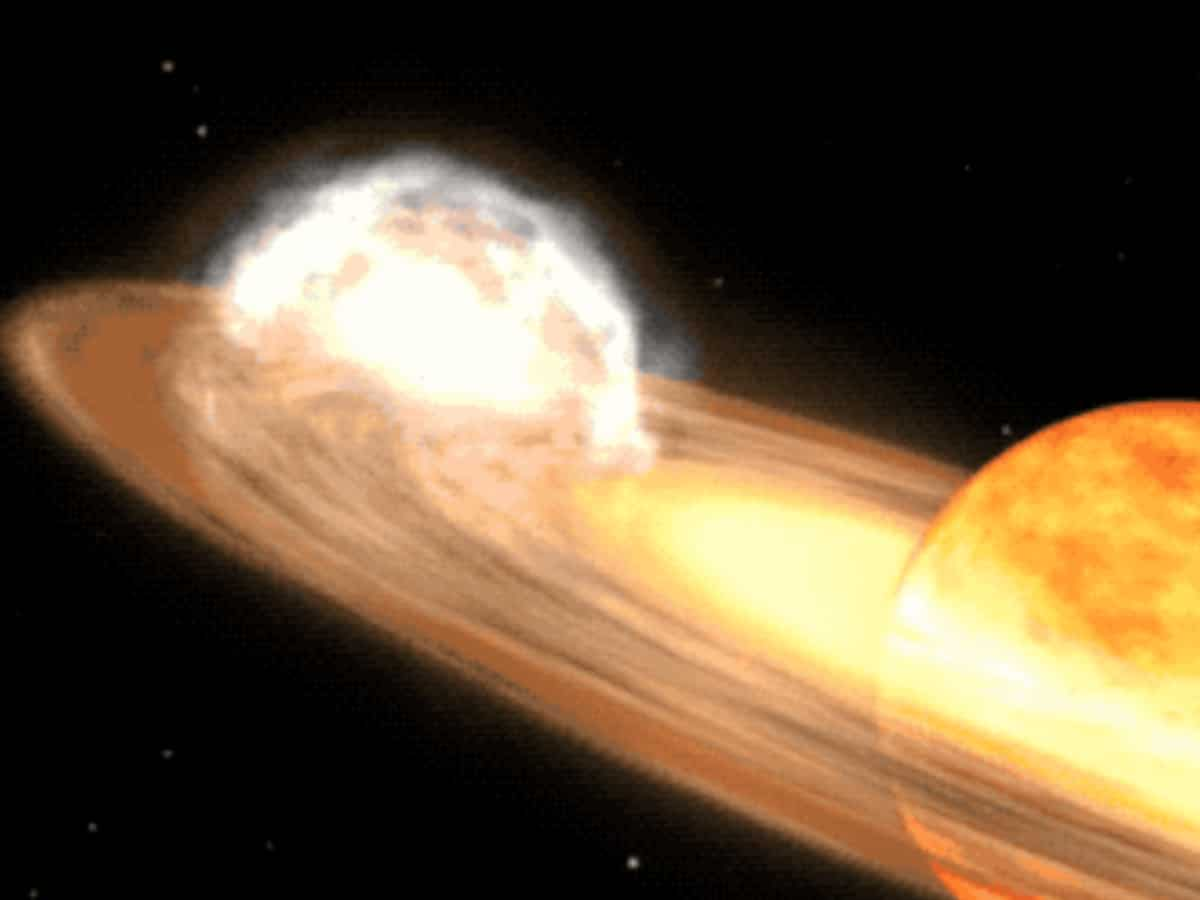
Artist's Concept of Nova Explosion
The universe could bless stargazers with a “once-in-a-lifetime viewing opportunity” of a 3000 light years away star system that will soon be visible to the naked eye from Earth, said NASA. The star system, T Coronae Borealis, also known as T CrB is expected to shine bright in the sky between February and September 2024.
The last time it exploded into a spectacle was back in 1946, and the next time thishappens will be after 80 years.So this is indeed a rare event that many people might witness this year.
Also Read |Odysseus: New pics emerge as moon lander to be 'put to sleep' for lunar night

The star system will become visible this year
The star system T CrB, normally has a magnitude of +10, which is quite far to see with unaided eyes. But during the Feb-Sep 2024 period, T CrB will jump to magnitude +2, making it quite bright to be seen with the naked eye. As per NASA, the star system will have similar brightness to the North Star, Polaris.
Also Read |7,300-year-old underwater volcano eruption emerges as largest in history, reveals new study
)
‘Kill all in the name of...’: FBI arrests 21-year-old over alleged ISIS-inspired mass-casualty attack plot
)
Space mines, lasers & robotic arms: Lt Gen Pannu decodes US disclosure of weapons in space
)
Bitter Zelensky snubs Trump for playing politics with Ukraine war | Gravitas
)
US fires up to 70 interceptors against Iran attack on Jordan, putting supplies under pressure
)
‘US military task force aiding Saudi Arabia forces with intel, planning support’: Official
)
OpenAI boss Sam Altman repeats AI 'slow down' call, says world 'right to be afraid'
)
Top military commanders from US, Israel, and 7 Arab nations held secret meeting on Iran War
)
Sydney Sweeney defends provocative ad choice, the internet is still not impressed
)
India to host IPL 2027 auction; WPL 2027 auction set for late October in Kochi
)
Shahzad Bhatti Network declared terrorist organisation under UAPA: Govt order
)
'Definitely feel bad for yourself': Kuldeep Yadav opens up on India Test snubs
)
US, China dominate global economy: Where does India rank among the world's biggest economies?
)
Ex-India all-rounder Yuvraj Singh wants India to avoid 'massive changes' before ODI World Cup 2027
)
Ed Sheeran’s US tour loses all support acts after Macklemore’s removal | Controversy explained
)
Ex-England footballer Raheem Sterling pleads guilty in reckless driving and crashing his Lamborghini
)
China's property crisis deepens as investment plunges nearly 20%
)
Alex Saab, ally of Venezuela's Maduro, pleads guilty in US corruption case
)
Messi set to play in farewell match on October 6 in Argentina vs Benin friendly
)
Who was Eliana Moreno? NBC LA aerial reporter killed in Chatsworth crash
)
Putin-linked Russian oligarch, Melania links: Why Trump skipped his son’s Bahamas wedding bash?
)
800 million years old - Scientists discover 'fingerprints' of supercontinent Gondwana in ancient rocks
)
Trump's name cannot return to Kennedy Center, US judge rules
)
Pakistan naval vessel returns to harbour with 'severe damage' after collision with Indian warship in Arabian Sea
)
Water equivalent to two Pacific Oceans could be stashed 2,900 km inside Earth
)
Ex-CIA officer caught with gold bars worth $40 million seeks plea deal | Gravitas
)
Pakistan: Imran Khan's sons Kasim & Sulaiman claim their father is 'tortured' in jail
)
Trump's Iran war faces fresh House rebuke; 7 Republicans join Democrats in push to end conflict ahead of midterms
)
US Treasury yields cross 5% as Scott Bessent warns of ‘global issues’ impacting bonds
&im=FitAndFill=(700,400))
New OTT releases this week (September 14-20, 2026): Lust Stories 3, Waiting Hai, Irumudi- 5 new titles coming on Netflix, Prime Video and more
)
Who is Kalyan Bainsla, accused in the Gurugram hit-and-run case involving woman biker?
)
Saudi Arabia discovers 110 million tonnes of Uranium-rich ore in Madinah region
)
Los Angeles helicopter crash: At least three dead, several injured; NTSB to investigate
)
India summons top Pakistan diplomat after Pak Navy ship collides with Indian warship at high seas
)
Saudi Arabia accuses Houthis of drone attack on Mecca, first-ever red alert in Islam's holiest site sparks panic
)
'Like a thug you are using agency to go after..': Kash Patel grilled by Senate Democrats over FBI firings, journalist investigations and hiring policy
)
Abhishek Sharma rises to No. 2 in T20Is; ENG’s Robinson 3rd after record Pakistan Tests
)
Canada to become EU’s first ‘associate member’? Von der Leyen proposes move amid US tensions
Once its brightness peaks, it should be visible to the unaided eye for several days and just over a week with binoculars before it dims again, possibly for another 80 years.
This phenomenon of a distant star system changing its magnitude and becoming visible to the naked eye is called a nova outburst.
Corona Borealis constellation
The constellation Corona Borealis is also known as Northern Crown, which is a small, semi-circular arc near Bootes and Hercules. This is the site where the outburst will appear as a “new” bright star, as per NASA.

This recurrent nova is just one of five observed within our galaxy. The phenomenon occurs due to the binary nature of the system T CrB, which consists of a white dwarf and a red giant.
Also Read |Great Barrier Reef authority plans full survey after observing extensive coral bleaching
The proximity of these stars enables a fascinating process- as the red giant experiences instability due to rising temperature and pressure; it sheds its outer layers, which are then captured by the white dwarf.
Over time, the accumulated matter on the white dwarf's surface ignites in a runaway thermonuclear reaction, resulting in the spectacular nova visible from Earth.
(With inputs from agencies)