
&imwidth=800&imheight=600&format=webp&quality=medium "Space mines, lasers & robotic arms: Lt Gen Pannu decodes US disclosure of weapons in space")
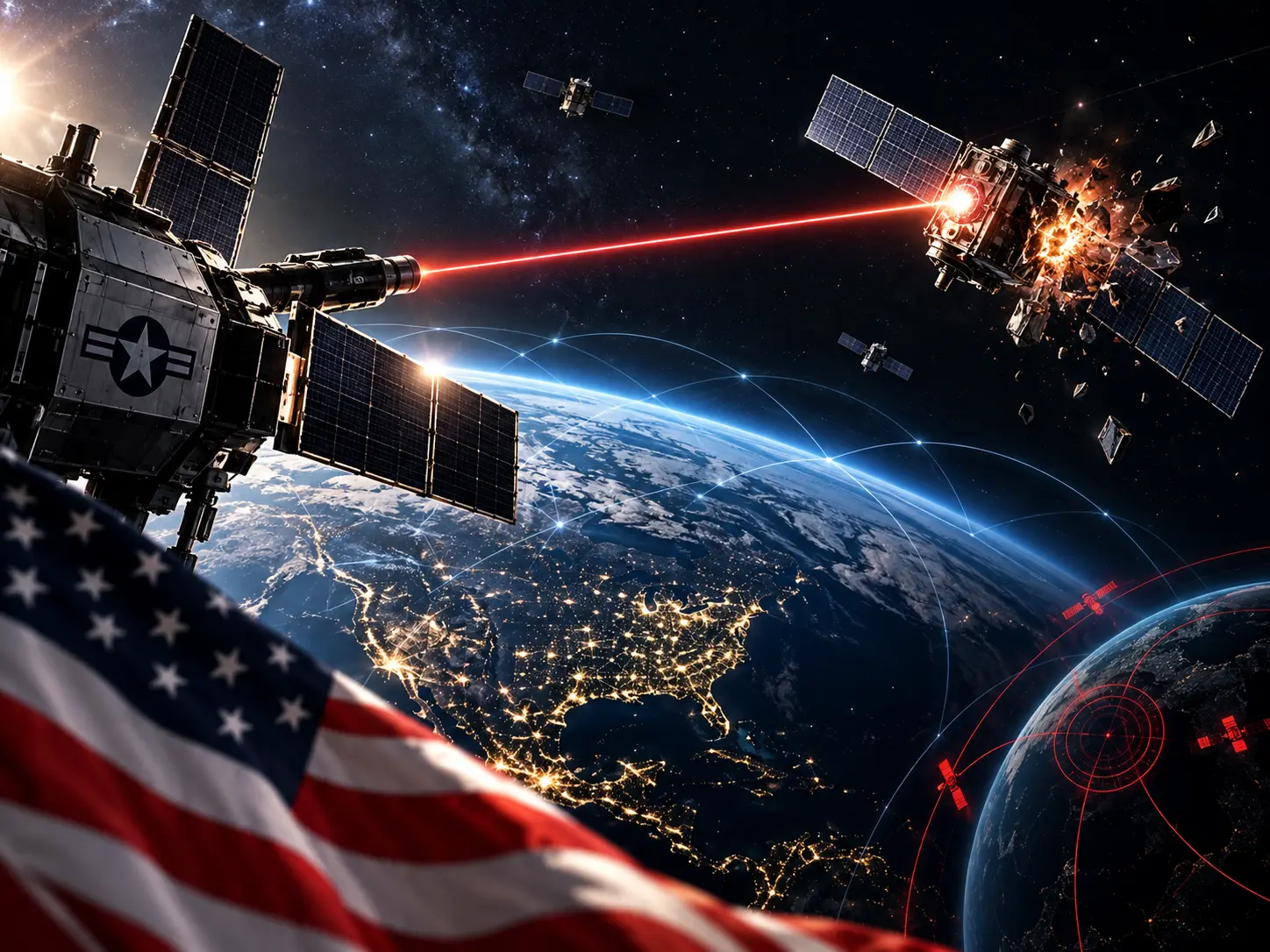
The United States has publicly disclosed the militarisation of space for the first time. U.S. Air Force Secretary Troy Meink has acknowledged that America now possesses “on-orbit space control weapons” capable of defending US forces against hostile action. Washington, however, has not disclosed what those weapons are, whether they are kinetic or non-kinetic, or precisely how they would operate.
For decades, satellites have been the invisible infrastructure behind modern warfare, providing communications, navigation, missile warning, surveillance, and targeting. Now, the battle may no longer simply be from space. It could be fought in space.
Speaking on WION’s Defence Pulse, Lt Gen P.J.S. Pannu (Retd.), GLOBAL SPACE FUTURES ADVISORY COUNCIL and former Deputy Chief of the Integrated Defence Staff, said the American announcement should not necessarily be interpreted as the sudden arrival of a new capability.
Pannu described a future orbital battlefield extending far beyond the popular image of missiles or lasers. He explains that co-orbital satellites could manoeuvre alongside another spacecraft. Robotic arms could potentially interfere with satellites. Directed-energy weapons and high-power microwaves could disrupt systems, while kinetic vehicles could physically destroy targets. Cyber attacks, spoofing, and jamming could target the communications and command links connecting satellites to Earth.
He also pointed to a particularly unconventional form of orbital warfare: forcing an adversary’s satellite to manoeuvre repeatedly until it exhausts its limited fuel. Gen. Pannu summed up the emerging American posture in stark terms: “They are ready to fight in the orbit to protect their celestial lines of communication.”
But destroying a satellite can generate debris capable of threatening military, commercial, and even civilian spacecraft. China demonstrated a direct-ascent anti-satellite weapon in 2007, while Russia has also demonstrated counter-space capabilities. Pannu argues that space has consequently become a “contested and highly volatile domain.”
The legal framework is also incomplete for this new reality. The 1967 Outer Space Treaty explicitly prohibits nuclear weapons and other weapons of mass destruction in orbit, but does not impose an equivalent blanket prohibition on conventional orbital weapons.
For Gen. Pannu, the implication of Washington's disclosure is clear: space control may increasingly require the ability not merely to observe an adversary, but to “disrupt, degrade, even destroy” its capabilities.


