Europe turns right: The revolution the establishment cannot ignore | The Verdict

&imwidth=600&imheight=450&format=webp&quality=medium "Europe turns right: The revolution the establishment cannot ignore | The Verdict")
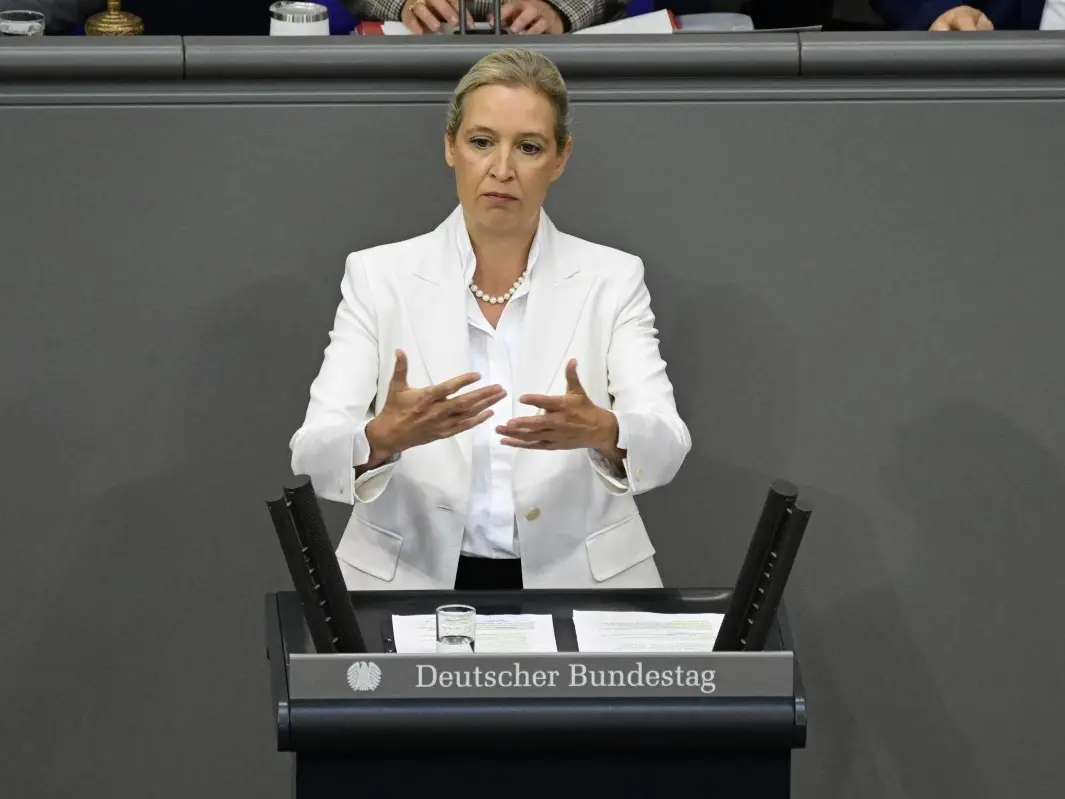
The co-leader of the far-right Alternative for Germany (AfD) party Alice Weidel gives her speech as at the Bundestag, the lower house of parliament, in Berlin on September 9, 2026. Photograph: (AFP)
AfD's opponents have legitimate concerns. Germany's history makes scrutiny of extremist rhetoric especially important. Its Saxony-Anhalt branch has been classified as right-wing extremist by the state's domestic intelligence authorities.
Alice Weidel embodies one of the strangest contradictions in European politics.
She leads a party fiercely opposed to mass immigration, yet her partner is Sri Lanka-born. She is in a same-sex relationship while leading a political movement that has championed the traditional heterosexual family. She raises children with her partner while her party has fought liberalisation of family policy. And the woman selling German nationalism has spent significant parts of her private life in Switzerland.
Then there is economics. The former investment banker carries distinctly market-oriented instincts while commanding a populist movement drawing heavily from workers who feel abandoned by Germany's political and economic establishment.
Welcome to the paradox of Germany's Alternative für Deutschland.
Except the AfD is no longer merely an alternative.
It is becoming a dominant political force.
Trending Stories
)
)
)
)
)
)
)
)
)
)
)
)
)
)
)
)
)
)
&im=FitAndFill=(700,400))
)
)
)
&im=FitAndFill=(700,400))
)
&im=FitAndFill=(700,400))
&im=FitAndFill=(700,400))
)
In Saxony-Anhalt, voters handed the AfD an extraordinary 43.8 per cent of the vote. Chancellor Friedrich Merz's CDU managed just 17.2 per cent. The AfD secured 39 of the state parliament's 83 seats — short of governing alone, but comfortably the largest party.
The political shockwaves have reached Berlin.
Merz described himself as deeply shocked and acknowledged a devastating defeat. Former chancellor Angela Merkel has also reacted with dismay. Meanwhile, thousands have taken to German streets protesting the AfD's advance.
But protests cannot erase ballots.
And that presents Europe's liberal establishment with an uncomfortable democratic dilemma.
If an election is free and fair, what happens when voters choose the political movement the establishment has spent years warning them against?
AfD's opponents have legitimate concerns. Germany's history makes scrutiny of extremist rhetoric especially important. Its Saxony-Anhalt branch has been classified as right-wing extremist by the state's domestic intelligence authorities.
But condemning a political movement is not the same thing as understanding why people vote for it.
Immigration. Economic insecurity. National identity. Cultural anxiety. Anger at established politicians. Frustration with institutions voters believe no longer listen to them.
These forces are not confined to Germany.
Across Europe, nationalist and right-wing populist movements have moved from the political fringes towards government, parliament and increasingly the mainstream.
Across the Atlantic, Donald Trump's movement speaks much of the same political language: borders, sovereignty, cultural conservatism, national pride and rebellion against an establishment accused of abandoning ordinary citizens.
Yet there is a crucial difference.
America's populist Right captured one of the country's two dominant political parties. Europe's insurgent Right operates through multiple parties and political systems, often confronting coalition barriers designed to keep it away from executive power.
And inevitably, Germany's history hangs over this debate.
Comparisons with the interwar years must be handled carefully. Europe in 2026 is not Europe in 1933. Its constitutions, institutions and political conditions are fundamentally different, and today's right-wing movements cannot simply be labelled replicas of twentieth-century fascism.
But history offers warnings rather than photocopies.
Economic anxiety, resentment towards political elites, arguments over national identity, hostility towards outsiders and the conviction that existing institutions no longer represent ordinary citizens all existed in Europe's darkest political periods.
That does not mean history is repeating itself.
It means politicians would be foolish not to listen when history rhymes.
The lesson from Saxony-Anhalt therefore extends far beyond the AfD.
Europe's establishment can build firewalls. It can organise protests. It can condemn extremists and challenge rhetoric that threatens minorities or democratic institutions.
But none of those things answers the most important question:
Why are so many voters moving Right in the first place?
Until Europe's political centre answers that question convincingly, the insurgency will continue.
The Right is no longer knocking on Europe's door.
Voters are increasingly handing it the keys.