

&imwidth=800&imheight=600&format=webp&quality=medium "War drums in West, green energy in Bharat! India powers Global South at Bharat Electricity Summit 2026")
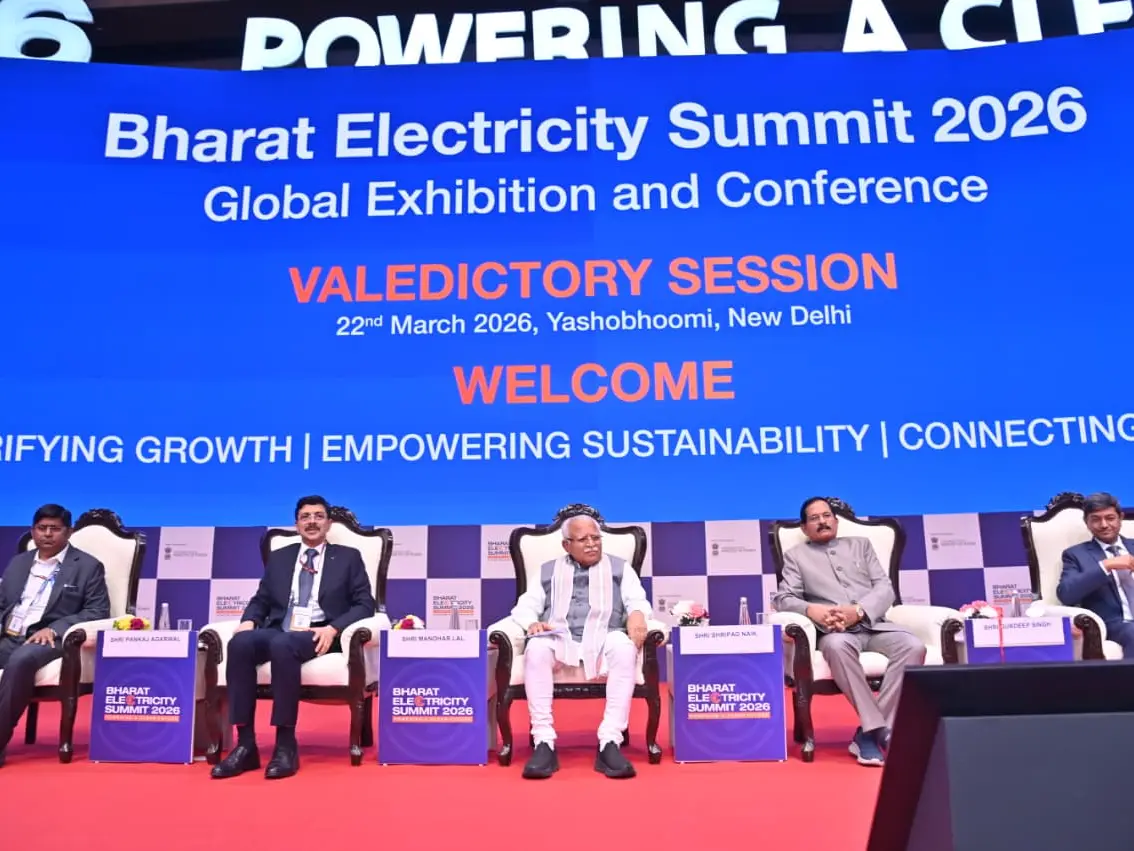
As the United States and the Israel-Iran conflict moved into a critical phase, with US President Donald Trump warning of possible strikes on electricity grids, a different story was unfolding about 1,758 miles away. In Yashobhumi, the national capital of India, the four-day Bharat Electricity Summit 2026 brought together energy leaders from across the world. The event featured deep and thoughtful discussions, important business meetings, a huge crowd of investors and innovators, and valuable talks between countries.
The first-ever Bharat Electricity Summit, organised under the guidance of the Union Ministry of Power, proved highly successful. It showed India’s firm promise to cooperate with other nations on energy matters and strongly supported Prime Minister Narendra Modi’s forward-looking vision of One Sun, One World, One Grid.
This idea connects solar energy across borders so that clean power can be shared by all countries. While India marches towards its Viksit Bharat Mission to become a fully developed nation by 2047, it is making impressive progress on its energy goals. The country aims to build 500 gigawatts of power capacity from non-fossil sources such as solar and wind by 2030. More than 250 gigawatts have already been achieved, which means India has reached its COP26 climate promises well ahead of schedule.
At the same time, the nation remains fully committed to net zero emissions by 2070, a target that will help fight climate change for future generations. Union Power Minister Manohar Lal Khattar explained it simply and clearly: electricity is a common resource that every part of the economy depends on, and this understanding is giving fresh momentum to India’s journey of self-reliance and overall development.
Energy security for Global South
The Bharat Electricity Summit 2026 opened many doors for global cooperation and practical deals that will benefit people far beyond India’s borders. High-level bilateral meetings took place with representatives from several countries, including Malawi, Tajikistan, Mauritius, Kyrgyzstan, and Russia. Industry groups such as Africa50 and other international delegations also joined these conversations.
Trending Stories
&imwidth=180&imheight=135&format=webp&quality=medium)
China's counter-surveillance industry booms amid heightened espionage fears | Gravitas
&im=FitAndFill=(700,400)&imwidth=180&imheight=135&format=webp&quality=medium)
Navratri 2026: 9 days, 9 forms of Goddess Durga and 9 colours- Check the complete list
&imwidth=180&imheight=135&format=webp&quality=medium)
Trump accuses Houthis of driving up oil prices before US midterms, warns of consequences
&imwidth=180&imheight=135&format=webp&quality=medium)
Russian woman and Bihar boy's love story goes viral after she reaches India to marry him
&imwidth=180&imheight=135&format=webp&quality=medium)
Arijit Singh 9-city India stadium tour to start from January: Check venue and ticket prices
&imwidth=180&imheight=135&format=webp&quality=medium)
US Midterms 2026: In Alaska, cost-of-living anxiety meets strangest ballot in high-stakes Senate race
&imwidth=180&imheight=135&format=webp&quality=medium)
F1 set to return to Africa for first time since 1993
&imwidth=180&imheight=135&format=webp&quality=medium)
'Don't ever mess with nature!': Trump’s tiger attack post triggers social media backlash as victim's family issues heartbreaking tribute
&imwidth=180&imheight=135&format=webp&quality=medium)
CMs Vijay-Naidu meet in Vijayawada, discuss water sharing, river-linking
&imwidth=180&imheight=135&format=webp&quality=medium)
Air India Flight from Frankfurt diverted to Jaipur after hijack alert, probe on
&imwidth=180&imheight=135&format=webp&quality=medium)
1,500 drones illuminate Mumbai sky as Cordelia Cruises unveils second ship, Cordelia Sky
&imwidth=180&imheight=135&format=webp&quality=medium)
Delhi Police arrest Cockroach Janta Party's Saurav Das, Ashutosh Ranka, Ajinkya Shinde in Jantar Mantar case, to be produced before court
&imwidth=180&imheight=135&format=webp&quality=medium)
‘Rise up, young patriots!’: American singer Mary Millben says US donors funding CJP, backs Modi govt
&imwidth=180&imheight=135&format=webp&quality=medium)
Nobel Peace Prize winner Navi Pillay calls on US to 'get back to' being defender of human rights
&imwidth=180&imheight=135&format=webp&quality=medium)
France accuses Musk of ‘online harassment’ of European leaders, warns of poll interference
&imwidth=180&imheight=135&format=webp&quality=medium)
'Turn approver, resign, we'll forgive you': Rahul Gandhi claims receiving messages from CEC Gyanesh Kumar
&imwidth=180&imheight=135&format=webp&quality=medium)
MI5 chief warns Russia is UK’s ‘aggressor number one’ as Iran and AI threats grow
&imwidth=180&imheight=135&format=webp&quality=medium)
Trump reconsidering calling off Nidal Hasan's execution livestream. Here's why
&imwidth=180&imheight=135&format=webp&quality=medium)
‘My president, I mean my husband’: Trump's new press secretary Katie Zacharia's first briefing goes off the rails in 14 minutes
&imwidth=180&imheight=135&format=webp&quality=medium)
‘How many people did she illegally bring from Somalia?’ Trump targets Ilhan Omar, questions her net worth
&imwidth=180&imheight=135&format=webp&quality=medium)
Marco Rubio to visit India next week, focus on energy cooperation and strategic ties
&imwidth=180&imheight=135&format=webp&quality=medium)
US politicians mistakenly use Indian, Russian warship images for Navy's birthday posts
&imwidth=180&imheight=135&format=webp&quality=medium)
'Ouch!!! That must hurt': Kangana Ranaut hails Kamal Haasan's sharp reply to Elon Musk over Starlink row
&imwidth=180&imheight=135&format=webp&quality=medium)
Girl 'dead' for 8 hours wakes up at her own funeral, dad insists she wasn't breathing
&imwidth=180&imheight=135&format=webp&quality=medium)
Sidhu Moose Wala’s younger brother wins hearts by recreating late singer’s signature move at Toronto Hologram Show
&imwidth=180&imheight=135&format=webp&quality=medium)
UK school ditches technology, shifts from screen to pen and paper for learning
&imwidth=180&imheight=135&format=webp&quality=medium)
Durga Puja 2026: Kolkata roads get a splash of colours
&im=FitAndFill=(700,400)&imwidth=180&imheight=135&format=webp&quality=medium)
New OTT releases this week (October 12-18, 2026): Sacrifice, Koffee with Karan S9, Roadies Rebirth- 6 titles coming on Netflix, JioHotstar and more
&imwidth=180&imheight=135&format=webp&quality=medium)
Inside Aneet Padda's 24th birthday bash with rumoured boyfriend Ahaan Panday and Alia Bhatt
&imwidth=180&imheight=135&format=webp&quality=medium)
New Cold War: Why is China buying more gold? Explained
&imwidth=180&imheight=135&format=webp&quality=medium)
Netanyahu wants to join Saudi's war on Houthis, but Crown Prince denies: Report
&imwidth=180&imheight=135&format=webp&quality=medium)
Anupam Kher joins Ranbir Kapoor's Ramayana as Jatayu, new poster unveiled
&imwidth=180&imheight=135&format=webp&quality=medium)
Measles kills again: 6 dead in Pennsylvania as America faces its worst outbreak in decades | Gravitas
&imwidth=180&imheight=135&format=webp&quality=medium)
Cornell University suspends fraternity parties over 2024 gang rape allegations
The talks centred on four key areas that matter most for energy security today: sharing electricity across national borders, working together on renewable energy projects, building stronger transmission networks, and helping each other through training and the transfer of new technology. One special highlight was the India-Africa Strategic Meet, which focused on expanding renewable energy sources, modernising old power grids, and making sure electricity reaches every last village and home across the African continent. These partnerships are not just about signing papers; they are about creating real solutions that can light up homes, run schools, and power small businesses in developing regions.
According to a report from the Press Information Bureau, the business side of the summit was equally impressive. More than 1,200 buyer-seller meetings took place, and the total business enquiries crossed Rs 517 crore. This shows strong interest from companies ready to invest and trade. More than 500 global exhibitors displayed the latest innovations covering every part of the electricity chain, from producing power to storing it and using it smartly.
The event clearly reinforced India’s growing role in supporting the energy needs of South Asia and the wider Global South through both technology and investment. As noted by KPMG, the Bharat Electricity Summit worked like a bridge where India’s own strengths in manufacturing and innovation met the larger dreams of the world. The goal was to create real and lasting results that improve energy security for entire regions. For ordinary people, this means more reliable power supply, lower costs over time, and new job opportunities in green industries. By bringing everyone together—governments, companies, and experts—the summit proved that teamwork across borders is the best way to solve the big energy challenges of our time. India is not only meeting its own needs but also stepping up as a trusted partner for many nations that are still building their power systems.
Energy for every corner
The Bharat Electricity Summit 2026 gave a big push to the idea of Make in India for the World, showing how Indian manufacturing can supply clean energy equipment and solutions to every corner of the globe. Detailed discussions made it clear that India’s long journey towards complete energy transition will need huge investments—more than 22 trillion US dollars by 2070. These funds will go into building new power plants, stronger transmission lines, advanced storage systems, and modern digital controls. To give one concrete example, the country must add over 1.37 lakh circuit kilometres of new transmission lines by 2030, and this alone will require around 9 lakh crore rupees.
Such massive expansion is needed to carry clean electricity from sunny deserts and windy coasts to cities and villages where people need it most. Energy storage is becoming equally important because the sun does not shine at night and the wind does not always blow. India has a huge potential of more than 200 gigawatts in pumped storage projects, which work like giant natural batteries by lifting water uphill during the day and releasing it to generate power later. Battery Energy Storage Systems, or BESS, are also gaining popularity as an easy way to handle peak demand hours when everyone switches on lights and fans at the same time.
Bharat builds, world buys
On the financial side, renewable energy tariffs and market rules are getting better, which helps investors feel more confident about long-term returns. A major step forward was the launch of the Indian Carbon Market Portal. Trading on this platform is expected to start soon, and it will open new ways to finance climate-friendly projects. Technology is changing the power sector in exciting ways too. Artificial Intelligence, Machine Learning, and digital twins—virtual copies of real power systems—are being used to predict problems before they happen and run grids more intelligently. Inspired by the success of India’s digital public infrastructure like UPI and Aadhaar, the concept of an “India Energy Stack” is now taking shape.
This will create one smooth and connected system for the entire energy world, making it easier for producers, distributors, and users to work together. At the consumer level, smart meters and rooftop solar panels are turning ordinary households into “prosumers”—people who both produce and consume electricity. When a family’s solar panels generate extra power, they can sell it back to the grid and earn money. This simple change is empowering millions of Indians to become active players in the energy story rather than just passive users. All these developments together are creating a strong domestic industry that can export world-class clean energy technology while also meeting India’s own growing demand. The summit proved that Make in India is not just a slogan; it is a practical plan that will create jobs, reduce dependence on imports, and help the country lead the global supply chain for green power.
The Bharat Electricity Summit 2026 has set a clear direction for India’s power sector: anchored in resilience, energy transition, and global leadership. The summit reaffirmed India’s commitment to building a future-ready, technology-driven, and investment-friendly energy ecosystem, while supporting the energy needs of both the nation and the Global South.
The outcomes of the summit will contribute significantly to shaping policy, strengthening partnerships, and accelerating the transition towards a reliable, affordable, and clean energy future. In the end, events like this remind us that when nations work together on something as basic as electricity, they are actually building a brighter and more secure world for everyone. India’s success at the Bharat Electricity Summit shows that a developing country can lead the way in solving one of humanity’s biggest challenges—providing clean power to all without harming the planet. As ordinary families switch on lights, run fans, and charge phones each day, they can now feel confident that India is quietly working behind the scenes to make sure this power is affordable, uninterrupted, and green for generations to come. The road ahead is long, but the summit has given a strong and hopeful start.